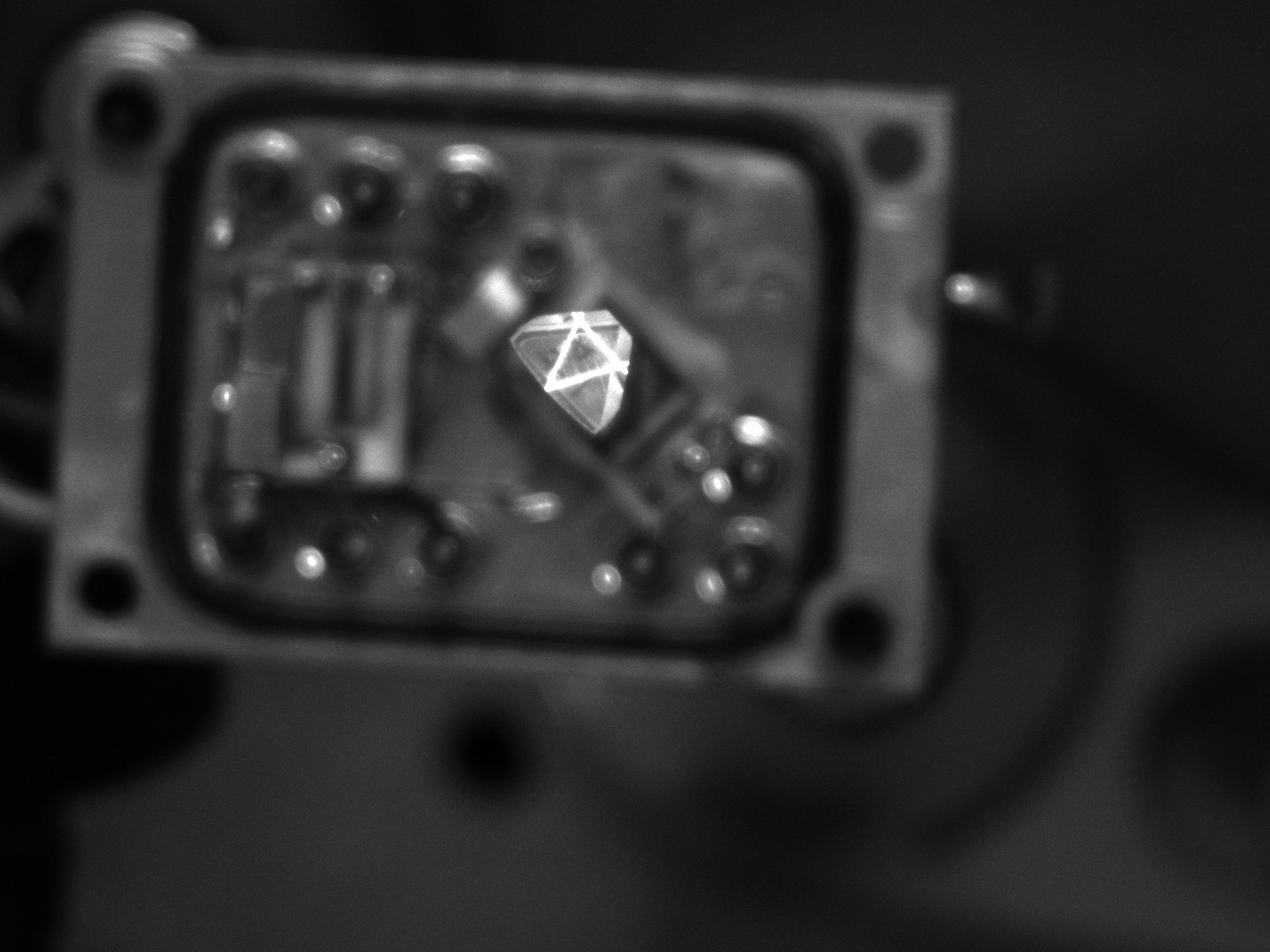
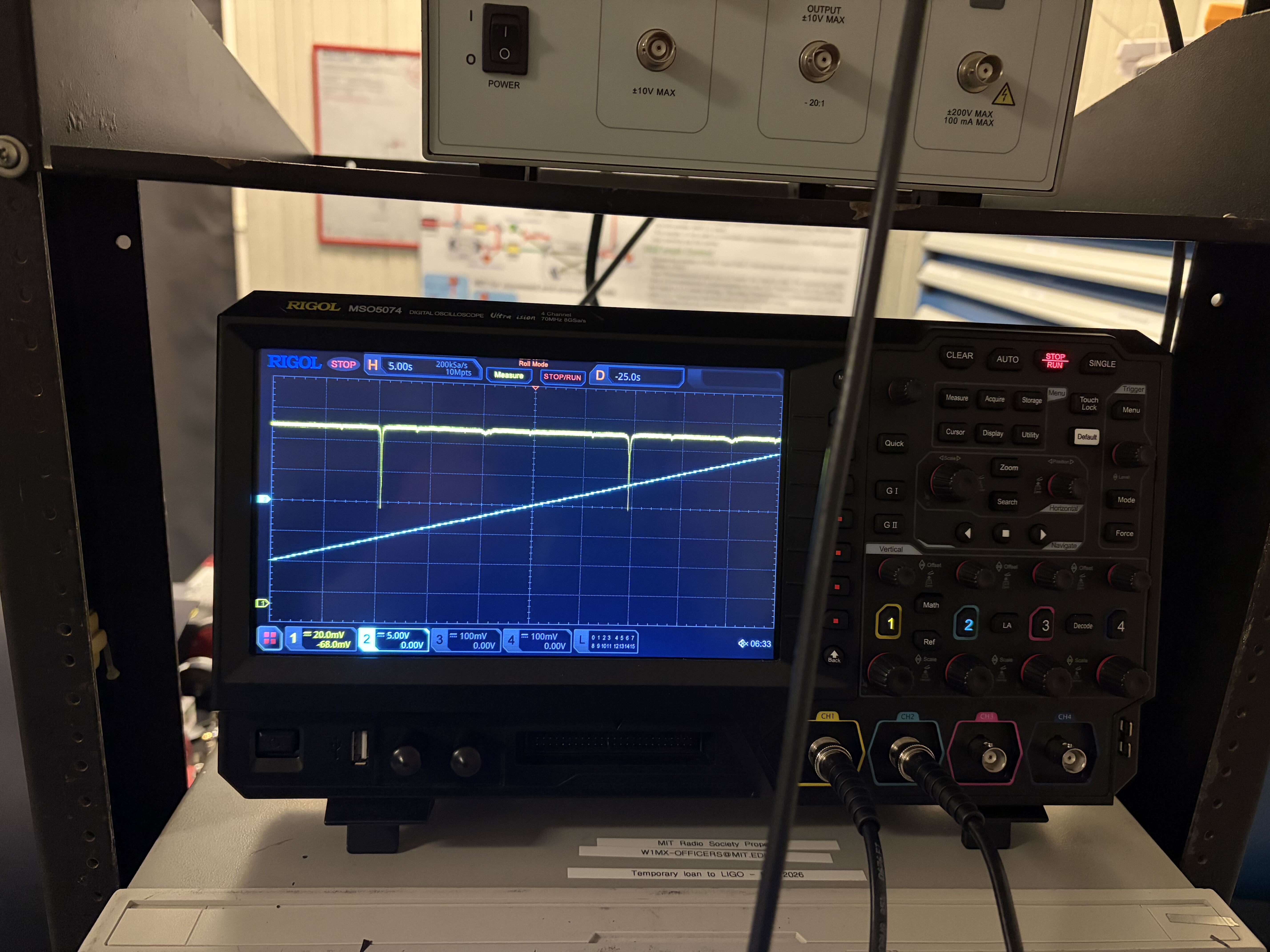
Last week, we were able to mode-match a 1064-nm beam from the NP Photonics "Rock" fiber laser into the crystal mounted in its original enclosure (see photo IR attached). In order to accomplish this, the pump diode and pump input optics present on the input path to the NPRO cavity were removed and a 1064-nm beam path is prepared externally.
Mode Matching
The beam parameters for this arrangement assumed an initial approximate eigenmode defined by a cavity with length L = 11mm and an input coupler ROC of 20mm. The computed beam parameters from this geometry are:
| Parameter | Value |
| Waist location (inside cystal) | 5.5mm |
| Lasing mode waist @ 1064nm (inside cavity) | 41um |
| Pump waist @ 808nm (inside cavity) | 36um |
| Waist location (outide cavity - image inside cavity) |
8.1mm |
| Lasing mode waist @ 1064nm (outside cavity) | 43um |
| Pump waist @ 808nm (outside cavity) | 38um |
With minimal adjustment of the mode-matching solution (using thorlabs triplet collimator TC06APC-1064 in alamode), fairly decent visual mode matching can be observed in reflection of the cavity. In this case, the NPRO cavity is very slowly scanned through one FSR using the heater in the laser package. PZT tuning of the "Rock" laser does not provide enough tuning range to observe a full FSR (~13 GHz) unfortunately.
Pump Thermal Lensing
Due to pump absorption, the thermo-refractive effect will slightly lens the lasing mode of the laser. Some back-of-the-envelope calculations (based on a simple thermal model) show that the expected lensing is quite minimal (i.e. the effective focal length of the thermal lens is ~10x larger than the cavity's length) when the laser is putting out 5mW of power at 1064nm while being pumped with 30mW of 808nm light.
Polarization Matching
Because of the instrinsic polarization rotation that occurs in the NPRO cavity geometry, the eigenmodes of the cavity are not generally linear. In fact, they are typically eliptical (see Kane and Byer attached). In this case, the polarization from the fiber is matched fairly well with a simple half/quarter-waveplate pair. The exact polarization seems to be only slightly eliptical. Without exact details of the output coupler coating and cavity geometry, calculating the eigenpolarizations with Jones calculus has been a guessing game so far.
Next Steps
At this stage, the aligned seed beam through the cavity should be an excellent alignment reference for the pump beam once the parts for it arrive. At that point, if the laser is lasing, we can figure out exactly what the fundamental cavity mode should be by profiling the laser's output beam. In any case, this is an excellent confirmation that we can indeed couple light from an external 1064nm path into the laser cavity, which will be tantamount for injecting squeezed light.