[ melissa, chaejin ]
Chip ID: SQA run PhM 1 device 18
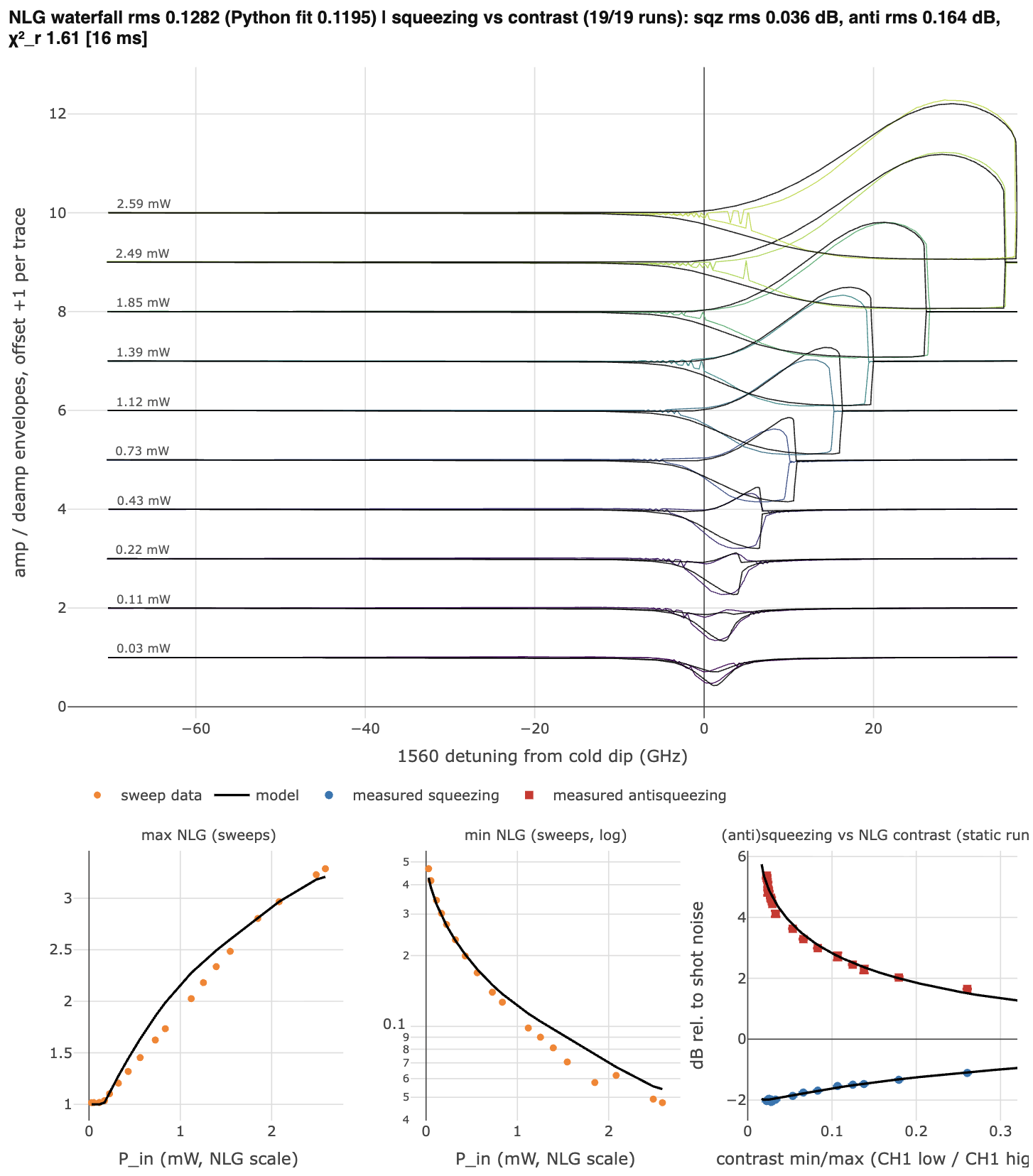
Our BHD visibility drifted down to 80% over the course of our squeezing measurement (limiting squeezing to 2 dB), but we decided to analyze the data and compare to our nonlinear gain (NLG) scans which serve as a classical probe of the parametric gain.
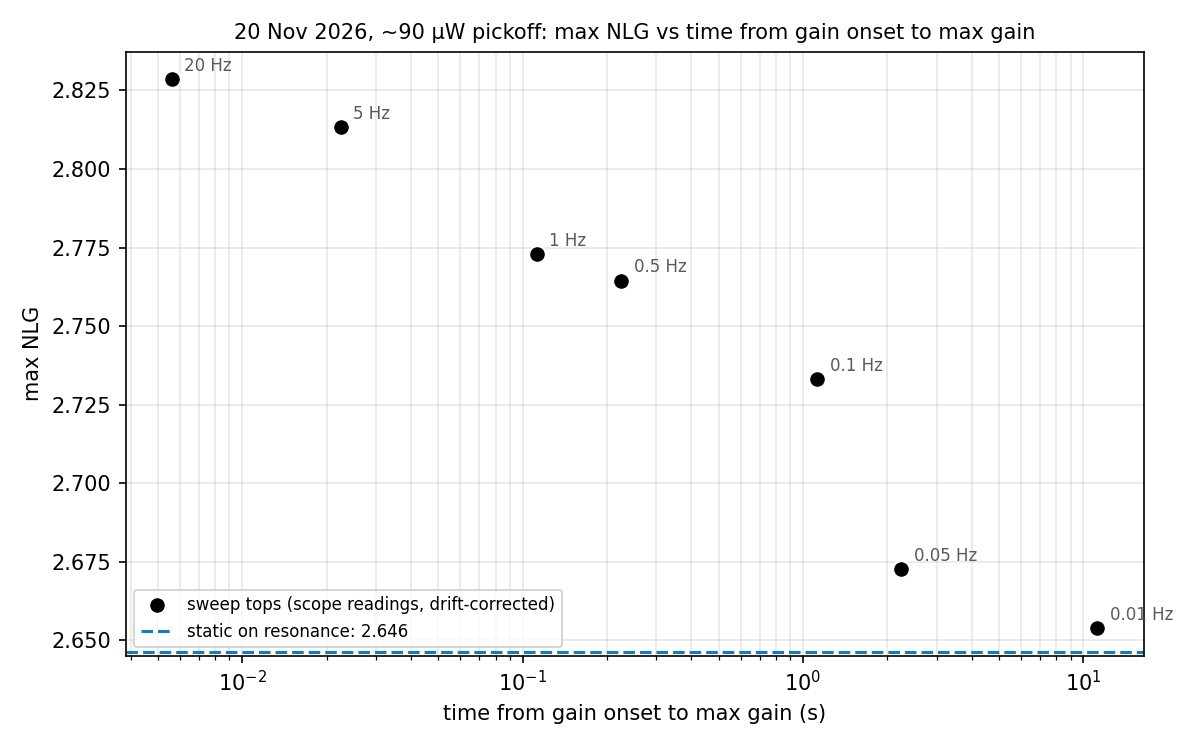
We start by fitting the 780nm scans to learn the intracavity photon number ( comes into the Hamiltonian like g0 sqrt(n) a^dag a ). These scans are Transmission through the waveguide @ 780nm versus heater voltage (converted to frequency detuning) for different power levels. Then we fit the NLG scans, which are collected simultaneously. This fit parametrizes the nonlinearity g0, nonlinear loss, among other things like waveguide interference, and allows for a prediction of the measured squeezing vs experiment. Then only the detection efficiency is the final free parameter in the fit against the squeezing data. We plot against NLG contrast (min NLG / max NLG) because we find there is a change in the max NLG when we stabilize on-resonance, likely due to a temperature-dependent interference phase that manifests elsewhere in our model. NLG drop vs sweep rate confirmed with measurement.
where we have the loss model:
kappa_i(n) = kappa_i_0 + gamma1 * n + gamma_2 * n^2
These two loss rates can act a bit degenerate in our data set so we will need to co-fit data sets versus wavelength and across devices.
Detection efficiency fit: 0.55
Loss budget: 0.558
| Loss budget component | Value | Note |
| BHD Visibility, V = 0.80 | 0.640 | re-measured after squeezing measurement |
| Bus waveguide propagation (~1.6 mm) | 0.94 | estimated from kappa_i (~0.5 GHz) |
| Output facet (Fresnel) | 0.975 | measured from transmission Fabry-Perot fit, assuming symmetric facets |
| Free-space optics chip -> BHD | 0.98 | Nominal free-space optics losses |
| Detector Quantum Efficiency | 0.98 | nominal spec, within error bars of responsivity measurement |
| Dark noise (~20 dB clearance) | 0.99 | need dedicated measurement... estimated on the ESA. 9.9 mW LO power |
| Loss budget | 0.558 |
Note:
-Have since added a PBS before the NLG measurement photodiode to remove background due to orthogonal polarization
To-do:
-Code up a gated swept squeezing measurement, to directly compare against swept NLG data