[chaejin, melissa]
Chip ID: SQA PhM 3
PhD student Lilli Thiel from UCSB sent us InGaP microrings designed to produce degenerate squeezed vacuum at 1560 nm when pumped at 780 nm. She fabricated the chips in the UCSB cleanroom. Her intuition is that the fab is botched, no definitive evidence yet. We are measuring the quality factors of the microrings at 1560nm to get the answer.
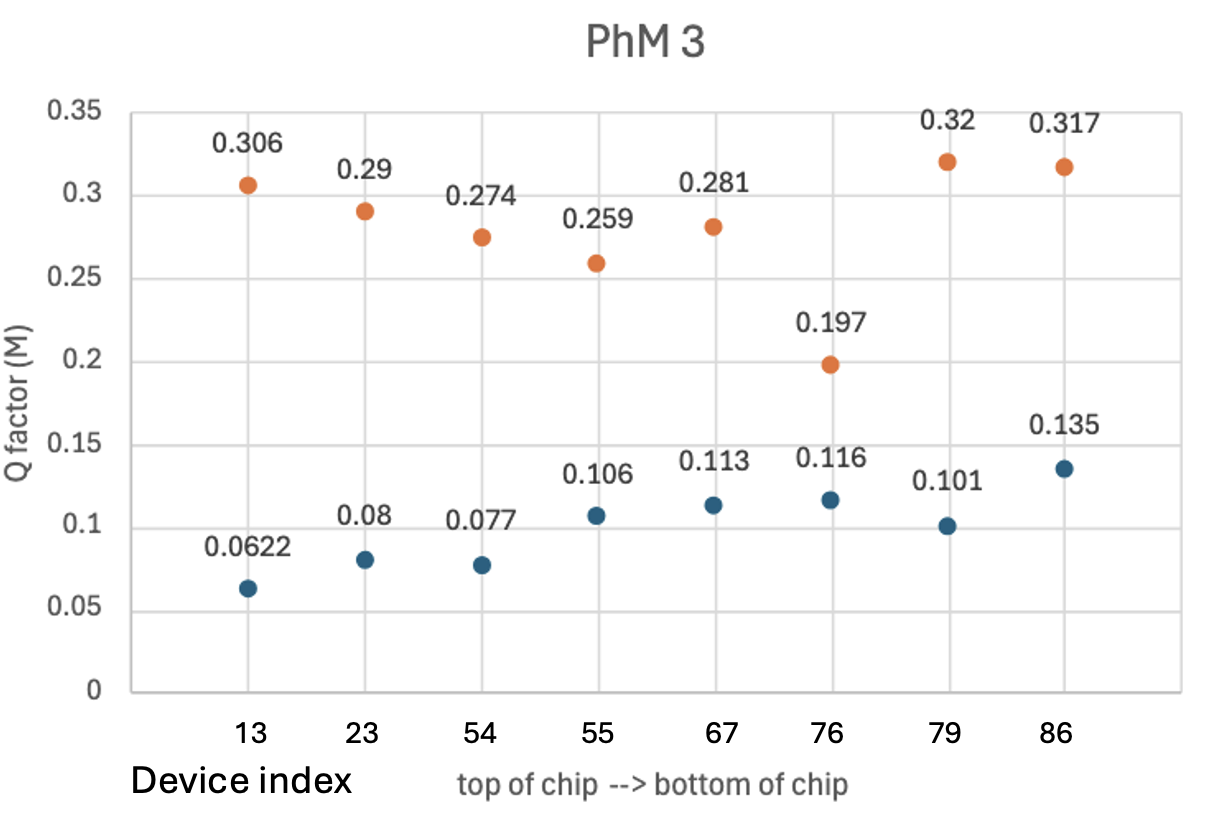
A plot of measured Q pairs {Qi, Qc} is attached, each the per device median. Unfortunately the gap (300 nm, point coupled) is not swept, so we are unable to definitively identify Qi (intrinsic Q) vs Qc (coupling Q). All devices should have similar coupling regions, so Qc should be roughly uniform across the chip, though both Qs appear to vary. The relation is 1/Q = 1/Qc + 1/Qi where Q is the loaded Q.
| Device ID | Ring Width [um] | Ring Radius [um] |
|---|---|---|
| 13 | 1.02 | 32.1 |
| 23 | 1.06 | 31.5 |
| 54 | 1.1 | 32 |
| 55 | 1.1 | 32 |
| 67 | 1.14 | 31.5 |
| 76 | 1.14 | 32 |
| 79 | 1.14 | 32.1 |
| 86 | 1.14 | 32.5 |
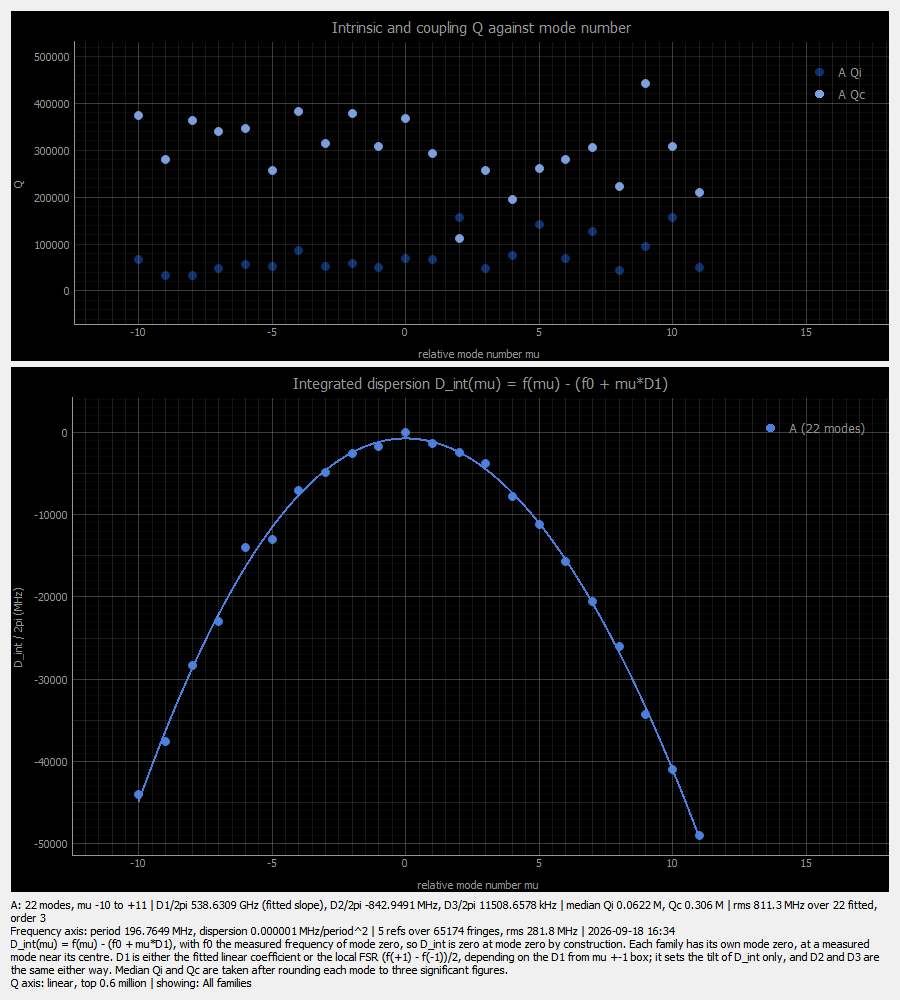
One hint that the lower Q group may be Qc is wavelength dependence: the Q decreases at longer wavelength (negative mode numbers), typical for point coupling (see Sapphire microring example plot, where Qc was confidently identified from the gap sweep). Example summary plot for an InGaP device is attached, where dark blue would be suspected Qc and light blue would be Qi (flip the labels).
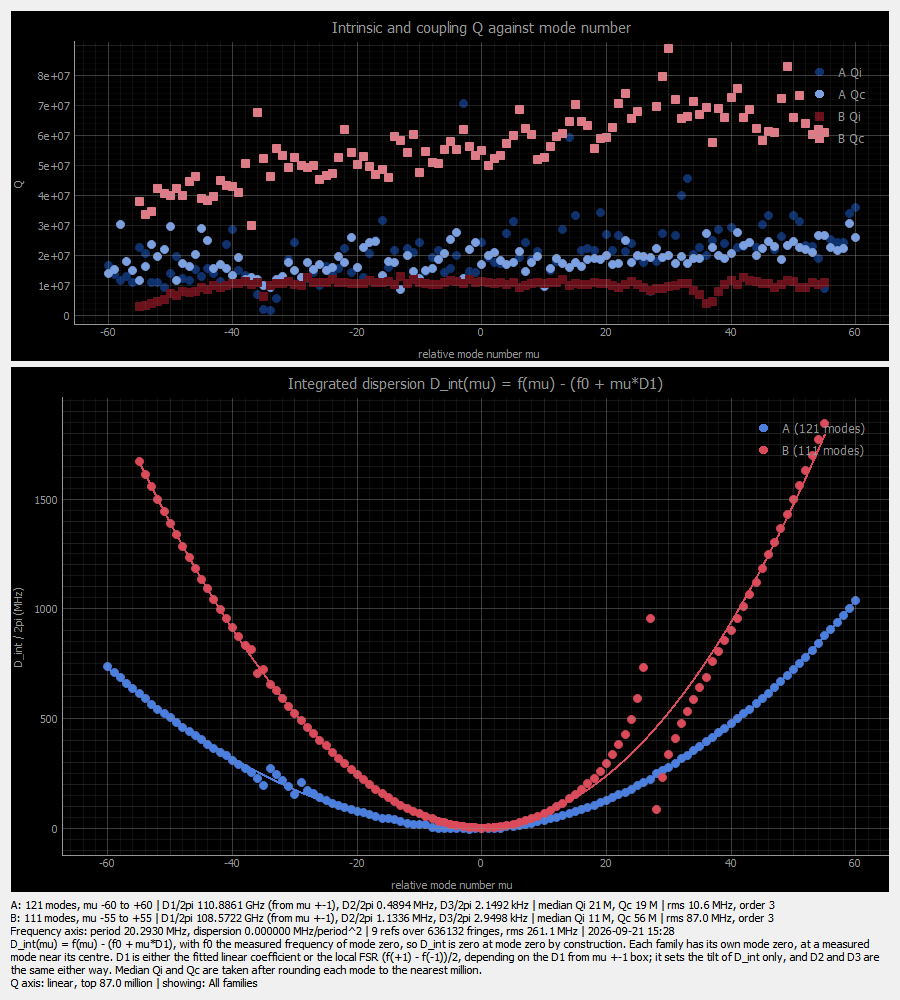
It is mysterious, though, that the Qc would vary so much across the chip (60-130k) for such similar geometry. This would point to large spatial discrepancies in the fabrication, leading to geometric scaling: was the resist reflow non-uniform (temperature non-uniformities)? was the deep UV stepper conditions non-uniform?
Also mysterious: Devices 54 and 55 are directly next to each other and have fully identical geometric properties (ring width and ring radius) but Qs are different: {80k, 275k} vs {100k, 260k}. This would suggest that the lower Qs are intrinsic, because random local scatterers would substantially change Qi and not Qc.
One more note: Our 3 dB squeezer chip had Qc = 80k and Qi = 400k (escape efficiency 83%), for gap = 350 nm, pulley angle = 5 degrees, ring width = 1.125 um, ring radius = 32 um.
Daniil will polish another chip for us from this batch, with a larger coupling gap (400 nm); we will compare the Qs and may perhaps put this question to rest. We are sending Lilli the chip we measured today, for her to take 780nm Q measurements using their mode-hop-free laser.
Chip ID: SQA OPA PhM 3
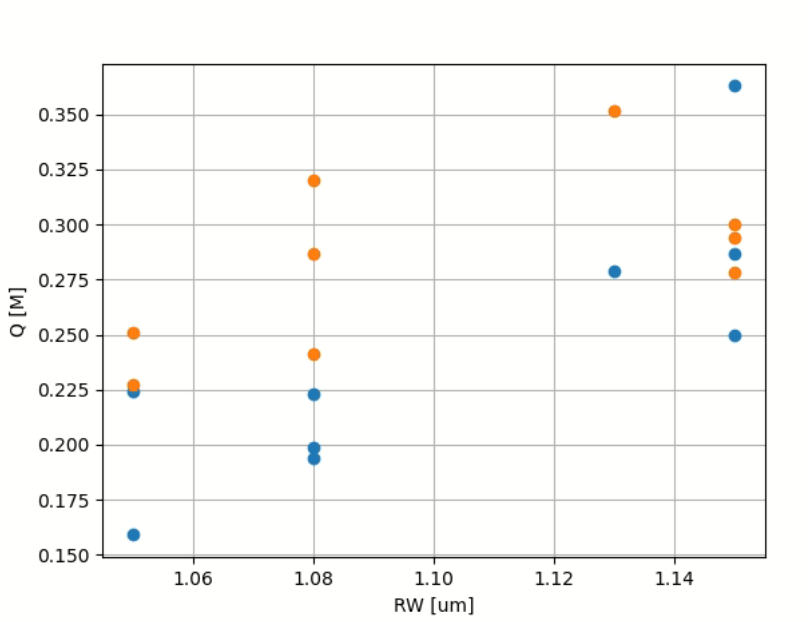
We measured the chip with larger coupling gap of 400 nm and found Qi,Qc both around 300k, an indication that the fabrication was successful and that the low Qs on PhM3 are in fact the overcoupled Qc -- i.e., Qi are sufficiently high for squeezer operation. A plot of the {Qi,Qc} pairs vs ring width is attached. It is not clear what is the origin of the Qc variation across the chip, which we saw on the other chip as well. Does ring width substantially modify the rate despite identical gap? Or are the fabrication conditions non-uniform spatially?