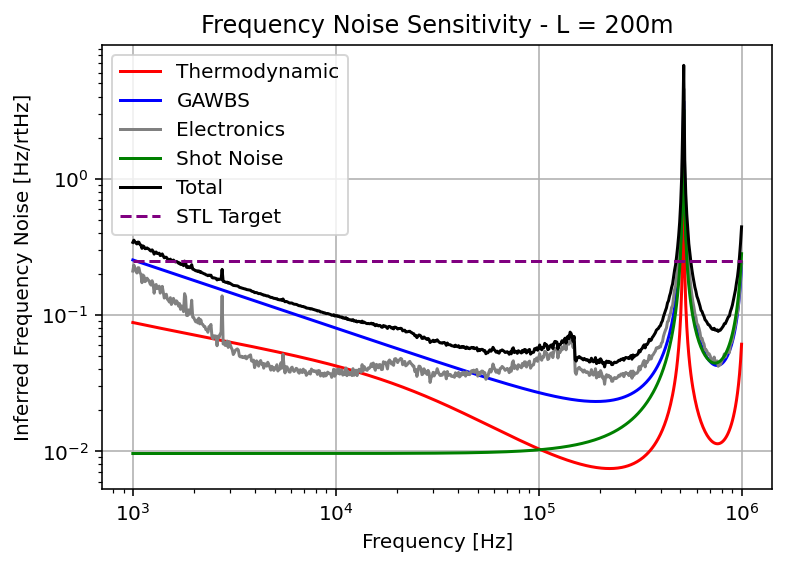
Over the past two weeks, I have been setting up and characterizing a delayed self-heterodyne measurement system for the sub-STL laser experiment. My goal in this endeavor was to model and confirm that the frequency noise sensitivity of this system could be low enough to feasibly measure the Schawlow-Townes frequency noise that Peter and co. measured back in 1989 (https://opg.optica.org/ol/fulltext.cfm?uri=ol-14-18-993). This sets a solid target sensitivity of better than 0.25 Hz/rtHz @ a Fourier frequency of 80 kHz to go after.
I started off with the simplest possible system using a Mephisto 500mW NPRO laser (the one we took from Vivishek's lab) as the source. It is coupled into PM fiber and split with a 90/10 fiber beam splitter. The 90% tap feeds a fiber-coupled AOM driven at 110 MHz. The other path is coupled into a 200-meter-long SM fiber as the delay line. After this, the delayed path and upshifted paths are recombined with a 50/50 beam splitter and one of the output ports is connected to our custom RF PD (it has much lower dark noise at 100 MHz than a Newport 1811... and we are fresh out of fiber-coupled 1811's anyway).
The beat tone is fed directly to the Agilent PXA and its phase-noise spectra is taken using the same feature we used to characterize the OEO. The phase noise in this measurement is a combination of the frequency noise spectrum of the laser and thermodynamic fiber noises. After reading this really cool paper (https://doi.org/10.1364/OPTICA.470430 ;) ), I was able to put together a best-effort model of the fiber noises including thermomechanical, thermorefractive, and GAWBS phase noise. In combination with a measurement of the PXA + RF generator noise floor, we can get an idea of our frequency noise sensitivity.
Our sensitivity noise floor is (hopefully) about 13 dB below the target frequency noise we expect from the low-power NPRO we are repairing. With this simple setup, the RF generator phase noise (driving the AOM) is actually quite dominant, but I have some ideas for how we could get around that noise. With this fiber length, we have a clean response all the way up to a few hundred kHz before the null in the discriminator response peaks up at 500 kHz or so.
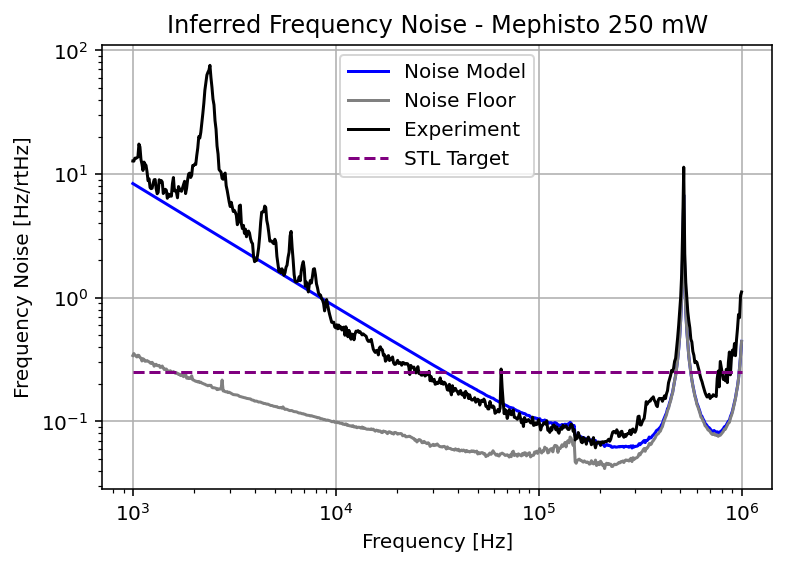
Finally, I went ahead and did the experiment with the Coherent Mephisto at 250 mW of output power. Comparing the total frequency noise measurement including the setup noise and a ballpark model of the Mephisto's frequency noise in this nice paper from Henning and co. (https://arxiv.org/abs/2508.10477v1) reveals a fairly close agreement.
Between 1 and 10 kHz, we are almost certainly limited by fiber vibration noises as it is not isolated from acoustic noise whatsoever. As far as I could tell, no published measurements of this laser's frequency noise above a Fourier frequency of 10 kHz exist. Fudging of the model can be done to show an extremely good agreement between 10-100 kHz, but that would only be speculation. In any case, it seems we have a good start at being able to measure frequency noise at or possibly below the STL for out test laser.