Yulin, Rich, Lari, Den
Rich mentioned to me that the BIS response has a relatively high-Q peak at around 0.95 Hz, as shown in the first attached figure, measured during the ISI RY excitation. Since the BIS / GS13 blend is at 0.3-0.5 Hz, the peak may lead to the instability of the blend. This log discusses the cause of such BIS response, the reason for the blend instability, and the implemented upgrade to the BIS analog servo to address the problem.
By design, BIS runs in force feedback mode similar to most broadband seismometers. Since we focus on low frequencies (below 1 Hz), we have not optimised the BIS mechanical structure for the high-frequency performance. As a result, the BIS body modes are at 20-40 Hz because we use M6 titanium rods to support the proof mass. The design bandwidth of BIS is 4 Hz. This worked well in Birmingham; however, the BIS feedback servo has run up the mechanical modes during the pump down at Lasti last Dec. This is likely caused by a better mechanical stability of the MIT ISI because we utilise rubber springs in Birmingham, which likely provide sufficient damping for the BIS modes.
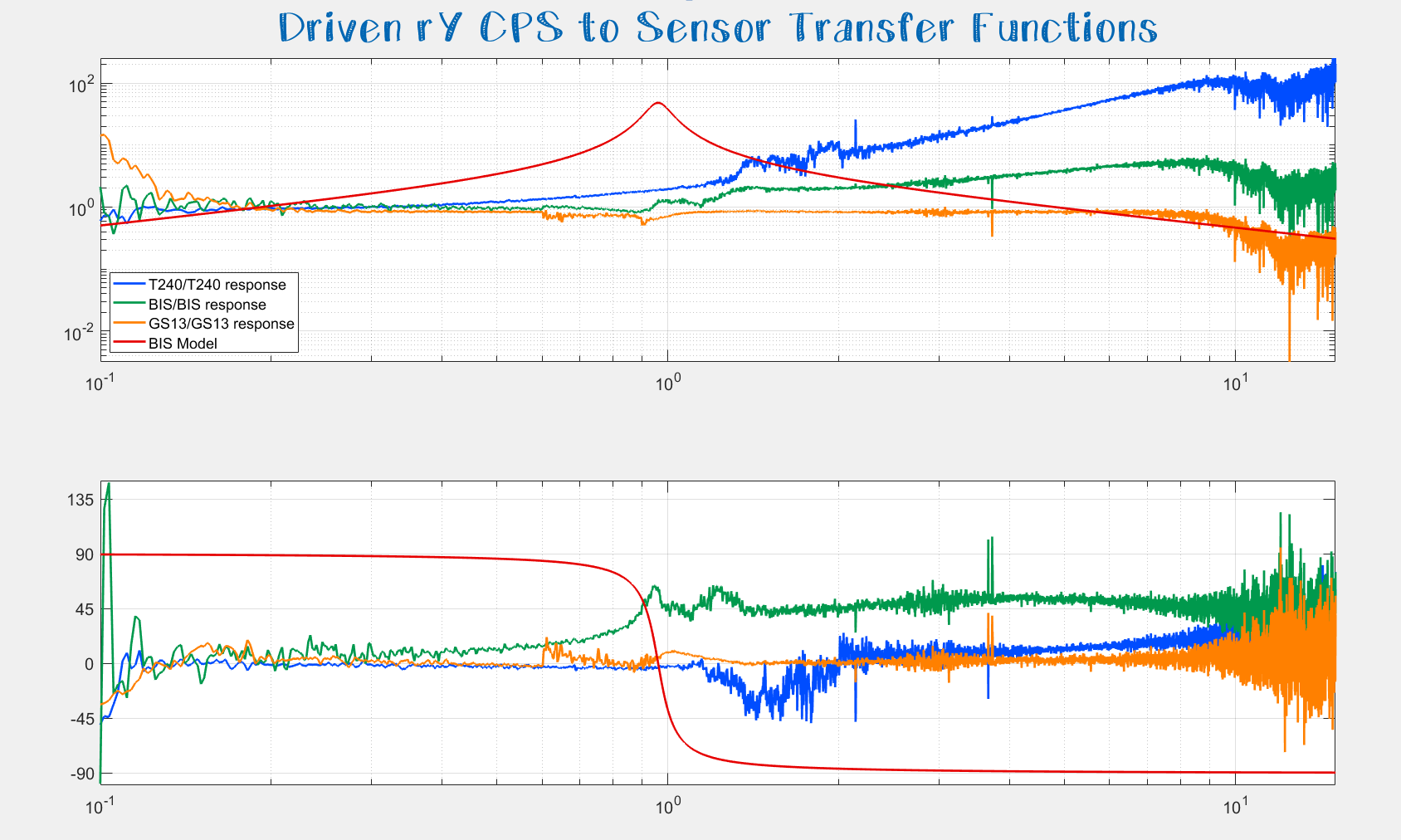
Since the BIS mechanical modes got run up on the last day of our Dec visit, we did not have time to update the analog servo. Instead, Amit has lowered the BIS servo gains by a factor of 8. In this configuration, the mechanical modes are stable, but we approach close to the lower frequency side of the stability phase bubble of the BIS servo. This is illustrated in the attached figures 2 and 3. Figure 2 shows the design open loop and the MIT servo open loop with a decreased gain. Figure 3 shows the BIS response to external excitation; it is calibrated to the velocity readout and indeed shows a peak at 0.95 Hz.
In designing the BIS blends in Dec, I have aggressively low-passed the BIS blend at 1 Hz with an elliptical filter to make the system stable. However, since Rich uses a more accurate approach, which relies on the inertial sensor noise figures, he got another, more optimised blend. That blend takes into account the BIS response but leads to the instability of the HAM control. The reason for this is that the ISI loop works on top of the force feedback loop of any inertial sensor. Loop algebra shows that the ISI control signal adds a boost to BIS according to the equation
boost = 1 + band_pass,
where band_pass is the BIS blending filter. We high-pass the BIS signal to blend with CPS and low-pass it to blend it with GS13. The effect of this boost is rather modest, and its Bode plot is shown in the 4th attached figure. The boost claims a few extra degrees of phase at 1 Hz. However, since the BIS servo has already been marginal, Rich's optimised blend has destabilised the BIS force feedback servo and, as a result, the ISI.
After discussing with Lari, we realised that the simplest solution would be to reduce the cut-off frequency of the Sallen-Key low-pass filter inside the analog servo to reduce the open loop gain near the BIS body modes. Conveniently, Murata also started to sell 470 nF class 1 C0G/NP0 1206 capacitors that Rich acquired last week. The last attachment shows the updated schematic of the BIS Rev A servo with increased capacitance. The design has shifted the low-pass frequency from 30 Hz to 10 Hz. The new simulated open-loop and BIS responses are shown in Figures 2 and 3.
Yulin replaced the capacitors on Sunday and increased the gain by a factor of 8 back to the nominal values. So far, the mechanical modes look stable, and the BIS response is consistent with the simulated value. Figures 5-10 show the measured BIS response during the HAM excitations in X,Y,Z,RX,RY,RZ. The phase shift between BIS and GS13 is close to zero up to 1 Hz, and the BIS response has a low-pass filter. After the next pump down, we will see how the optimised BIS/GS13 blends behave and may push the BIS bandwidth a bit further if needed.