Eric, Anders, Daniel
We are long overdue for a formal alog post for the LASTI squeezer, so here is our current status
Over the past few weeks, we have been installing an LO mode cleaner cavity before our homodyne detector. This process involved rebuilding a lot of the readout and locking PD table next to the chamber. In this process, we have been able to clean up the LO mode considerably and thus improve our homodyne detector's visibility. As of last Friday, we are fairly consistently able to align the homodyne detector up to the 99% level of visibility - something we could not realistically achieve before adding the mode cleaner. On Friday, using a detuned LO, we measured the visibility after careful alignment to be (based on PD1's voltages):
| Vmax | Vmin | Visibility |
| 1.99 V | 0.01 V | ~99% |
This corresponds to a homodyne detector efficiency (n_HD) of 98%, or a loss of 2%.
Furthermore, we remeasured the escape efficiency of the OPO in the current position (0.614mm stage readback). First, we measured the front-seed path mode matching:
| Mode | CLF PD (Transmission) Voltage |
| TEM00 | 937mV |
| TEM01 | 35mV |
| TEM10 | 95mV |
| HOM1 | 170mV |
| HOM2 | 65mV |
| Background | 17mV |
This scan corresponds to a mode matching of 75.6% into the TEM00 mode. Next, measuring the reflection dip from the front seed path:
| Off-Resonance REFL Voltage | 6.49V |
| On-Resonance REFL Voltage | 5.89V |
| Background REFL Voltage | 13.7mV |
This corresponds to an on-resonance cavity reflection coefficient of 90.8%. Using this result, we can infer the additional intracavity red losses to be ~0.28%, which is about 1000ppm higher than the AR coating loss we measured in this alog and verified in this alog.
This loss equates to a 97.05% escape efficiency, which is down almost 0.7% from when we last measured it. It is possible that some of the above measurements were made in error, but it seems like our cavity's red losses have nearly doubled from our last characterization of them. Nevertheless, we pushed forward anyway to try and characterize the squeezing we could detect now.
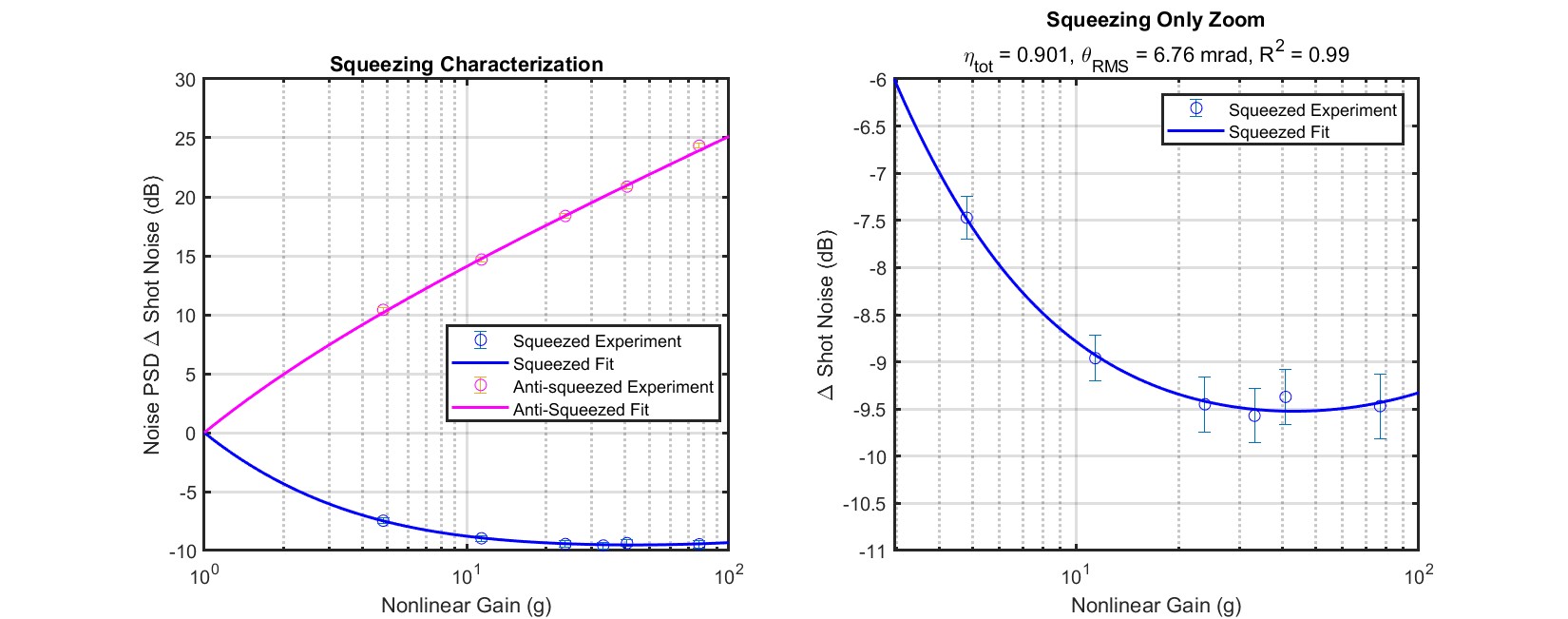
We then set up the squeezer and measure squeezing and antisqueezing over a wide range of nonlinear gains by adjusting pump power. The resulting spectra are trace-averaged 400 times in the SR785 before being exported. Then, for each datapoint (sqz and antisqz spectra pair) we compute the average squeezing and antisqueezing level (in dB) over a band starting at 1kHz and ending at the top-end of the measurement bandwidth (~30kHz). This average is computed after removing spurious tones from the data that exceed 3 standard deviations from the initial mean squeezing over this band (for simplicity). This data is then fit to the theoretical curve for lossy squeezed light detection here.

According to this data, the result is a surprisingly low overall detection efficiency of 90.1%. Our expected detection efficiency (assuming a PD quantum efficiency of 97% and 0.5% path loss ballpark to the homodyne PDs) should be more like 91.8% (n_esc*n_HD*n_PD*n_path). This indicates that we have a loss of around 1.8% unaccounted for in our calculations and measurements - even with the degraded escape efficiency. I am beginning to wonder about how good the quantum efficiency of the photodiodes in our homodyne detector is at the moment - we may want to consider retroreflecting their reflections back with a mirror to see if we observe any improvement here (like Roman Schnabel's group). Moreover, it looks like we have some measurable phase noise now which shouldn't be too hard to track down.
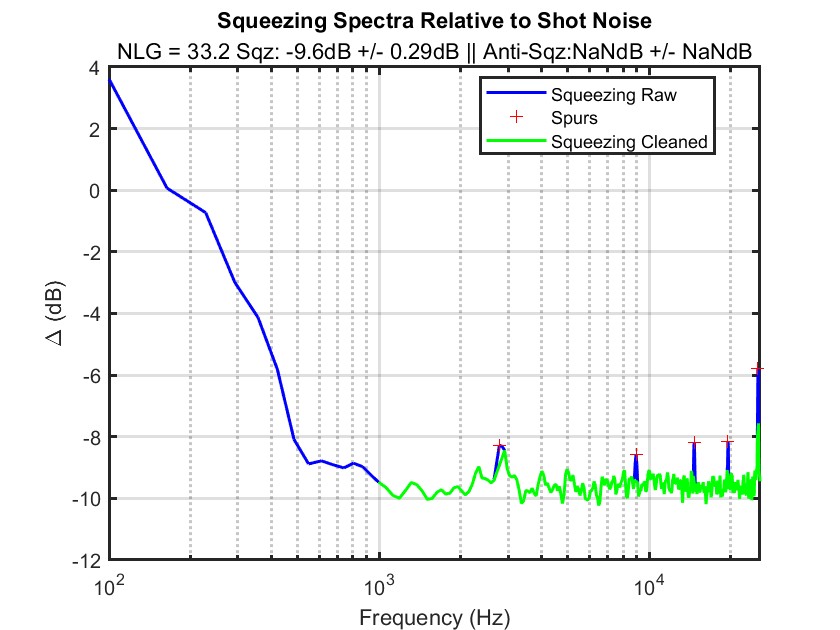
Nevertheless, our best real squeezing observed to date can be seen in the plot here (anti-squeezing is missing as I failed to properly save the antisqueezing spectrum data for this point somehow). Hopefully as we continue to wrap up the build over the next couple weeks, we will find the cause of this loss/phase noise, as removing it would very likely make observing 10dB of squeezing very doable without too much strain on the OPO.