
sasha - posted 14:46, Wednesday 21 May 2025 - last comment - 14:47, Saturday 31 May 2025(11968)
Curve Fitting for Teraxion Linearity Measurement - 2 GHz
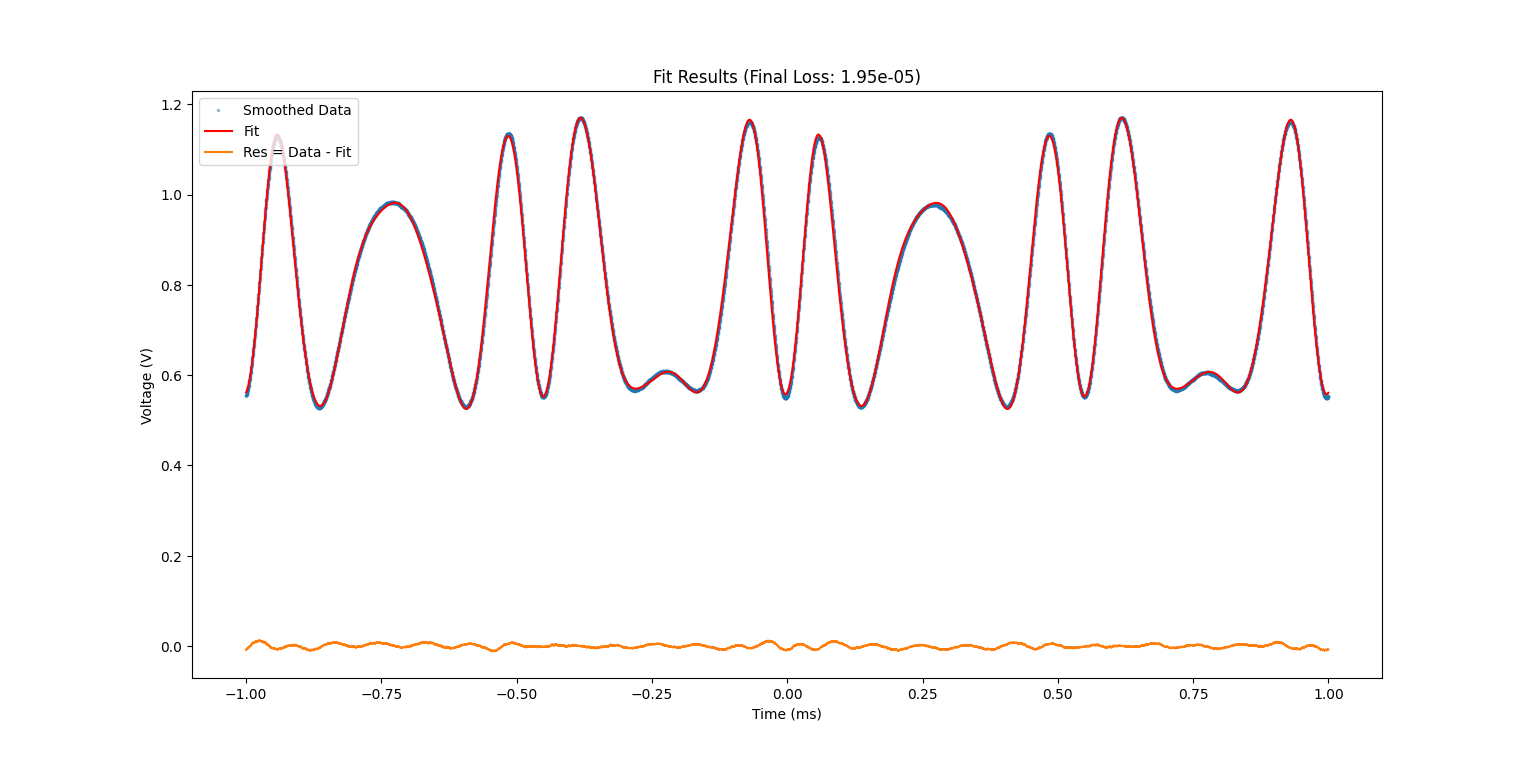
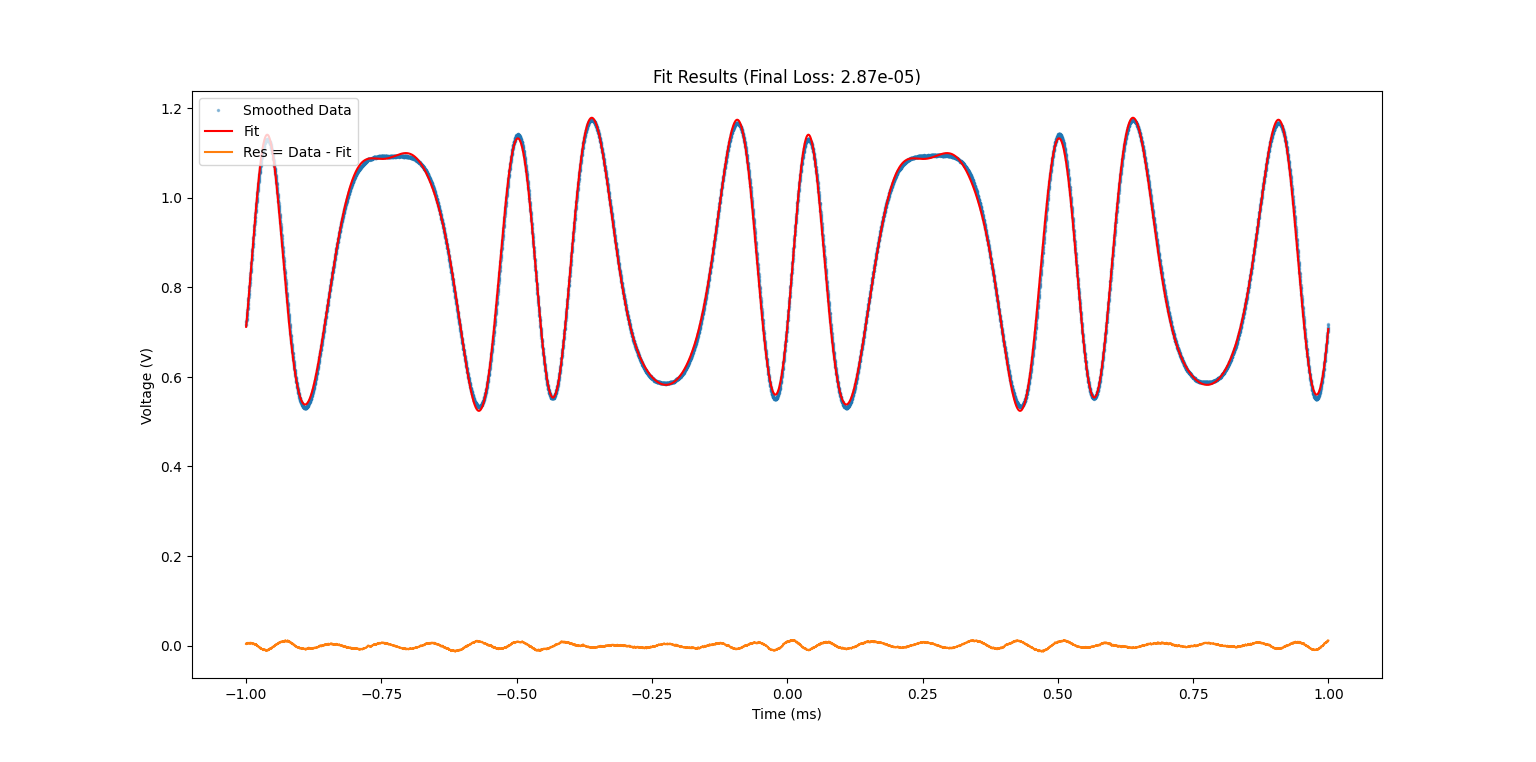
A few weeks ago, we took more time series data for Teraxion linearity measurements with higher frequency modulation amplitudes (2GHz and 5 GHz) and 1 kHz carrier frequency. The new data has been difficult to fit with both least squares and MCMC, but I recently tried using gradient descent for curve fitting and now have some informative fits for the 2 GHz data. These results required fitting for 10 harmonics, abandoning the assumption that all modes are in phase with each other, and adding a term for residual amplitude modulation. The results suggest that Teraxion is noticeably more non-linear for deeper frequency modulations (as opposed to 1 GHz that we fit for previously).

I attach two fits and list their parameters below.

fit27_10:

V0: 0.6251
Vfringe: 0.7836
phi: 1.0711
a: 0.2020 (AM)
psi_a: 3.0275 (phase of the AM)

Modulation depths:
m1: 0.7143   m2: 0.5826   m3: 0.5468   m4: 0.3856   m5: 0.2048
m6: 0.1631   m7: 0.0875   m8: 0.0747   m9: 0.0254   m10: 0.0266

Phases:
psi1: 3.0520   psi2: 3.1502   psi3: 3.5166   psi4: 3.2619   psi5: 2.7604
psi6: 3.7823   psi7: 1.1881   psi8: 3.6516   psi9: 0.5109   psi10: 3.3111


fit28_10:

V0: 0.2421
Vfringe: 1.4911
phi: 0.8916
a: 0.3625
psi_a: 3.2381

Modulation depths:
m1: 0.6388   m2: 0.4169   m3: 0.4405   m4: 0.2875   m5: 0.1278
m6: 0.1349   m7: 0.0217   m8: 0.0379   m9: 0.0159   m10: 0.0089

Phases:
psi1: 3.2005   psi2: 3.4836   psi3: 3.8031   psi4: 3.8273   psi5: 3.7472
psi6: 3.5363   psi7: 5.9480   psi8: 2.9835   psi9: 5.6154   psi10: 2.4806
Images attached to this report
Non-image files attached to this report

Comments related to this report
Adding data files: 27, 28 - 2V; 29, 30, 33 - 5V
Non-image files attached to this comment
