
[Eric, Wen, Daniel]
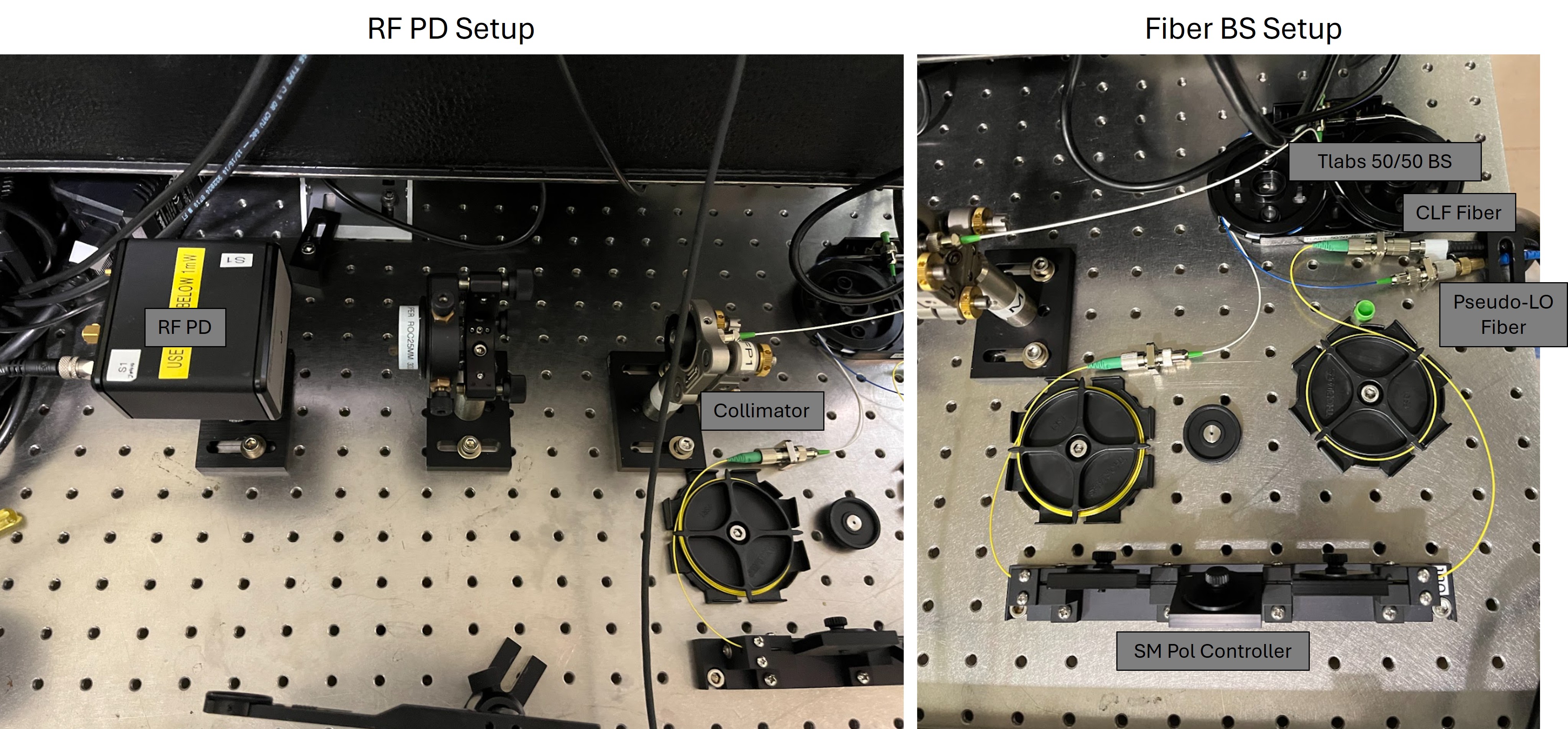
In the LASTI squeezer setup, we have managed to resurect part of the LO-generation path. In this configuration, we want to generate the LO signal using two AOMs driven at the same frequency with frequency modulation on one of the two AOMs to allow for limitless tracking of the squeezing angle at the homodyne. Before we built the LO path out completely, we coupled the light from a single 80-MHz shifted signal following the first AOM into fiber and beat it against the CLF by combining them with a fiber beam splitter and shining the resulting combined signal on a New Focus 1611 RF photoreceiver. A simplified diagram of the experimental setup is here, along with a photograph of the setup here. In principle, this should allow us to analyze the spectrum of the CLF signal to see how nonlinearities/nonideealities of the AOMs in the CLF generation process behave.
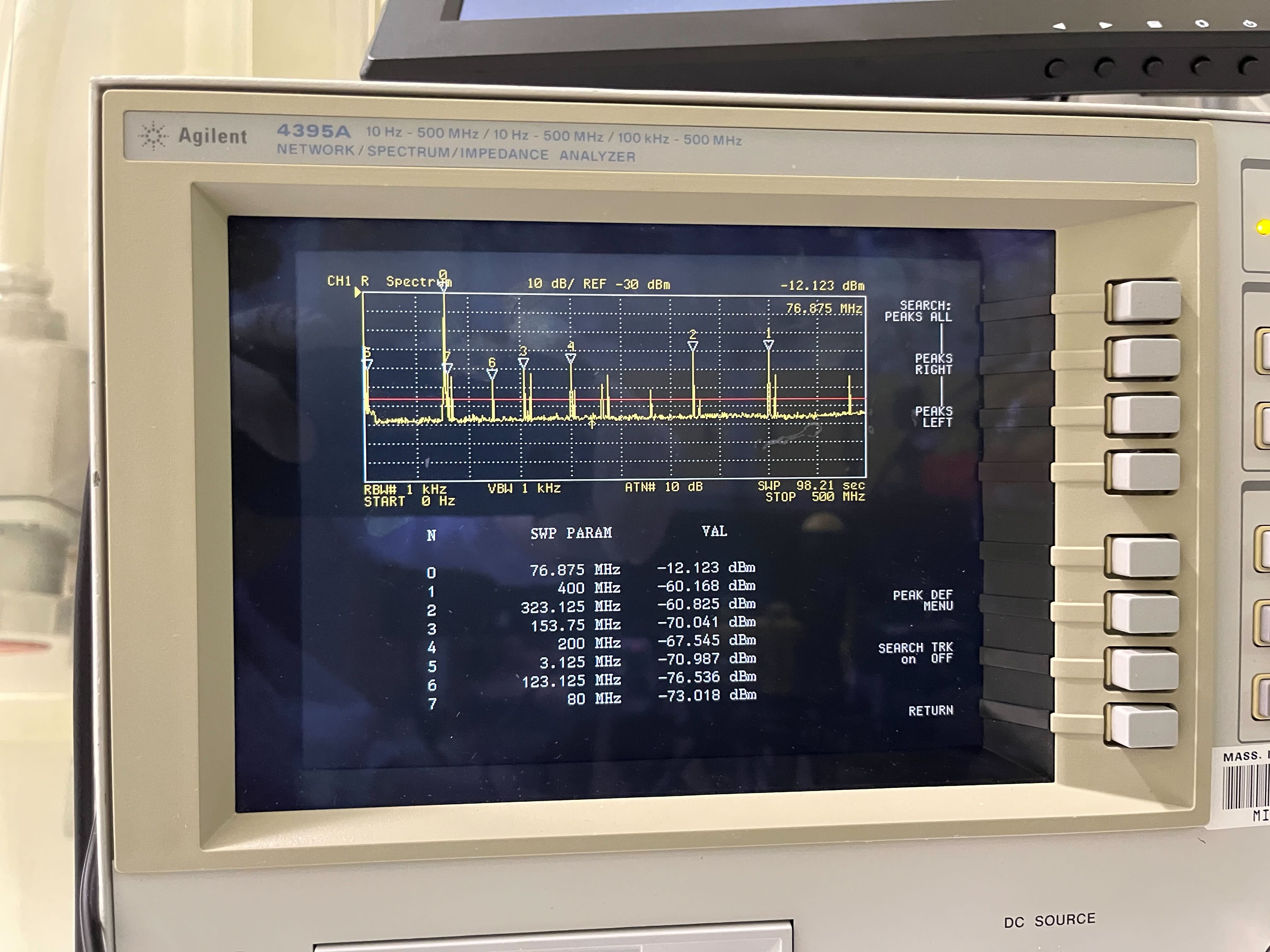
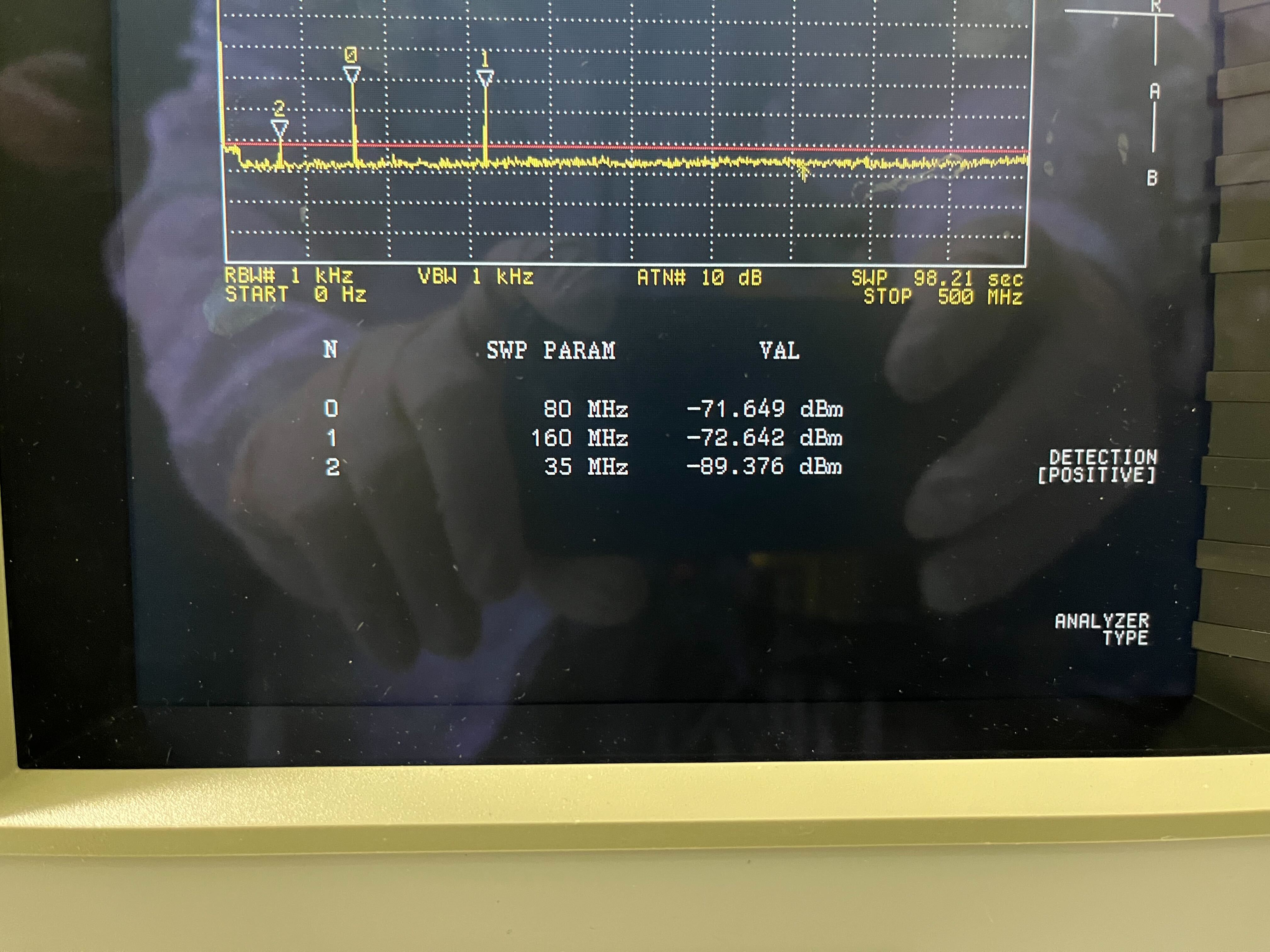
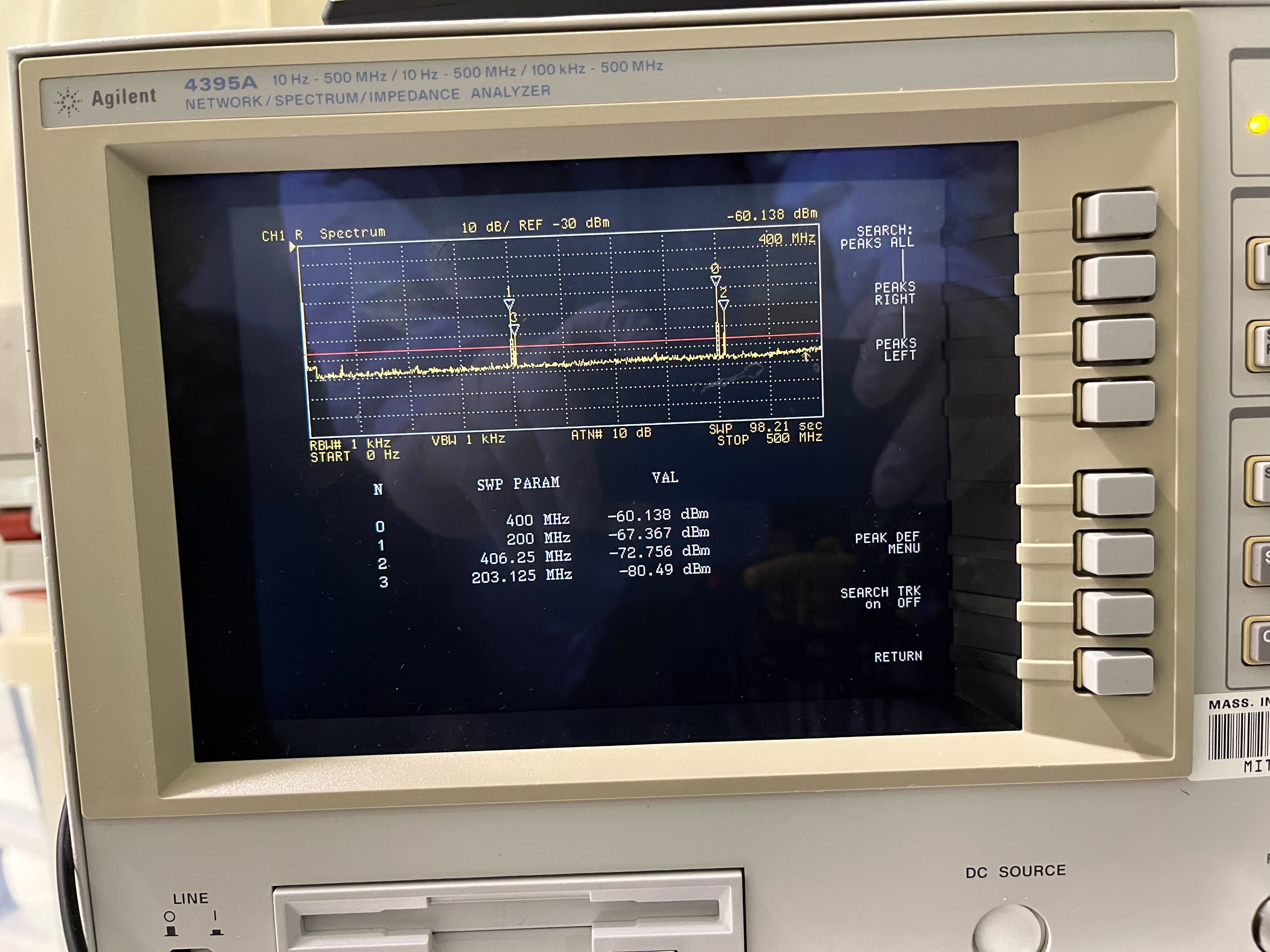
Looking at the full heterodyne signal on an ESA here, we would ideally expect to see a tone only at omega3-(omega1-omega2) = 76.875 MHz. In reality, the spectrum is quite complex displaying a dominant heterodyne signat at 76.875 MHz and many undesired terms other frequencies. By removing the LO from the fiber beamsplitter, we can observe the CLF's "self" homodyne signal on the ESA here. This shows clear tones at both AOM drive frequencies (1 and 2), indicating that there must be some leakage of the seed "carrier" through the CLF path. The same can be done with just the pseudo-LO here, resulting in tones at the LO AOM3 drive frequency of 80 MHz, as well as some second-harmonic content.
In the next few comments, we will try to understand the sources of the non-idealities in the heterodyne spectra to see if we can pin down if/what AOM nonidealities are ultimately contributing to seeding of the OPO during normal operation.
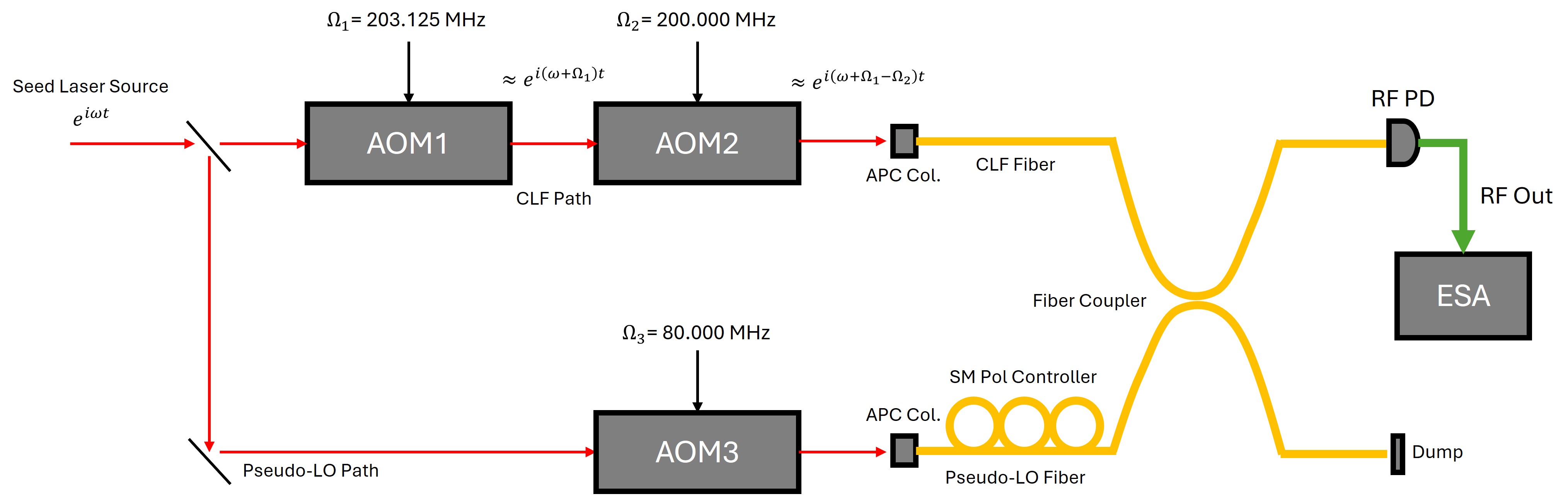
We measured the CLF self homodyne today with RF drive to each AOM as:
AOM1 RF Drive Power: 30dBm
AOM2 RF Drive Power: 20dBm
The resulting CLF signal was measured on an RF PD (1611) and tones at the following frequencies were measured.
200 MHz: -63.7 dBm
203.125 MHz: -79.0 dBm
400 MHz: -59.6 dBm
406.250 MHz: -66.8 dBm
Futher analysis hopes to determine how much power there exists at the seed laser frequency from this data.
It might be useful to compare with this old post where I was debugging the original setup (the same AOMs and amplifiers, but different optical table with a different layout). I wasn't doing exactly the same thing, and it might be a bit tricky to compare numbers, but it gives an idea of the range of seed powers that it is possible to see with such a setup:
To access:
Username: reader password: readonly