javenn - posted 18:16, Thursday 08 May 2025 (11956)
Frequency noise measurements of Toptica CTL and NKT Boostik
[Jasper]

To get an idea of the frequency noise of the Toptica CTL with and without the NKT Boostik I used the unequal arm length fiber Mach-Zehnder interferometer I put together a while ago, which has an arm length difference of 10m. The interferometer sits inside a metal box that is padded with rubber sheets and acoustic foam. Only the input and two output fibers are coming outside the box and I tried to seal to opening for the fibers as best I can with small rubber pieces. I put a fiber attenuator in the input of the interferometer to adjust the input power. The output fibers are connected to two fixed gain Thorlabs InGaAs PDs. The idea of the measurement is to lock the interferometer at midfringe and use the differential output signal as a frequency readout.

Although the two PDs are the same model and new, one of them was significantly less sensitive for some reason, i.e., the output voltage was only about 80% compared to the other one for the same incident power. I want to look into this again, however, as it seems to work fine otherwise I simple attenuated the other PD signal with a voltage divider to balance the outputs. In the configuration that I ended up using the maximum power in the outputs was about 1.2mW (measured with a power meter) corresponding to 7.3V on the PDs (measured with a 1MOhm impedance oscilloscope) (exact values commented in the measurement files on the Dropbox).

To lock the interferometer at midfringe I used a Newport LB1005 servo controller to feed the differential signal back to the piezo voltage of the CTL. Setting up the lock was a bit tricky a since there was only a small margin where the gain was large enough to keep the interferometer at midfringe without ringing due to a resonance in the actuator transfer function at 3.8kHz. Eventually I found a configuration where the interferometer stayed locked for at least 10min at a time, which was more than I needed and is only a lower bound given that I did not test it for longer. In this configuration the unity gain frequency was around 100Hz (measured with swept sine with SRS785). The exact control bandwidth does not matter, only the fact that it is significantly below the measurement band (1kHz to 10MHz), as I am measuring the frequency noise in the error point of the midfringe lock loop. The power spectral density at the error point was measured with the HP4195A (50 Ohms input impedance).

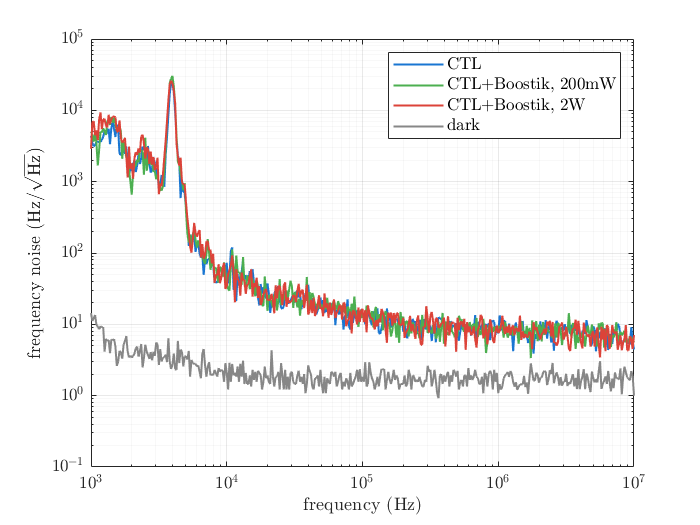
I performed the measurement for the CTL directly, and for the laser amplified with the Boostik at the lowest and highest gain setting, i.e., 200mW and 2W nominal output power respectively. I also measured the error point dark noise with the loop off and no light in the interferometer. The result can be found below. The frequency noise measured for all three configurations is identical. This indicates that the amplifier has no impact on the frequency noise, which would be great news.
It is also possible, that some other, common noise is limiting the measurement. The noise floor of the interferometer is unknown, however, when I performed tests with the NKT Adjustik I measured a noise performance below this level, so I think this is unlikely.
Furthermore, the noise floor of around 10Hz/rtHz above 100kHz would fit well to the manufacturer specification of an instantaneous linewidth of 300Hz (see also: https://www.toptica.com/fileadmin/Editors_English/04_applications/10_application_notes/05_Linewidth_Measurement_of_Diode_Lasers/Linewidth-measurements-of-diode-lasers.pdf).

Regardless this gives us an upper bound on the noise performance in the MHz regime which is quite promising. I still want to investigate this further for example by repeating this measurement with the NKT Adjustik. I also would like to perform a beat measurement of the CTL with the Adjustik to independently verify the measurement.
Images attached to this report