javenn - posted 16:31, Thursday 08 May 2025 (11952)
RIN measurements of Toptica CTL and NKT Boostik
[Jasper]

I successfully installed the Toptica CTL as the low-power, tunable seed laser and the NKT Boostik as the high-power amplifier. The CTL is tunable from from 1510nm to 1630nm, with a maximum output power of ~30mW at 1560nm, i.e., the nominal wavelength of the experiment. The NKT Boostik is an erbium-doped fiber amplifier, which nominally provides up to 2W of output power in the frequency range from 1545nm to 1565nm.

I measured the power with a fibercoupled powermeter downstream of a fiber isolator in the 10% output port of a 10:90 fiber beamsplitter, which gave up to 150mW at maximal gain of the Boostik. Taking into account the manufacturer provided insertion losses this corresponds to 1.84W out of the amplifier and 1.68W behind the isolator. The Boostik test certificate of the manufacturer gives no specification of the exact output power. One stability plot suggest that it should be around 1.95W (however, it is not clear how this measurement was performed or calibrated). This would correspond to 110mW losses, i.e., 5.6% or 0.25dB, that are not accounted for. I lack the experience to gauge if this discrepancy is within the expected margin or if this points to real, extraneous losses. Further investigation might be necessary at some point.

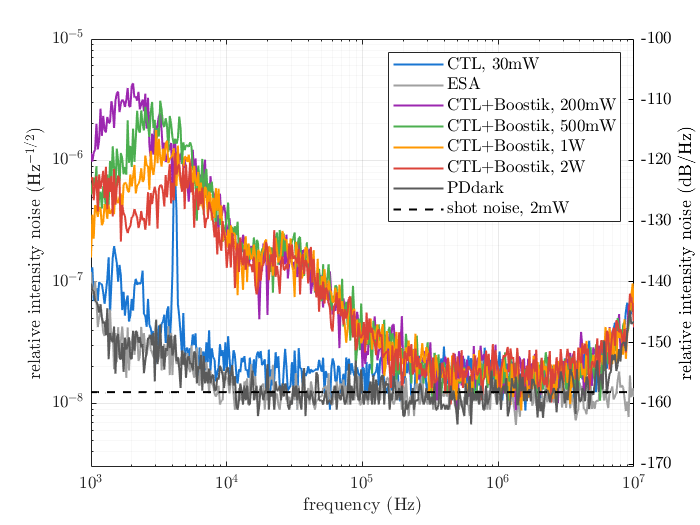
Regardless, I continued to perform some RIN measurements. For this I implemented a variable optical attenuator in the measurement port and connected it to a fibercoupled PD. I measured the RIN for different nominal output powers of the Boostik, and always adjusted the power incident on the PD to 2mW, corresponding to a DC voltage of 3.3V measured with an oscilloscope (1MOhm impedance). The responsivity of the PDs is specified by the manufacturer as 1.04A/W at 1550nm, which corresponds to a quantum efficiency of 82.7%. To measure the RIN I used the HP4195A from the e-workshop (50 Ohms input impedance). To high-pass filter the signal to avoid saturation of the input range from the DC component, I put a 10uF capacitor in the input of the HP4195A, which together with the input impedance should result in a corner frequency of about 320Hz. I then measured the RIN at 200mW, 500mW, 1W and 2W nominal output power of the Boostik (always adjusted to the same DC level on the PD with the attenuator). I also measured the PD dark noise and HP4195A noise floor. Lastly, I repeated the RIN measurement for the CTL without amplification to compare to the results from the demo unit a couple of months ago. For this I operated the CTL at maximal diode current (300mA), i.e., around 30mW output power, and attenuated the beam on the PD to 2mW as for the other measurements. The plots are found below.

The RIN measurement for just the CTL is close to the electronic noise floor except for some features in the kHz range, especially the 3.8kHz peak. These kHz features also appear in frequency noise measurements with the fiber interferometer and are sensitive to vibrations, so I assume they are an internal mechanical resonance of the laser head, probably of the piezo or grating assembly. Accounting for the electronic noise, the measurement suggests that the CTL is shot noise limited for the detected power above 10kHz.

The measurements with the Boostik agree for all gains above 5kHz and match the CTL noise above around 200kHz. In other words even after the amplifier the laser remains shot noise limited at high frequencies. Interestingly the low-frequency noise appears to improve roughly linearly with the gain/output power. This behavior makes me think that this might be some internal feedback stabilization which has a better signal-to-sensor-noise ratio with higher powers. This is outside of our frequencies of interest, but it is convenient.

Overall, these are very nice results, as this means we hit our RIN target in the MHz frequencies without any additional stabilization.
Images attached to this report