
Swadha, Evan
We had struggled for a while to align into the cavity by coupling in reflection with a single prism only, and with the entire cavity mounted vertically (letting gravity set the kinematic contact between the prism and three small squares of copper leaf). The key changes this time were to mount the cavity horizontally (with kinematic contact described below) and to couple with two prisms (one input one output) so that transmission information is available for alignment.
The key points of the optical setup were:
- The cavity was mounted on three nylon-tipped 8-32 setscrews. The flat optical faces of the cavity were prepared with three small squares of copper leaf each as described earlier. (MIT:11889)
- Each prism is let to rest on two nylon-tipped setscrews, then pressed by hand against the cavity, flattening the copper leaf. This contact is then maintained with a third nylon-tipped setscrew aimed horizontally. This should give kinematic contact (three points of contact from the copper leaf, two points from the setscrews supporting the bottom of the prism, and another point from the horizontal setscrew).
- The laser beam emerges from a fiber collimator F220APC-1064 and is steered with two steering mirrors. The first steering mirror is placed between two 150 mm FL lenses so that its action is approximately conjugate to the second steering mirror.
- We did not attempt any mode matching into the cavity's mode, and the laser mode right now is grossly oversized compared to the cavity mode.
The optical alignment procedure went like this:
- We started with a few milliwatts of p polarized light going into the cavity, with a CCD camera on the transmitted output.
- When the beam is sent into the cavity even roughly at the correct angles and locations, a ring of points emerges in transmission that is visible on the card (and too big for the CCD — probably about 1 cm by 1 cm in extent). We were initially confused about what these points were, compounded by the fact that at 1064 nm there are non-negligible AR beams bouncing around everywhere, leading to stray beams emerging from the optical faces of the cavity at strange angles.
- We started driving the laser current with a 4 V pp triangle wave at 5 Hz. Some small, high-order fringing was visible more or less everywhere on the CCD, but nothing clearly resembling a Hermite–Gauss mode.
- In any case, we adjusted the steering mirrors in yaw until the ring of points in transmission could be made into a more or less vertical line of points.
- Adjusting the steering mirrors in pitch was more difficult as the line of points would expand out into a ring again. Nonetheless, by iterating (including with yaw) we were able to condense the line of points down into a wad of points as viewed on the card. On the CCD, the wad of points appeared as a more or less as a mess of light and fringes. However, it was evidence that the interference was stronger now than before, hinting that we were closer to something modal.
- After some more fine iteration with the steering mirrors, a TEM00 mode was evident, although it was surrounded by a strong background of messy fringes. Since the finesse in p is presumably small and the mode matching is so poor, this is not surprising in hindsight but it probably slowed us down a bit, and higher-order Hermite–Gauss modes would not have been evident.
- We switched input polarization to s, where the finesse is higher. The TEM00 mode was more evident now, and the background fringes smaller. We declared success.
Our estimate of the finesse in s is based on the following:
- The FWHM of the 00 mode corresponds to a slew of 0.78 V into the laser current driver modulation.
- The current driver is LIGO-D1200719-v1. My reading of this schematic is that the relevant transconductance is set by the op-amp current source U7, which appears to be 1/(3 kΩ) ≈ 0.33 mA/V.
- David Yeaton-Massey gives the current-to-frequency coefficients of these lasers as roughly 30 MHz / mA, but this is going to depend on the dc current drive to the laser, which I have not worked out yet.
- Putting these numbers together implies a finesse in s of a few hundred.
The key points for future iterations of this procedure are as follows:
- The horizontal cavity setup made by pressing the prisms against the cavity with fingers (and then maintaining with setscrews) seems to have worked well. We may want to formalize this with a jig because the prisms are not totally aligned with the optical face of the cavity.
- Importantly, the mode seems to have formed at least a few millimeters off vertically from the midline of the cavity. This is not unexpected given the toleracing we specified for the curved faces (they are 5 m ROC nominal), but it justifies our decision to design large prisms with wide clear aperture.
- In hindsight, the optical alignment is probably achievable without a CCD in transmission, which is important for silicon at 1550 nm. This also probably hinges on having better initial mode matching.
Attachments show the optical layout, and CCD videos of the p and s polarized transmissions as the laser frequency is swept.
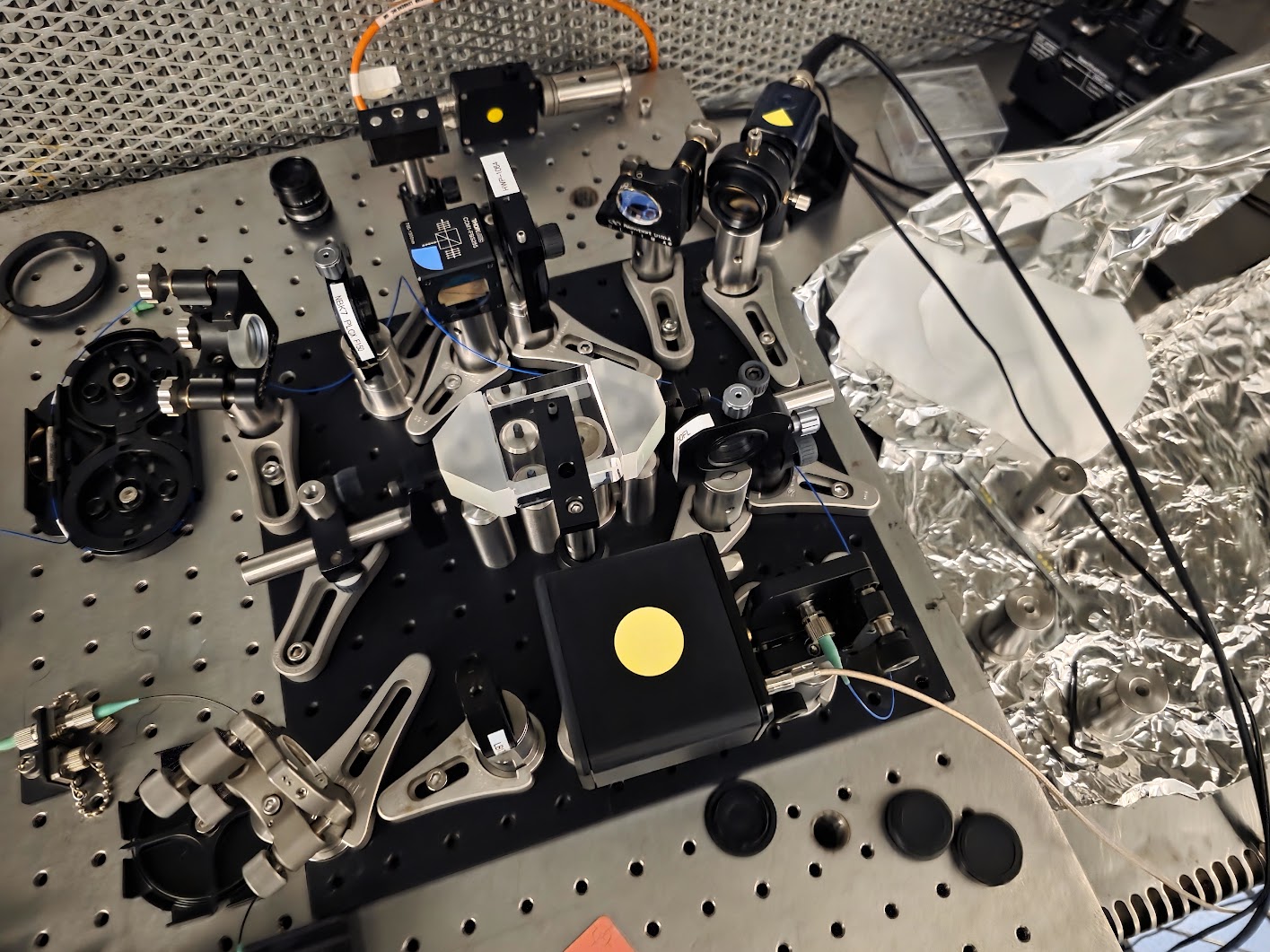

Matt, Swadha, Evan
We were able to PDH lock the cavity with a bandwidth of about 20 kHz. In the kilohertz range the driver and the laser current actuation have a transfer function that is neither flat nor 1/f (see attachment for David's measurements of this from Caltech — driver and laser should be identical to ours). We probably want to think carefully about pole placement here. Using 𝜈FSR = 2.9 GHz and finesse of 370 implies an optical pole at 𝜈HWHM = 3.9 MHz, which is currently irrelevant but could shift down by an order of magnitude if we redo the coupling with a larger gap.
We applied 49 MHz PDH sidebands with a fiber phase EOM that Melissa lent us (LNY10D2A 200 MHz X-cut). We are detecting in reflection with a New Focus 1811. The PDH error signal is not clean because (to give one reason at least) we are desperately in need of better mode matching. In transmission, the second-order HOMs are about 50% in height compared to TEM00.
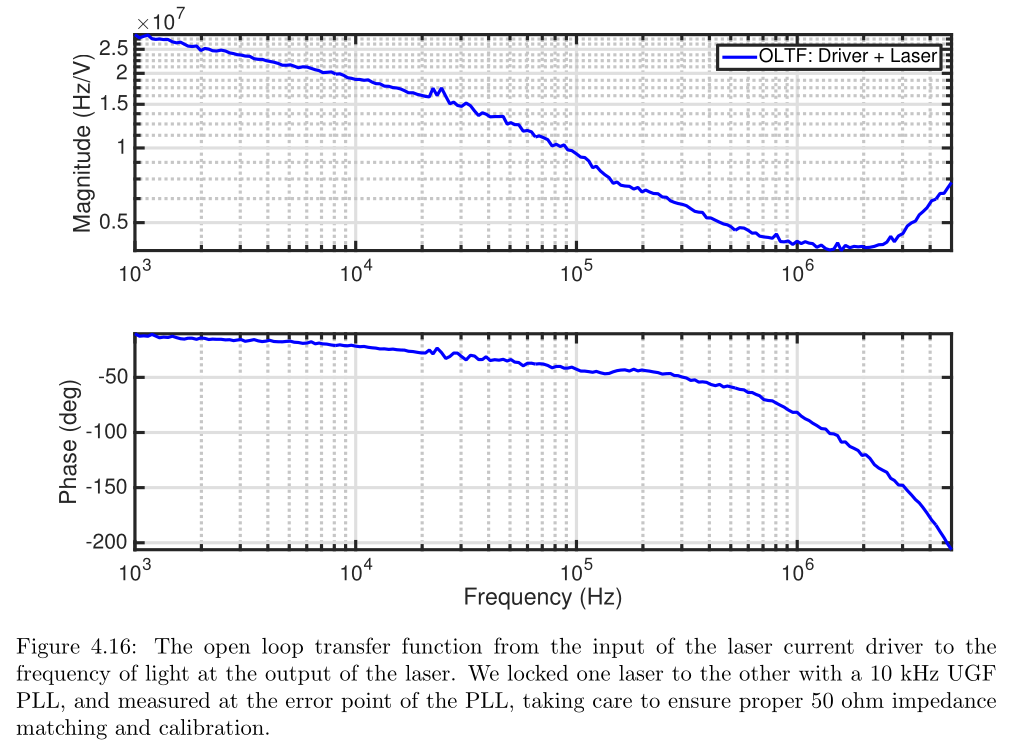
Swadha, Evan
We continued to study the transverse modes of the cavity. We attempted better mode matching with a different lens arrangement but were only able to achieve a transmitted power of TEM02 = 96 mV and TEM20 = 112 mV versus TEM00 = 270 mV (dark noise: 18 mV), which is modestly better than before but not spectacular.
We were driving the laser current with a triangle sweep at a rate of 1 V / 4.2 ms. We applied phase sidebands at 49.2 MHz and found they appeared around the carrier at ±3.05 ms, enabling a calibration of the sweep time into frequency. The TEM00 FWHM was 3.24 ms, implying a FWHM of 52 MHz, and hence a finesse of 57 (s polarization). The laser current knobs were set at 6′00″ coarse and 7′30″ fine; temperature readback 7.27 kΩ.
Similarly, the TEM02 mode appears offset from TEM00 by 10.2 ms ( = 164 MHz) and the TEM20 mode appears offset by 13.4 ms ( = 216 MHz). The mode identifications were confirmed with the camera in transmission.
We loosened the setscrew pressing the transmission prism against the cavity, the finesse rose. The transmitted TEM00 power was now 205 mV with a FWHM time of 2.52 ms ( = 40 MHz) or finesse 72. Re-tightening the screw lowered the finesse again.