dmdesant - posted 19:39, Tuesday 29 April 2025 (11947)
LASTI VOPO Phase Matching Spot Exploration
[Wen, Daniel]

This is my first log post as I just got my aLOG account - so this information is a bit old!

A couple weeks ago, we swept the parameter space of the LASTI VOPO PP-KTP crystal temperature and lateral wedge displacement to find the possible 523nm/1064nm co-resonant conditions where nonlinear gain can be observed. In this test, we scanned the cavity while pumping the OPO cavity with 532nm light along with a weak 1064nm seed signal. The cavity was scanned over at least a full FSR while monitoring the transmission of both the seed and pump transmission.

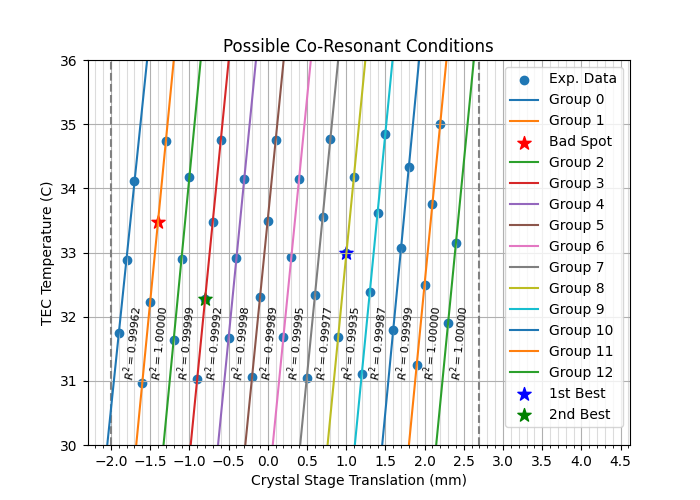
Next, we moved the crystal using the piezo stage to the furthest negative displacement that still allowed the intracavity beam to pass through it. This was found to be around -2mm using the zero origin that was persistent in the stage controller at the time. At this position, we swept the crystal's temperature control setpoint until co-resonance was observed. At co-resonance, we observed the sporadic gain peaking of the seed transmission and noted the relative amount of nonlinear gain qualitatively. Next, another resonance condition could be found by incrementing the crystal position and increasing the crystal temperature to recover co-resonance. This process was repeated until the temperature exceeded around 35.0C, at which point we would move to the next co-resonant cavity mode by incrementing the crystal position and reducing the temperature back to approximately 31C. These loops in temperature are repeated as the crystal is translated from left to right until it falls outside the intracavity beam. This way, each loop represents a "group" of possible co-resonant conditions within the ~30-35C temperature range scanned in this experiment. The exact range of the crystal's span over stage translation are depicted as dashed gray lines in the plot below.

These groups are plotted and fit in the graph attached. Along with these trends, we note some of the locations where exceptionally high nonlinear gain was qualitatively observed. We plan to revisit these locations in the parameter space when optimizing the nonlinear gain quantitatively at a later date. Since we expect there to exist an optimal phase-matching temperature for the PP-KTP crystal, these curves of possible co-resonant conditions should tell us where a discrete set of 13 phase-matched and co-resonant locations (or spots) exist on this particular crystal. In this initial experiment, there was only one spot where we noticed that the crystal was damaged and no resonance could be observed at all. This was noted in the plot as a red star.

Unfortunately, the power surge that occurred a few weeks ago happened right after this data was taken. The surge caused the piezo stage to move past the stage's limit switches and collide with the VOPO assembly's base. Consequently, the zero origin of the stage was lost, so we will need to re-zero the controller before we can revisit this data.
Images attached to this report