dmdesant - posted 20:25, Wednesday 30 April 2025 (11946)
LASTI VOPO CLF beam path re-alignment and profiling
[Wen, Daniel]

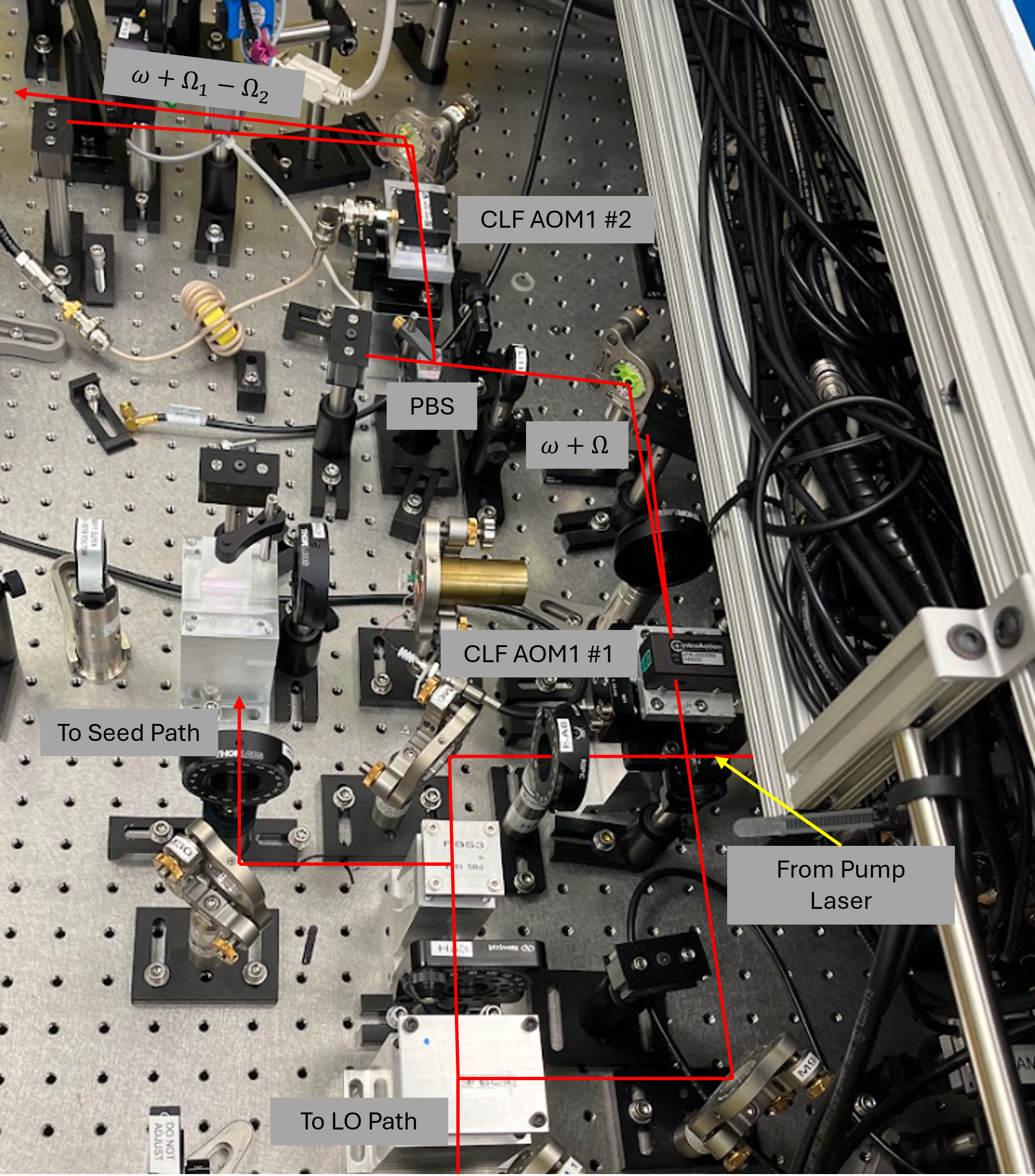
On Monday, we performed some preliminary alignment and profiling of the beam through the two CLF AOMs. Last week, both AOMs were aligned into the beam path and had their phase-matching angles set to produce the maximum diffraction efficiency. The optical path is depicted in the first image attached here.

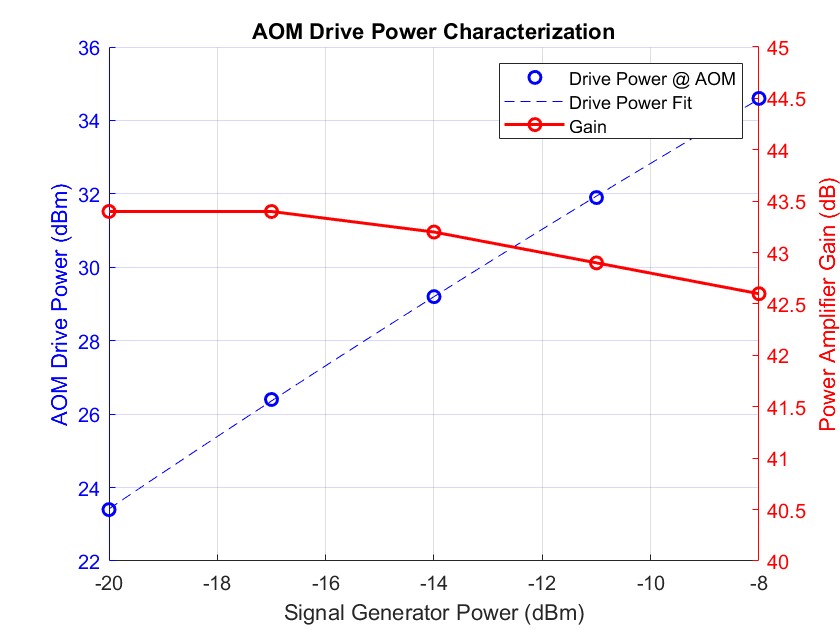
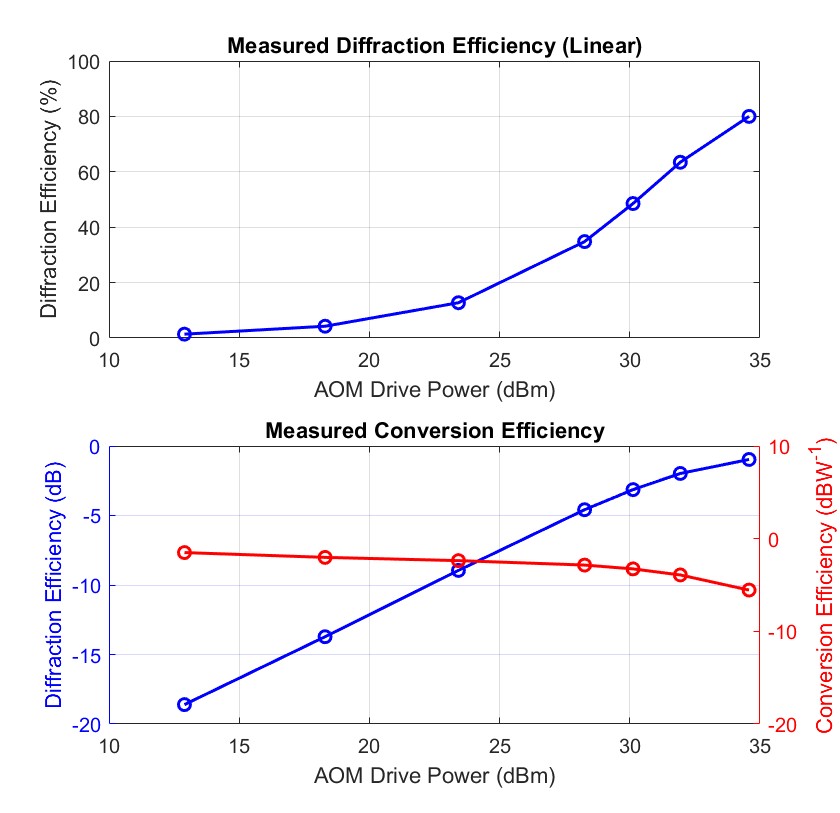
First, the RF drive power to the first CLF AOM was characterized as a function of signal generator drive power at 200 MHz to calibrate out the nonlinear effects of the Mini-Circuits benchtop RF power amplifier used (TVA-R5-13). We then characterized the diffraction efficiency for the first CLF AOM (IntraAction ATM-200-2DA6) as a function of drive power as it's datasheet lacked drive specifications for the 1064nm wavelength used in this setup. The resulting diffraction efficiency is shown to exceed 70% with RF drive above approximately 2 watts at 200 MHz. Also plotted is a normalized figure of merit for the AOM conversion efficiency, which is the ratio of diffracted power to input optical power (diffraction efficiency) normalized by input RF drive power (P_optical_diff/P_optical_input) * (1/P_rf_drive). This ratio in dB has the units of dBW^-1, and is useful for modeling small-signal conversion losses in RF-optical systems like this. From this figure of merit, we can see that the AOM starts to compress with about 30 dBm (1 watt) of drive. So for any future linear single-sideband conversion applications of this modulator, the total RF drive should be kept well below 1 watt at an operating RF frequency of 200 MHz and operating wavelength of 1064nm.

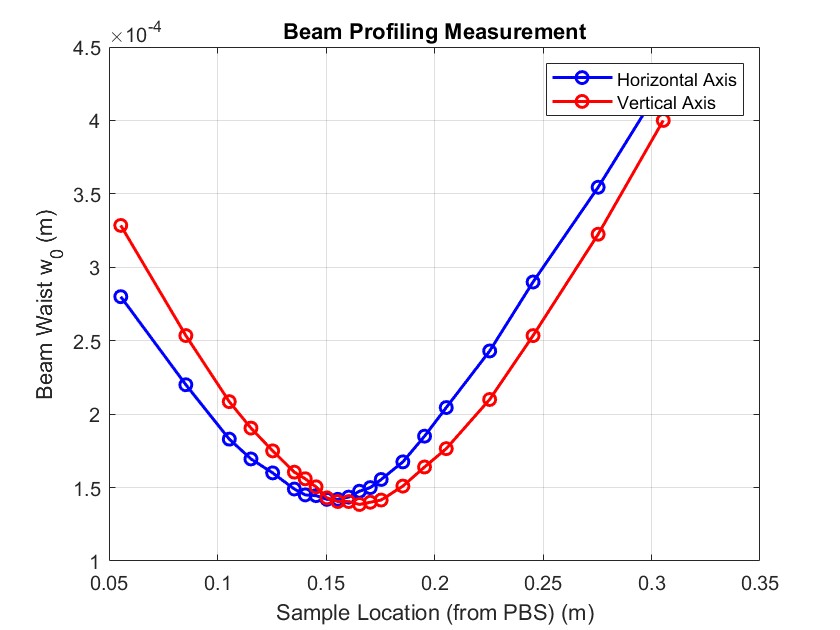
With the upconverted CLF beam back in action, we aligned it through the second CLF AOM configured to shift the frequency back down by approximately 200 MHz +/- our CLF frequency and approximately profiled the beam transmitted through the PBS in the beam path before the second CLF AOM. Using the BeamScanner model 1280, we measured the beam diameter as a function of distance from the PBS center (plot attached). This revealed that the beam has some amount of astigmatism, but should allow us to start mode-matching into the fiber soon.
Images attached to this report