[Begum, Haocun]
We tried to debug HD board #4 for a while this week, the bias paths looks fine, problem unclear as of now, although diodes have been replaced with new ones, to be tested further later.
Haocun and I then built two new homodyne boards, #5 and #6. #5 works, so we assigned it to be the homodyne readout board for the 1550 nm path of the MZI. #6 has an unknown error, presenting as lower gain and small V_avg offset from 0, to be debugged later.
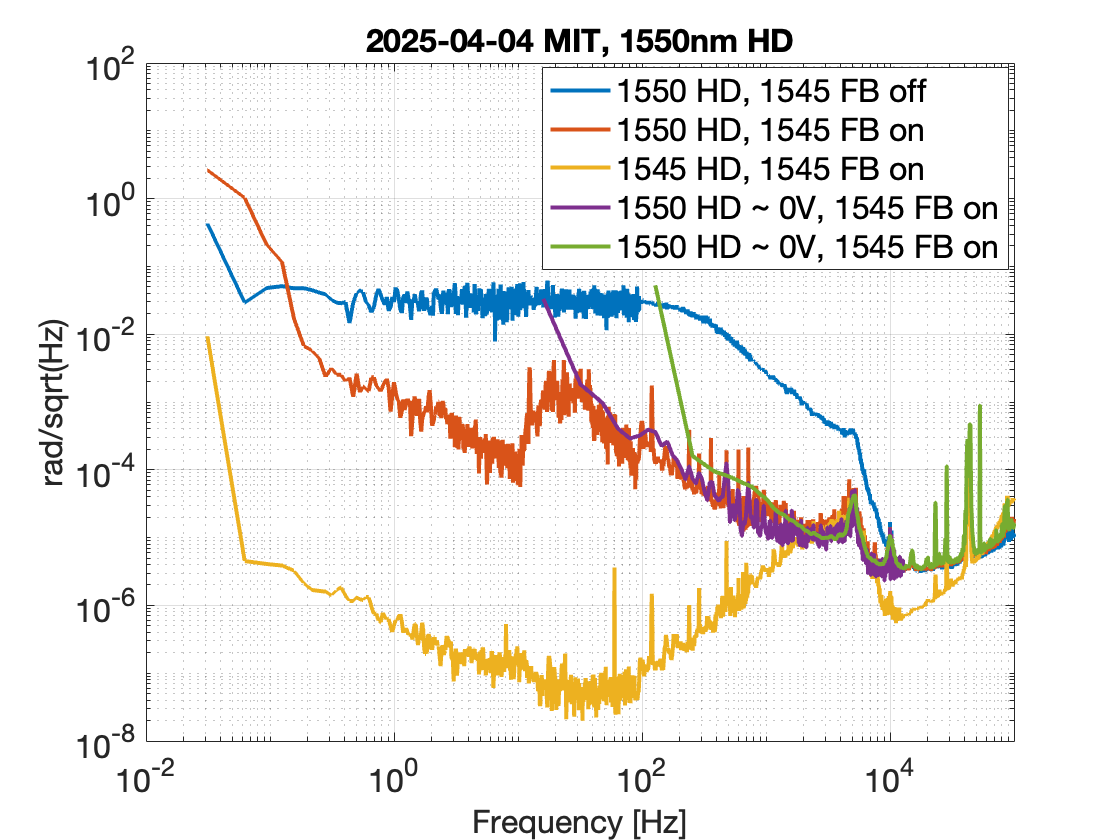
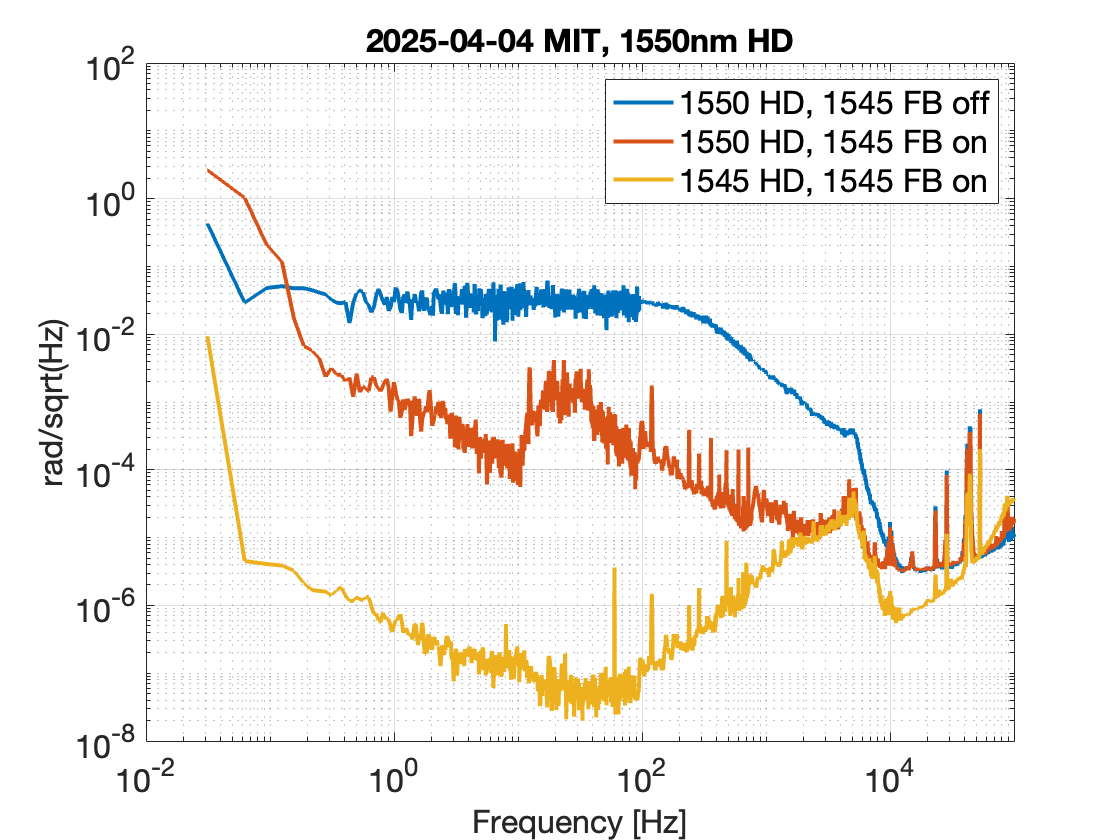
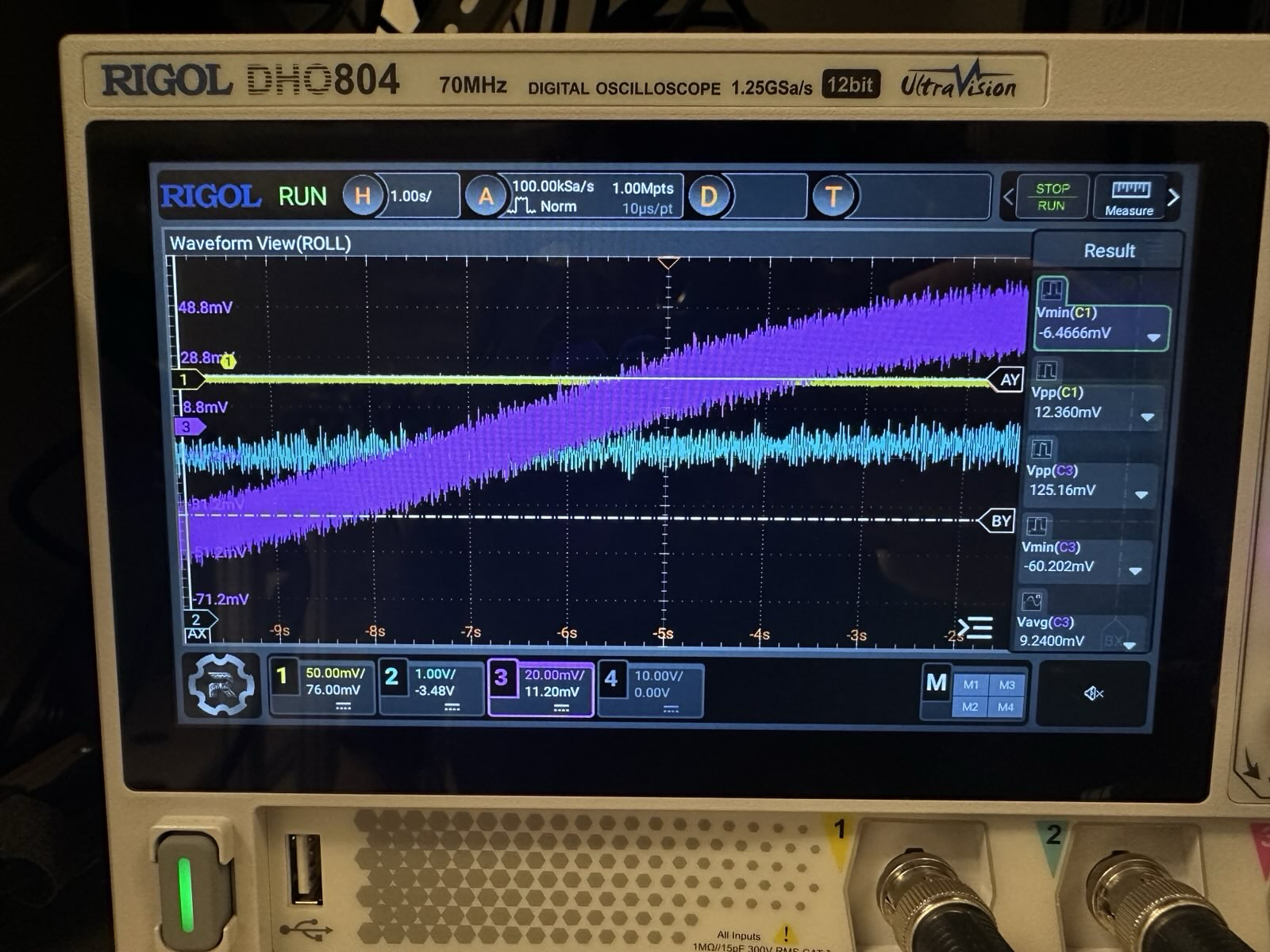
We measured the 1550 nm HD spectra, with the 1545 nm feedback loops (VCO + PZT stretcher) off and on, attached here. The noise falls below ~10^-2 rad/sqrt(Hz) above 0.2 Hz. The acoustic peak around 5 kHz shows up around the same strength for the 1550 nm noise and the 1545 nm with the feedback on. It is worth talking about the calibration for the 1550 nm noise units from V/sqrt(Hz) to rad/sqrt(Hz). The attached plot shows the 1545 nm HD readout signal in yellow and 1550 nm HD readout signal in purple. There is significant drift on the 1550 nm HD readout signal with the feedback on, so the calibration varies between Vpp/2 and 0. In the plots presented here, all 1550 nm HD signals are calibrated with Vpp/2 factor, corresponding to the lower limit for the noise curve. To see the effect of this calibration drift, we also took faster measurements (102 kHz bandwidth, and 10 kHz bandwidth on SR785) when the 1550 nm HD signal is ~0 V. The attached plot shows these measurements with purple and green traces. The high frequency portion of the composite measurement for 1550 nm signal matches well with these. I will add acoustic shielding boxes around the fiber spools, which will also act as a temperature enclosures. This should help with the stability. We are waiting on the new fiber strecher with broader range and lower pzt capacitance (11823). This will affect the low frequency noise suppression.
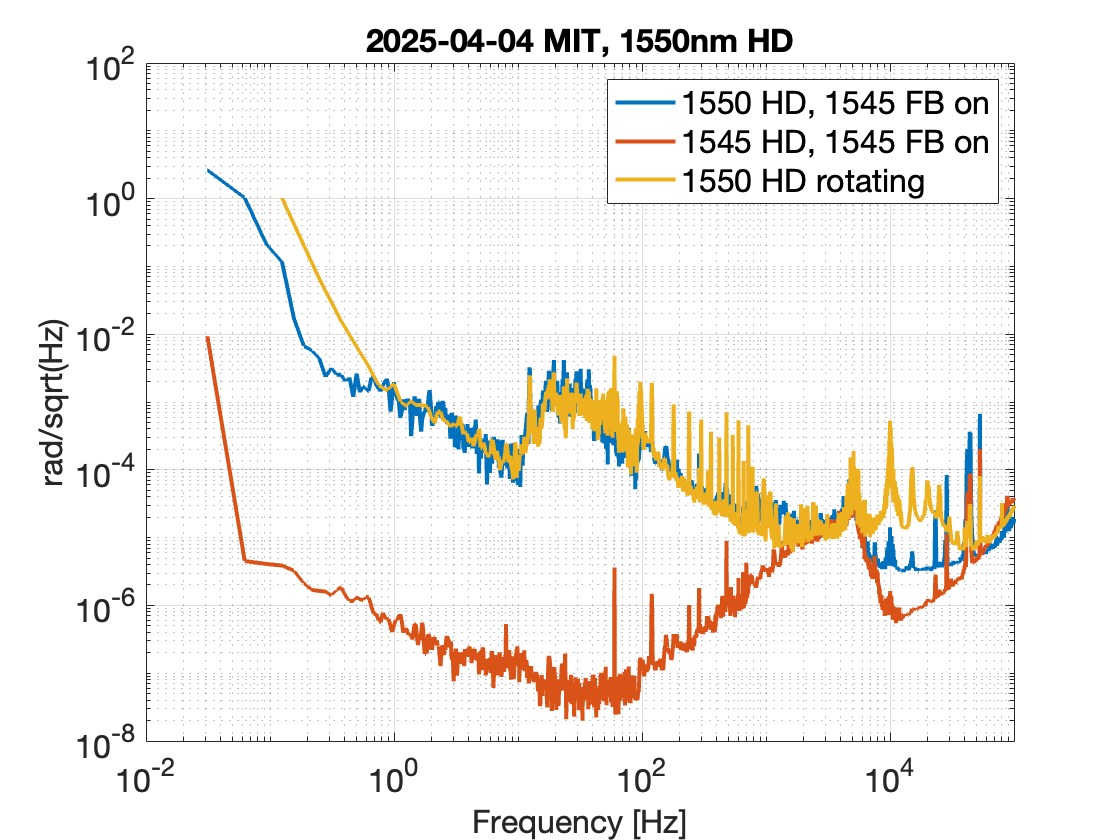
I also measured the 1550 nm HD spectra, while rotating the MZ arms to 340 degrees and back. The attached plot shows the composite trace measured during rotating in yellow. I slowed down the stage to a maximum of 1 degrees/s, which seems to have helped with the acoustic coupling I saw before with the 1545 nm signal, see here for past measurement. Noise injection due to rotation is more apparent >10kHz for the 1550 nm trace.