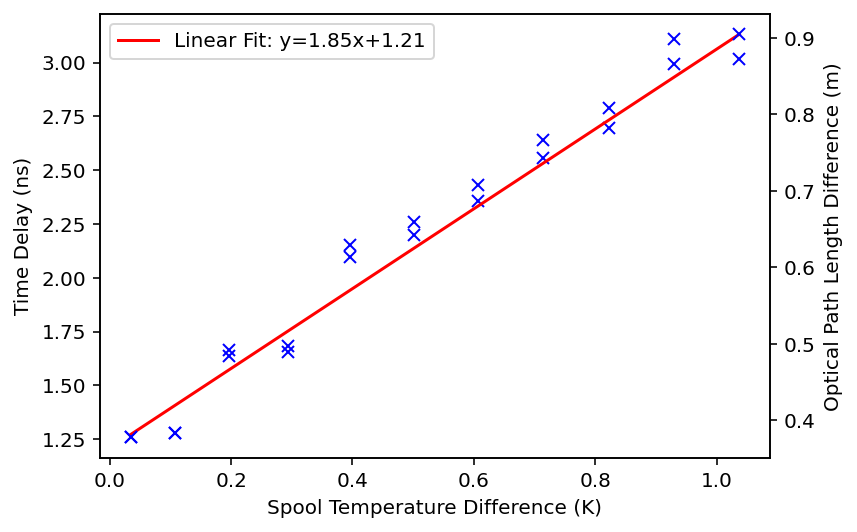
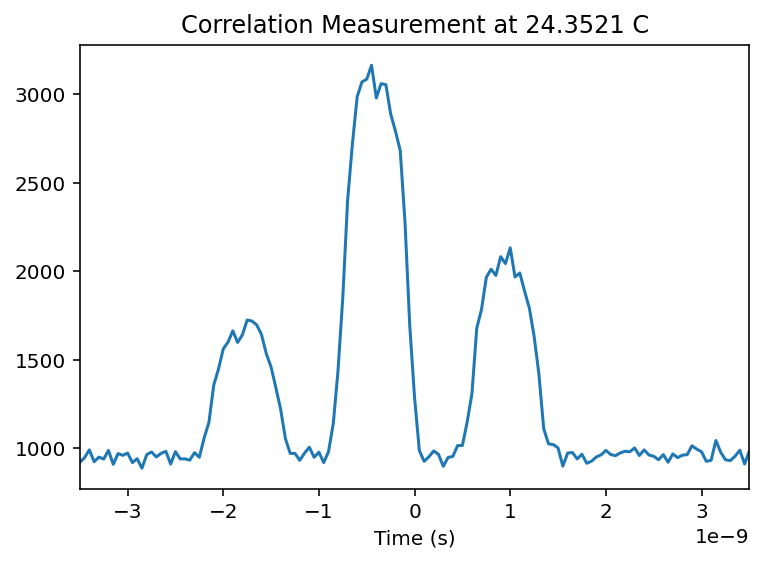
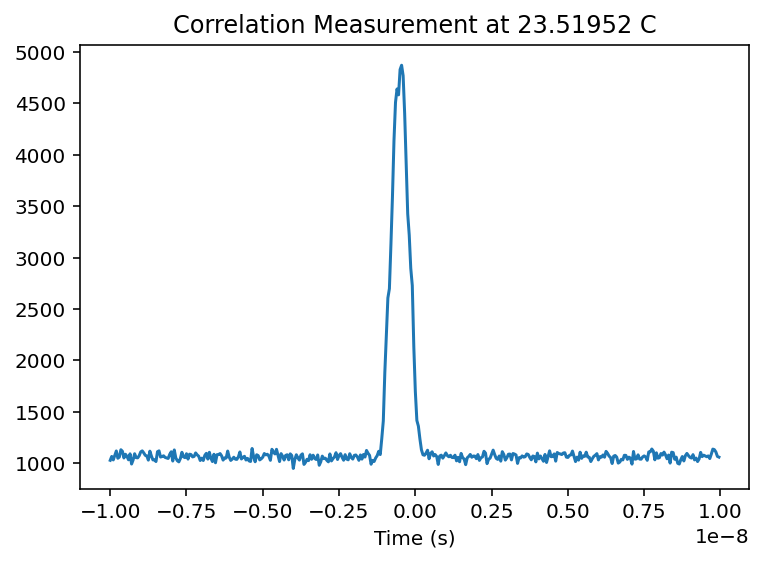
Over the past week we've been working on using temperature control to length match the spools. We measured the optical path length difference as a function of temperature difference between the two spools over a full degree, letting the spools thermalize for about 2 hours after every increase of .1K (fig.1) and found a very linear relationship between the temperature difference and optical path length difference between the two spools. I used these measurements to roughly calculate what the temperature difference should be to match the path lengths. We did this this way instead of just walking the spool temperatures because (1) it required less active work once the remote interfaces with all the instruments were cooperating, and (2) because the peaks on the correlation plots have significant width, so we need to do some amount of interpolation to get as close as possible to matched lengths-- the side peaks caused by the mismatch (visible on fig. 2, for example) will not always be visible as they could disappear inside the width of the main peak. After allowing the system to thermalize overnight, the correlation measurement shows a large improvement-- the side peaks appear to have disappeared (fig. 3). Note that the temperatures referenced in the plot titles refer to the temperature of spool 1 when the correlation measurement began.
The temperature of spool 2 (which was kept at the same target temperature during these measurements) doesn't seem to be perfectly stable, but changes a few hundredths of a degree over the course of hours. We could make this length matching more robust by: (1) consistently tracking the temperature difference and adjusting the set temperatures, (2) using regressions or a transfer function (rather than hand calculations) to determine the expected steady state temperatures of the spools themselves with relation to the set temperatures on the controllers, and (3) using regressions (rather than a hand calculation) to determine the ideal temperature difference between spools. I'll probaby implement at least (2) and (3) in the near future as both should be fairly simple with the amount of data I've already collected.