eoelker - posted 11:10, Monday 17 February 2025 (11890)
Reduction in Losses and Improved temp stabilization [Vienna]
[Tom, Dorotea, Eric]
Last week we made some extensive improvements to the optical and thermal control setups to reduce loss and improve thermal stability. We hope that this will improve our stability in the 1-50 mHz band and enable us to start making low loss single photon and NOON state measurements with the setup. We did the following:
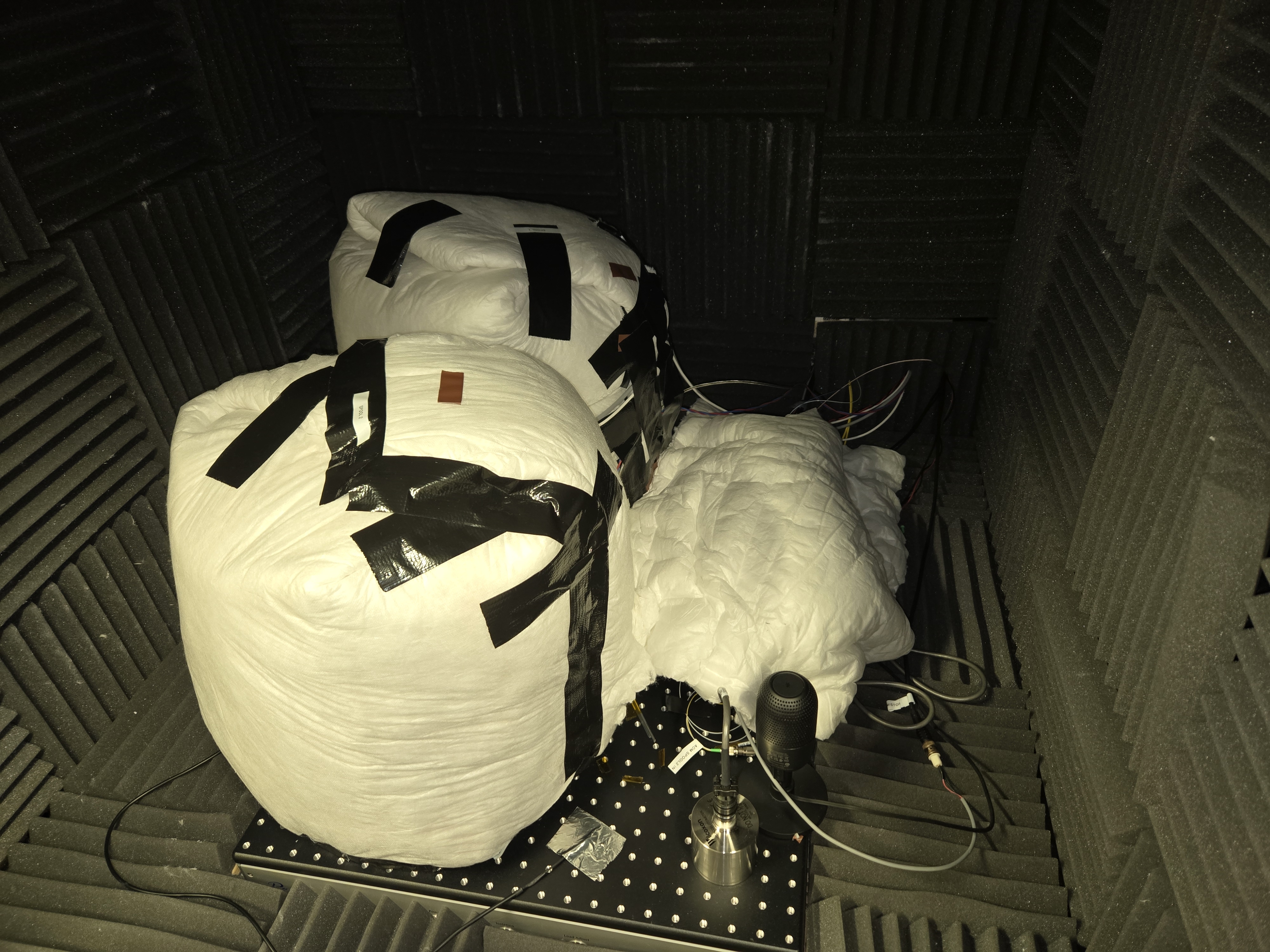
- We added additional thermal insulation to both spools. We also decided to put all of the additional fiber components onto an aluminum plate with an actuator and thermistor for temperature control. Tom ordered a new temperature controller that we will use to stabilize the plate. See this photo of the new setup. Since saturday, both spools have settled and are showing fluctuations of <0.5 mK over each 12 hour measurement with the multimeter.
- When we unwrapped both spools, we improved strain relief for the fibers going into the pods. This was the primary source of loss in the two spools. Now both spools have roughly 12% throughput, closer to what we'd expect based on the 0.18 dB/km loss quoted in the datasheet for the Corning SMF28-Ultra fiber.
- We removed the 99/1 beamsplitters that were previously used for power monitoring. The power has been quite stable in the stationary setup over the last few months and we don't think we need this monitor anymore.
- The DWDMs were moved outside of the box. They are not phase-sensitive components since they come before and after the interferometer to combine/separate the two wavelengths. Dorotea and I set them up on the optical table outside the box.
- We added polarization paddles on both the 1542 and 1550 nm inputs to allow us to optimise the contrast of the interferometer outside of the box. We optimised this to significantly improve the fringe contrast on both homodynes.
Now the total throughput at 1542 nm is above 5% when measured after the output DWDMs. Previously, we were getting only 2% throughput, so this is a significant improvement. Next, Dorotea and Tom plan to begin setting things up for more serious single photon and NOON state measurements. Peter has optimised the type-2 source and we can begin this week.
Images attached to this report