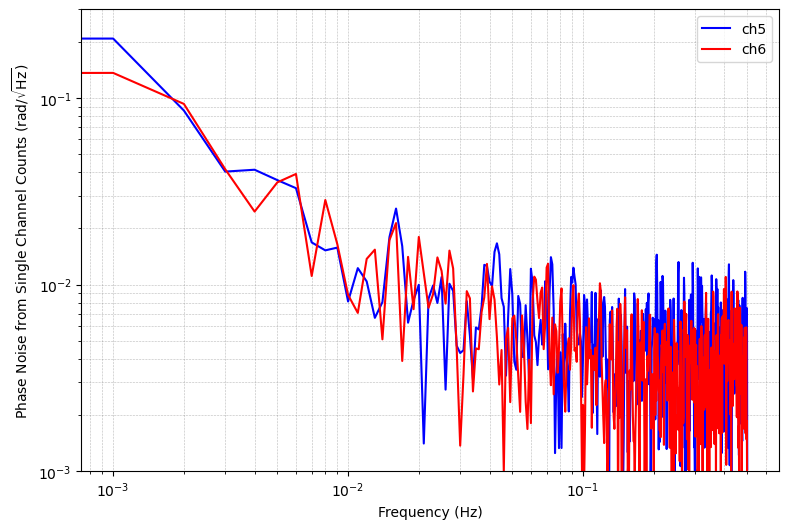
I've been looking into all things temperature since arriving in Vienna. A few points of interest:
- Maintaining a stable temperature is essential for keeping the phase constant at 1550 nm when we lock at 1542 nm. We are seeing roughly a 100 rad/Kelvin coupling from spool temp to the phase measured by the 1550 nm homodyne (or equivalently by the single photon readout) when we are locked at 1542 nm (see this measurement, for example). From the PZT voltage reading, we can infer that the coupling when the servo is unlocked is rougly 1e6 rad/Kelvin, so the length servo leaves us with a 10-4 coupling of unsuppressed fluctuaions. That's a plausable number given dispersive effects in the fiber.
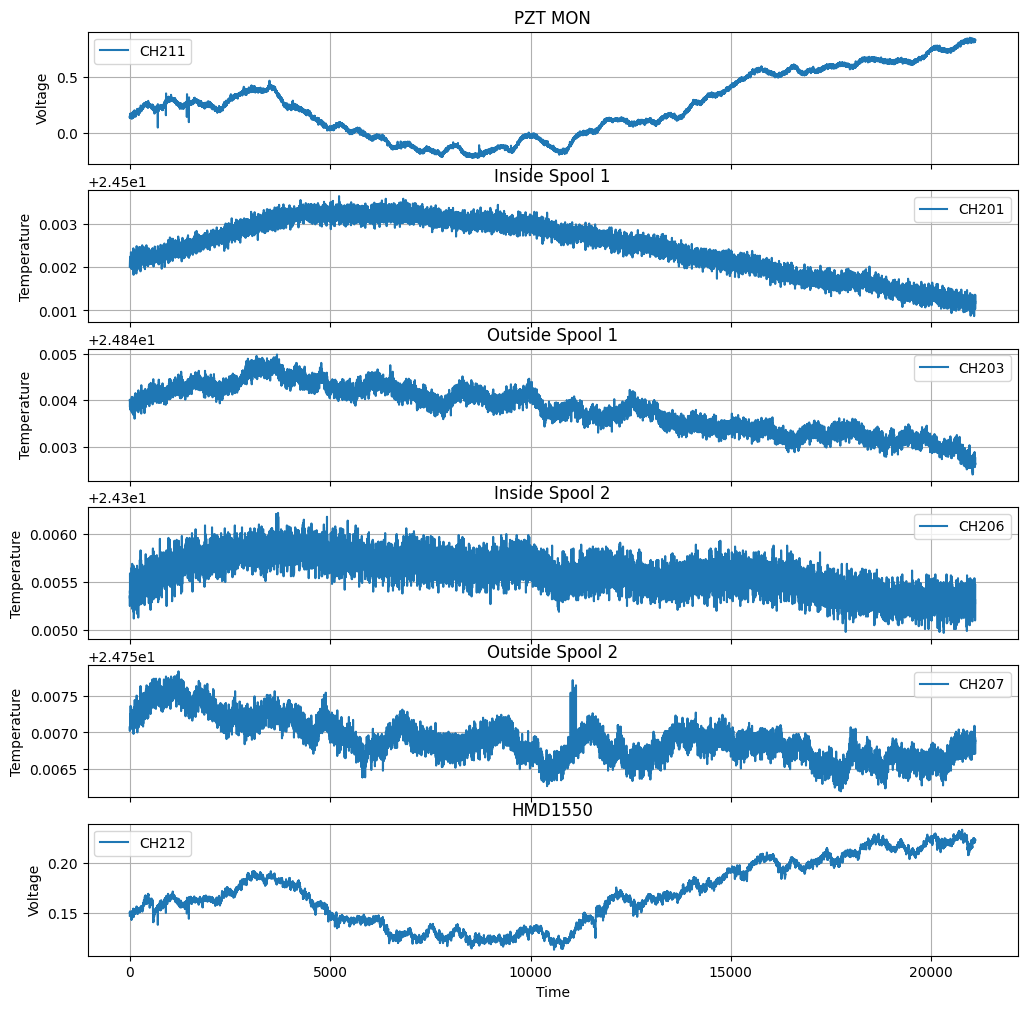
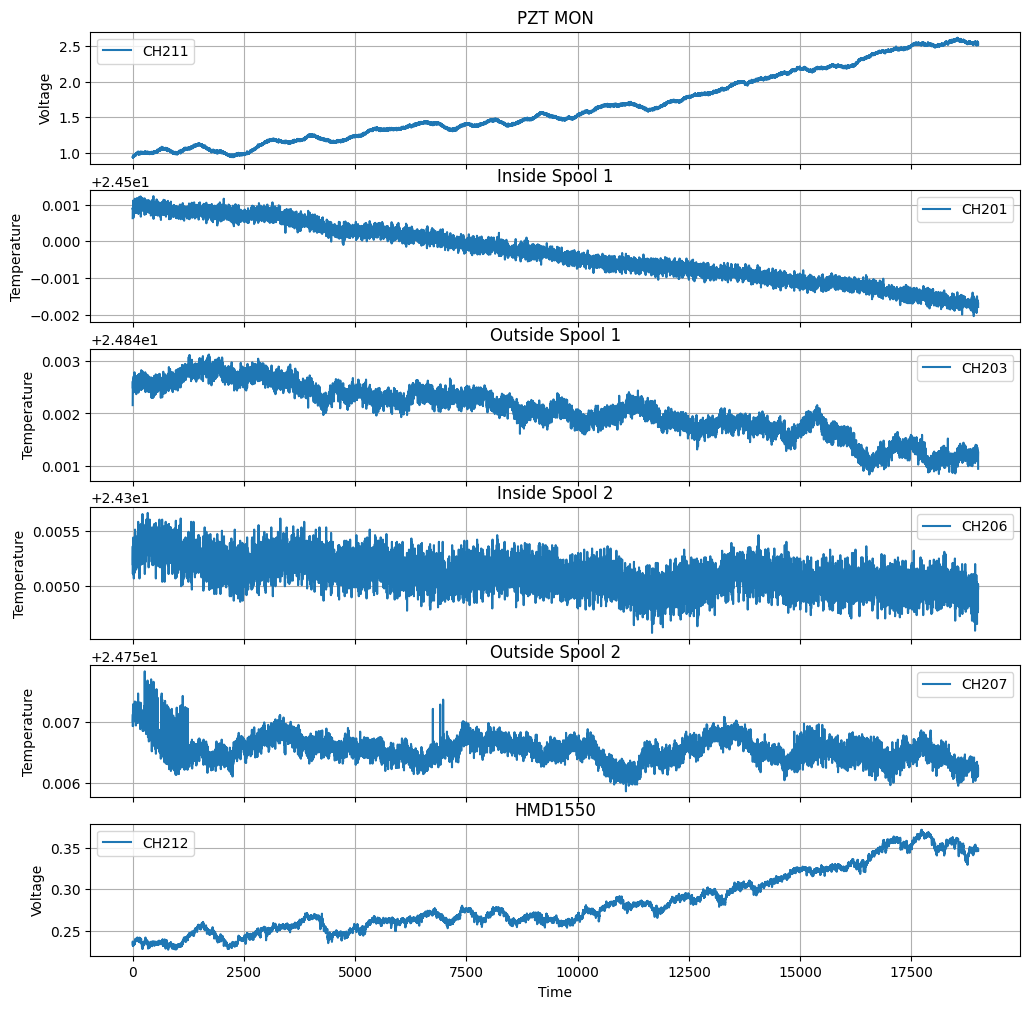
- When I arrived, it appeared that our temperature sensors on the second spool weren't making sense. I tracked this down to a pair of non-working channels on our multimeter multiplexer. After switching channels, it looks like spool two is actually remarkably stable, fluctuating by less than 1 mK over 12 hours: Meas 1, Meas 2.
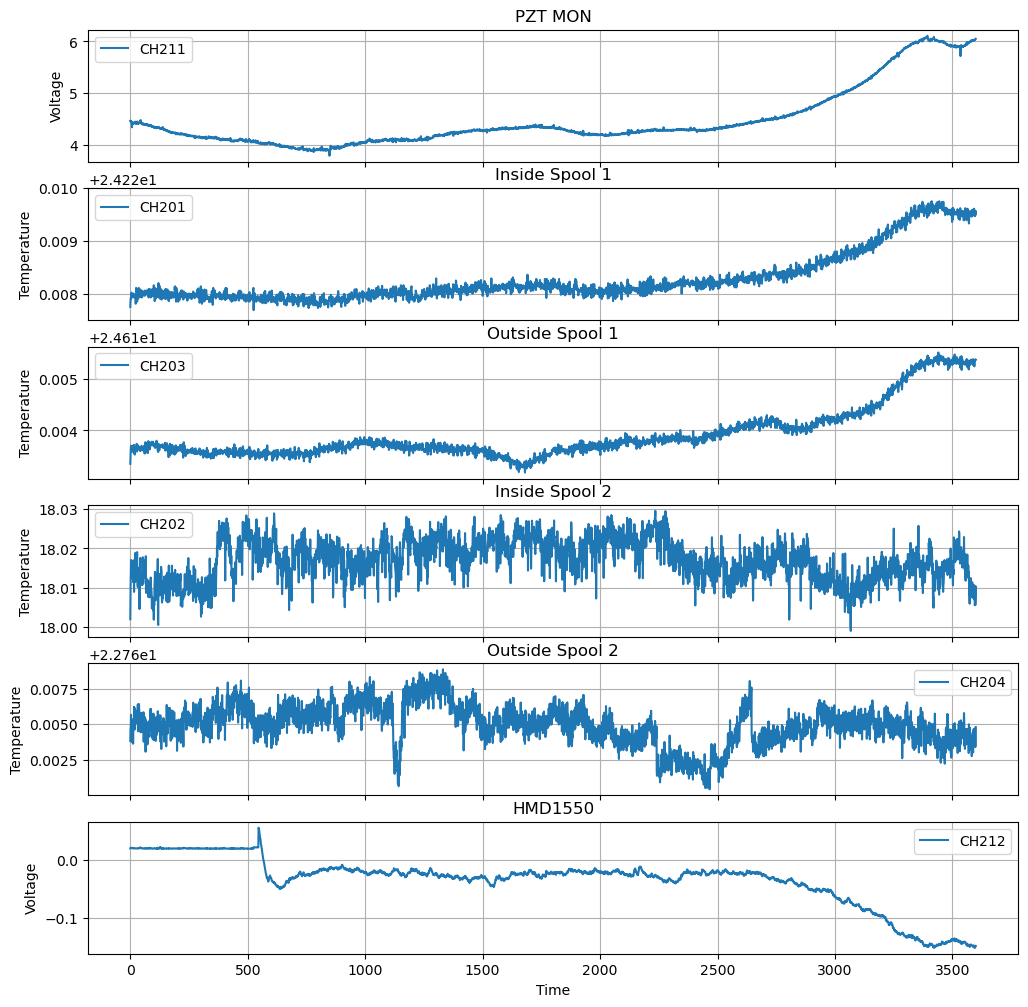
- Spool 1 still frequently sees few mK temp swings that are correlated with the phase shifts we observe at 1550 nm. Calibrating these temp spectra, this seems like a plausible source of our remaining noise below 100 mHz. Compare with Haocun's recent single photon measurements, for example. I'm not seeing perfect coherence with the 1550 nm homodyne output, so this isn't the whole story. Still, it seems like something worth addressing
- Haocun had previously added more insulation to spool 2. I opened the box today to add a similar amount of extra insulation to spool 1. We'll see how that goes.
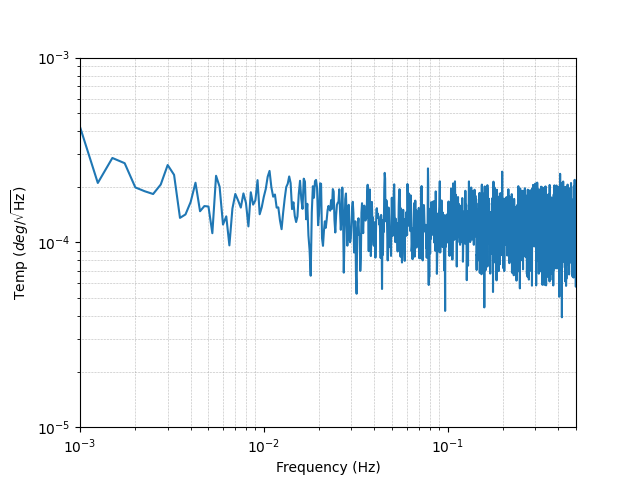
- Based on our measured coupling coefficient, we need something like < 50 uK/rtHz of temp fluctuations to be below our expected shot noise level for the single photon readout. Currently, even spool 2 appears to be above this. I suspect that this spectrum is limited by the noise floor of the multimeter multiplexer card. I will remeasure on Monday with the front input on the Keithley which has lower noise.
I'm on the fence about the best route forward. I've achieved much better stability with good thermal filters under vacuum, but that will be somewhat cost and labor intensitve to implement. We're already quite close, so we might be able to get away with staying in-air. I think we need a bit more experience with thermally length matching the two spools to make sure that process is robust and reproducable when done in air. This absolutely essential for doing the measurement. I think this is likely to be the deciding factor.
This week, I've been designing new copper pods for our vibration-insensitive fiber spools that should be much easier to stabilize than the current (poorly designed) aluminum pods we're using at present. All components will be vacuum compatible so we can go that route if we decide to. One actually needs a fairly decent vacuum to achieve good thermal isolation. We plan to do a pump-down test with the chamber Chris bought to see what sort of vacuum we can achieve here. Hopefully the blank flanges will arrive soon and we can complete the test before I leave.