I did a series of measurements to study how temperature fluctuations of the 50km fiber spools influence the interferometer arm length difference, i.e. photon travel time difference. The goal is to measure the actual coversion coefficient of temperature fluctuation noise to length/phase noise in the noise budget, and to prepare for using temperature to control arm length difference in photon measurements.
1550nm HH entangled photons are sent into the MZI through one of the inputs (the same one used for senting the 1550nm CW laser), and two outputs are directed to photon detectors. When there is a length difference (greater than the photon coherence length) betweent the two MZI arms, three coincidence peaks appear in the photon histogram. The time difference of the two side peaks from the center peak tells the photon travel time difference in the two arms.
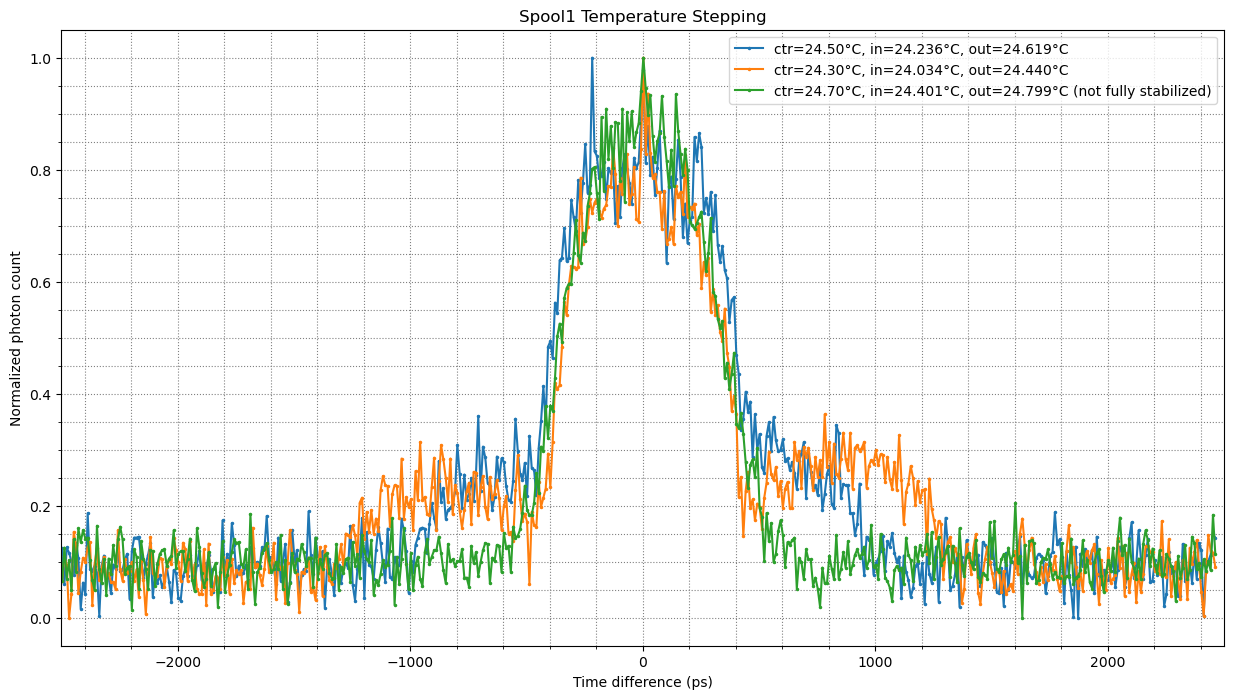
Fig. 1: Spool1 temperature stepped to different temperatures. [inner spool, 24ohm heating resistor]
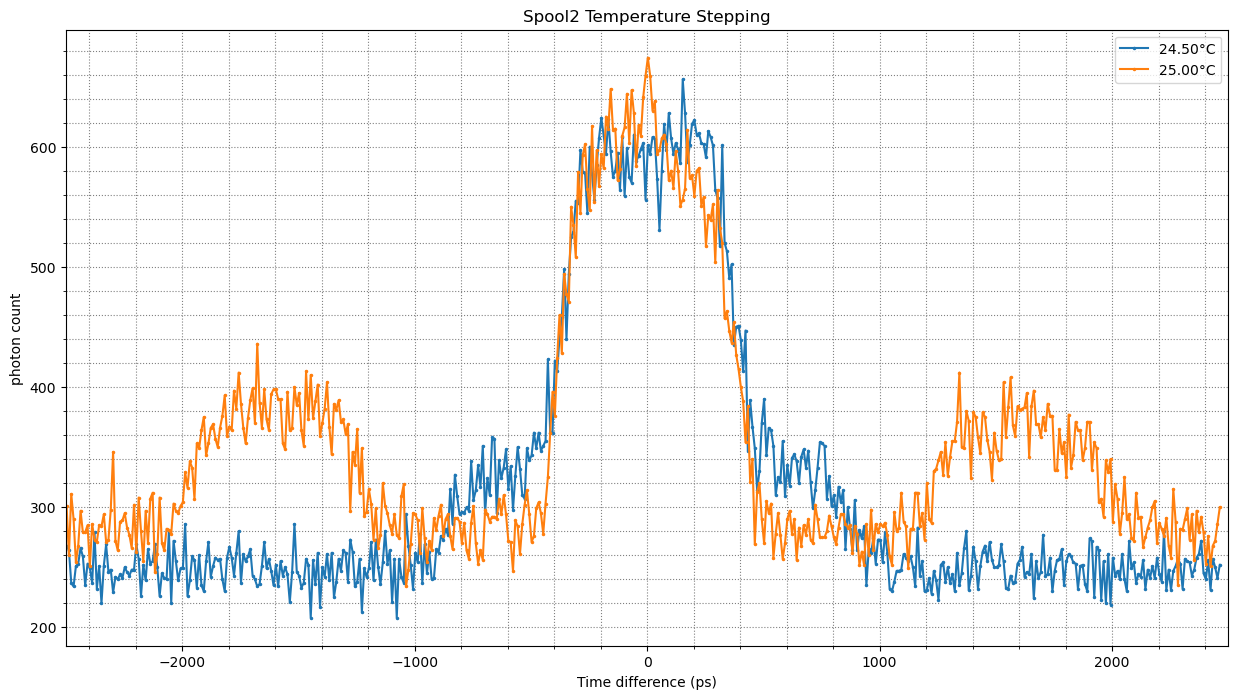
Fig. 2: Spool2 temperature increased by 0.5°C. [outer spool, 16ohm heating resistor]
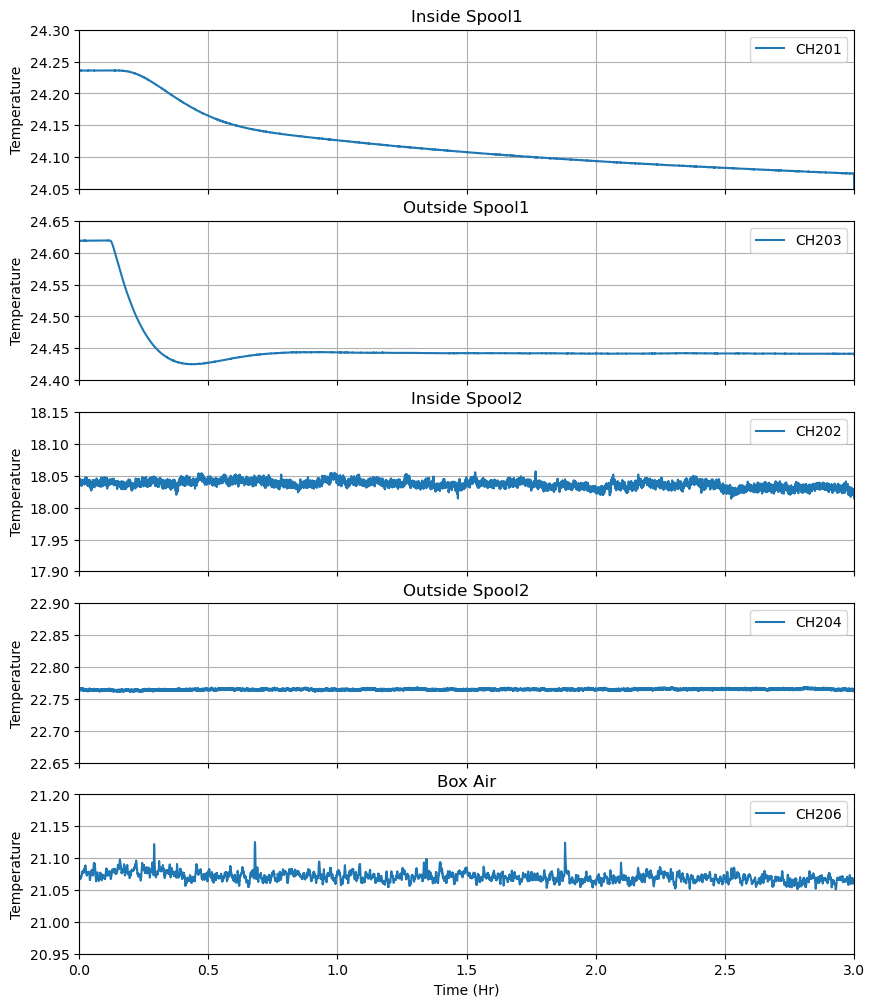
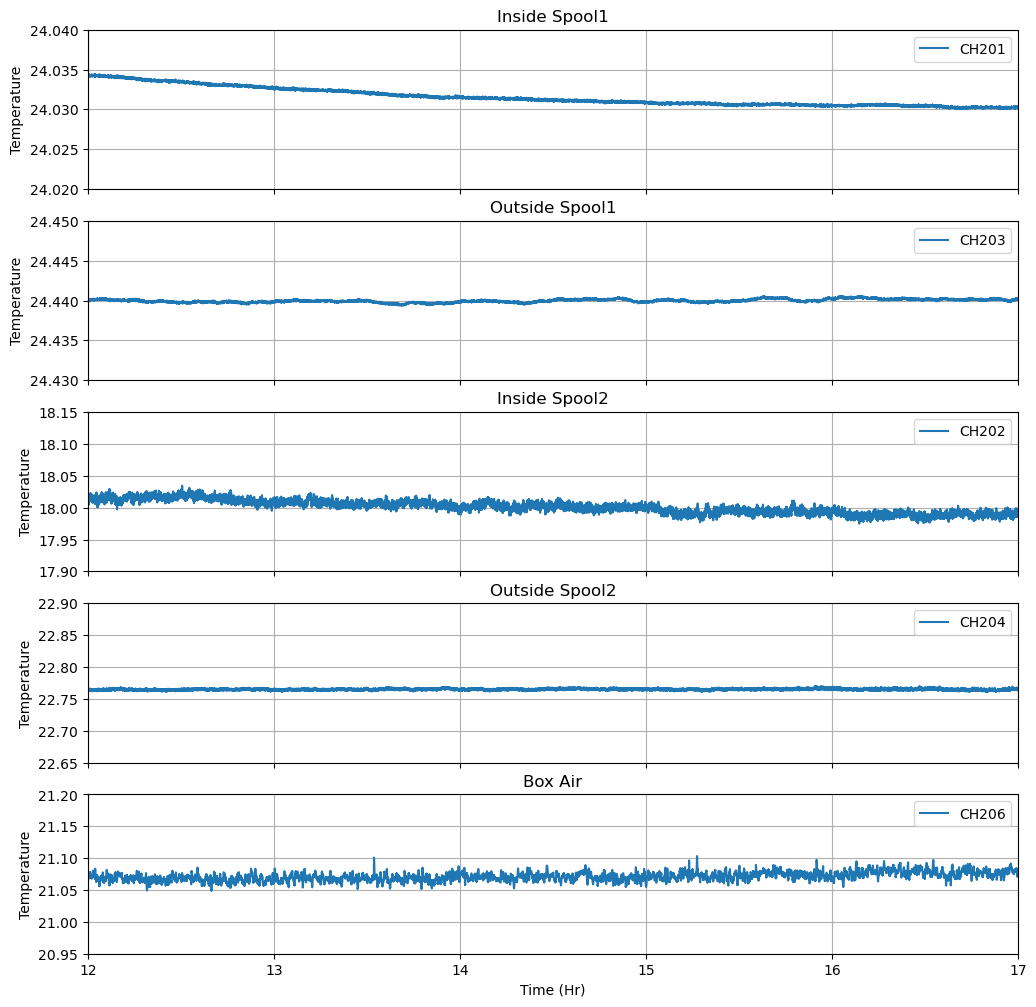
Fig. 3 & 4: Readings from inside and outside out-of-loop temperature sensor of the two spools with Spool1 temperature reduced by 0.2°C. Note that it took ~17 hours for the temperature inside the pot to fully thermally stabilize to 1mK (we need better design for future spools). The out-of-loop sensors of Spool2 appear to be not working/poorly attached.
The resulting coeffifcient is approximately 0.8~1e-5 (dL/L)/K, which is roughly consistent with dn/dT for optical fibers, which is the dominant factor in these plastic fiber spools. This translates to a change of 40-50cm/K, and we should be able to find the photon interference (0.5cm coherence length) by tuning the temperature to that 10mK range. A side note: These coincidence peaks arequitewide (~800 ps), which is 40-50 times of detector jitter (timing jitter < 18 ps per photon detector spec), not sure whether that is from interferometer noise or some kind of dispersion, need some further investigation.