denis.martynov - posted 04:35, Thursday 26 December 2024 (11848)
C6D transition into the 1000-sec mode and noise analysis
Once C-6D is transitioned to the low-noise state (or into the medium noise state in our case with the RZ offset), it can be transitioned into the 1000-sec mode. This implies that all angular control bandwidths are reduced from 0.1 Hz down to 1 mHz. We run C-6D in a high-control bandwidth during the installation and pump down. Once in a quiet environment, we need to float the mass above 1 mHz for the ISI control. We steel control the mass below 1 mHz because it may drift over time. Another key difference between the 1000-sec and 10-sec modes is that we utilise only LPS signals in the former regime and shadow sensor signals in the latter. The transition implies that the BOSEM's shadow sensor noise is no longer injected into C-6D.

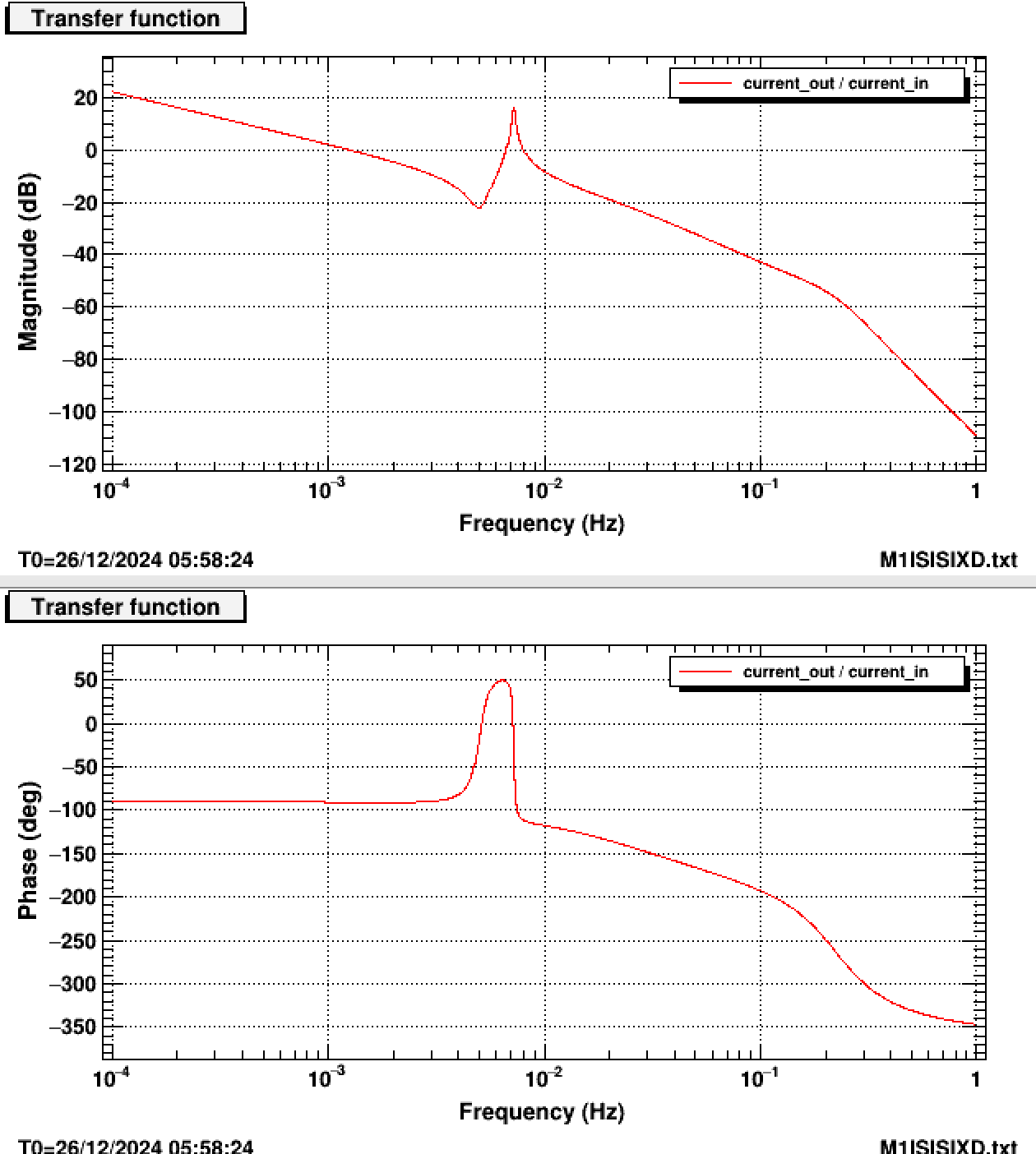
The first attached figure "RX_OOL" shows the estimated open loop transfer function of the RX degree of freedom. The servo has two goals: control the mass below 1 mHz and reduce the tilt's Q-factor. In Birmingham, we had a simpler 1/f servo because the Q-factor was only 5. However, since we now use monolithic spacers glued by a thin layer of EpoTec, the Q-factor has increased up to 125. There is another benefit of monolithic spacers regarding classical temperature noise as will be discussed below. Since the rind-down time is 1.5 hours, I have modified the servo to include the damping term for the tilt modes and reduce their Q-factor down to 5-7.

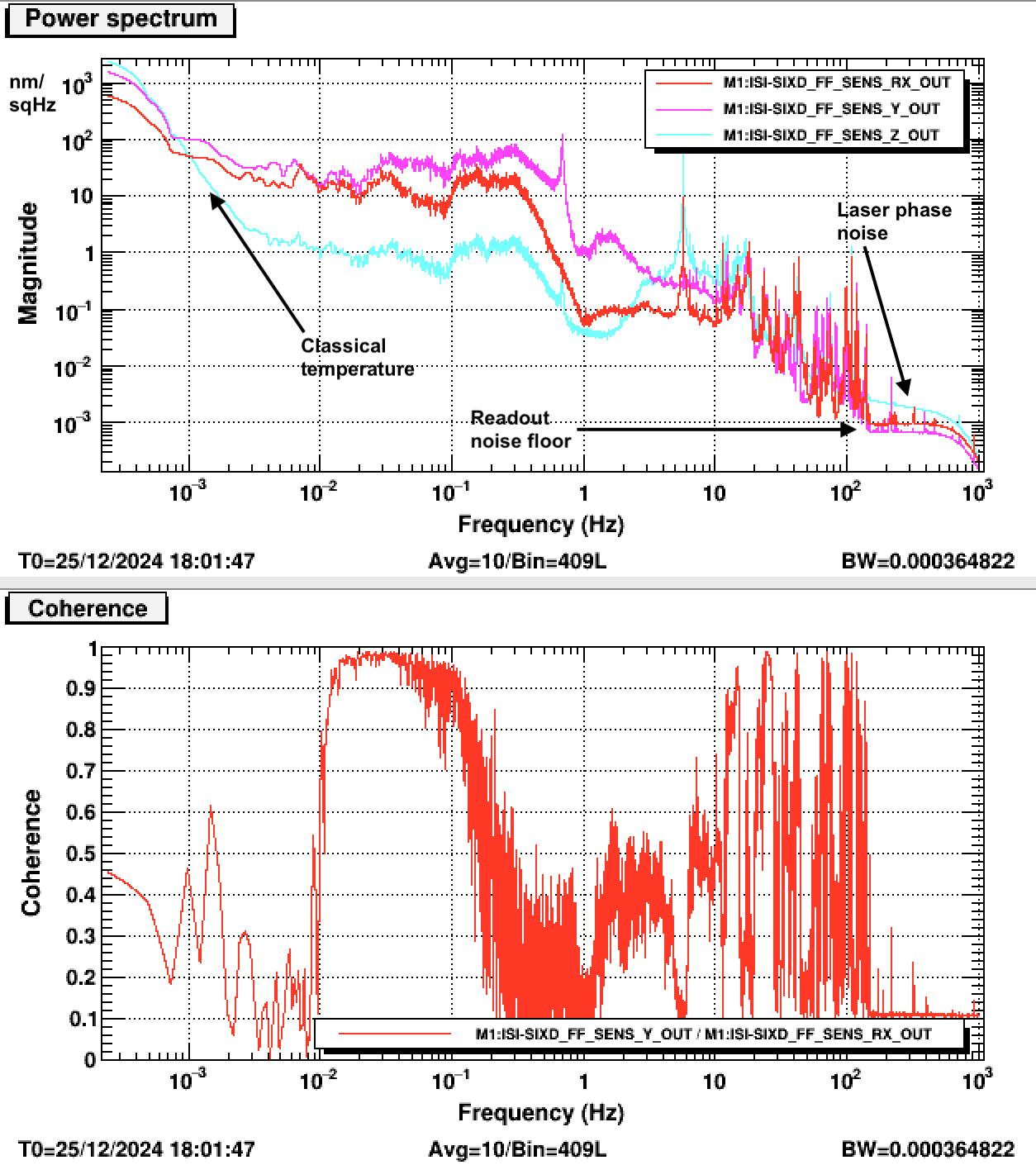
The second attached figure "RX_Y_Z" shows the spectrum measured by C-6D in RX, Y, and Z degrees of freedom. The units are nm/sqHz. There is a high coherence between RX/Y at 10 - 100 mHz that implies that the sensor measures the ground tilt in this frequency band. Above 150 Hz, the signals are limited by the readout noise from LPS. The Z degree of freedom sees the free-running DFB laser noise above 150 Hz (FITEL-FRL15DCWD-A82-19030-C 61408A02). The laser has a ~1 MHz linewidth. The noise is low-passed above 700 Hz to facilite demodulation of the laser modulation harmonics at 1.65 kHz. The noise reaches the level is ~0.7 pm/sqHz at the modulation frequency and then downconverts to lower frequencies. Note that only Z and RZ see the raw laser frequency noise at high frequencies. Other degrees of freedom, including RX and Y are insensitive to the laser phase noise because they subtract signals from different sensing heads and the matrix elements add up to zero.

The third attached figure "C6D_RX_NB" shows an estimation of the RX sensitivity. I utilise the Y-axis signal to estimate the platform tilt and a simple g/omega^2 coupling coefficient. Despite being coherent at 10 - 100 mHz, the tilt estimation does not fully overlap with the RX measurement. I think this is due to the active control of the plantform and the coupling coefficient should take into account the platform actuation with existing GS-13 blends. I think the RX sensitivity below 10 mHz is limited by the H1 actuator noise (that is still in the medium-noise state). I estimate the noise by assuming the coupling factor of 1:6 from H coils to V. I estimated this coefficient by redistributing the RZ control signal among different H coils and measuring the response in V coils.

A positive outcome of the measurement is the observed sensitivity below 4 mHz. In Birmingham, we were limited by the classical temperature noise at the band as shown in Fig 3 of arXiv:2405.13475. The noise level observed in the current version of C-6D is a factor of 100 less than in the previous one at 1 mHz. This is even without the C-6D thermal shields that we did not have time to install. There are two key factor that are now different: vacuum tank and spacers. First, I looked at the vacuum temperature fluctiations. The fourth attached figure "Temp" shows the comparison of the temperature noise in Birmingham and Lasti (the thermisters are on the C-6D frame and on the ISI). The latter noise is better by a factor of 4-7 (red vs blue). I think the residual improvement of the noise comes from the monolithic spacers as discussed above. In Birmingham, we utilised spacers that consisted of several 6.25 mm blocks glued together with Araldite 2014 II that likely tilted the mass during temperature fluctuations. We also had the stock glued to the triangular plate with the same epoxy. We now utilise a monolithic assembly instead.
Images attached to this report
Non-image files attached to this report
