
denis.martynov - posted 03:36, Wednesday 25 December 2024 (11846)
C-6D assembly
Amit, George, Lari, Peter, Rich, Den

On Dec 9 - 17, we have assembled C-6D and installed it on the HAM-X ISI. A few notes related to the installation:

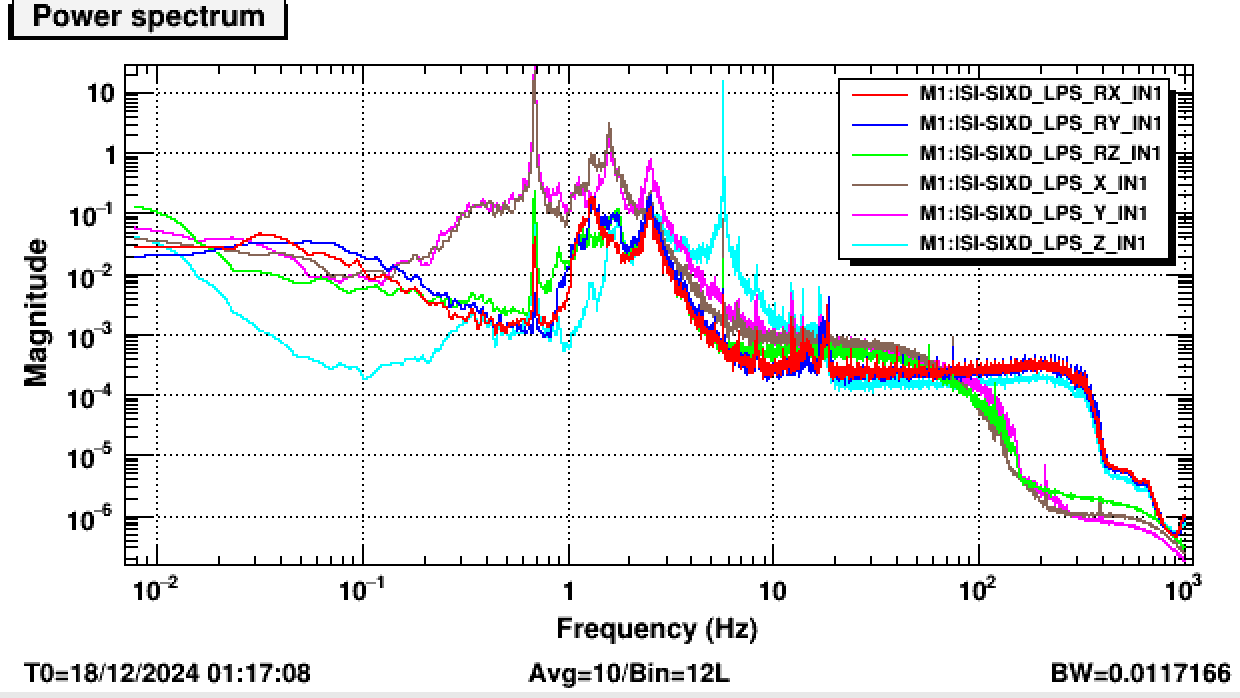
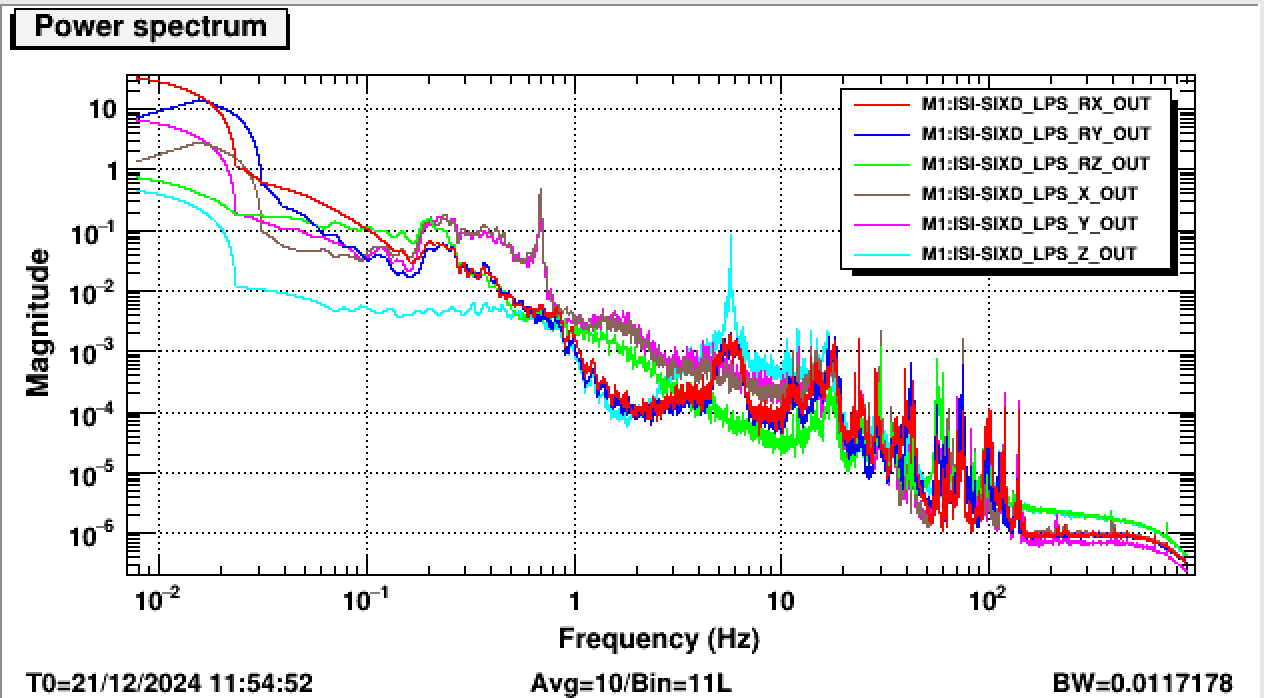
* C-6D consists of a fused silica mass with a diameter of 50 cm suspended by a 55 cm long fused silica fibre. The position of the mass is monitored with 6 BOSEMs and 6 LPS (Laser Position Sensor) relative to the ISI. X,Y modes are at 0.67 Hz, Z mode is at 5.7 Hz and corresponds to the fibre tension of 1.1 GPa. RZ eigen mode is 1.4 mHz.

* RX/RY modes are tunable by the vertical position of the centre of mass relative to the fibre's bending point. Our fibre is a bit elliptical and welded under a noticable angle relative to the anchor. This leads to a noticable nondegeneracy between RX and RY. We tuned the mass such that RX mode is at 7.2 mHz and RY mode is at 16 mHz. Importantly, the eigen modes of the fibre determine the C-6D's local coordiate system. It may not coincide with the ISI's coordinate system (see attached). It is tilted by +30 degrees in RZ relative to the ISI coordiate system. The C-6D controls work in the local coordinate system and then we rotate X,Y and RX, RY signals before sending them to the ISI model.

* The mass hosts 3 "magnetobullets" that can be moved to rebalance the tilt. Each bullet consists of a PFTE sharf with two thin aluminium disks at the ends. The mass of the assembly is 4 g. We typically need to move it by a few um to rebalance the mass. This is achieved by sending short (msec) pulses to one of the two coils installed near the aluminium disks. AC magnetic field create eddy currents on the corresponding aluminium disk and make it work as a magnet for the period of actuation.

* RZ has differente equilibrium positions in air and vacuum. We tried to forecase the effect of buoyancy by adding small masses on the inertial mass and tracking the RZ control signal but still missed the proper position of the mass in vacuum. It seems the best RZ position is its natural one before all sensors and actuators are installed. During the next vent, we should rotate the top rotation stage (that supports the top anchor of the fibre) by 29 degrees anticlockwise (looking from the top).

* During the installation, we suffered with charging noise quite a bit that we did not witness in Birmingham. It turns out that the mass charges positively (up to 2 kV / inch) and our blue suits charged negatively (up to -2 kV/inch). The white suits that we took from the bake-out lab did not charge as much. The cleanroom curtains are charged up to - 1 kV / inch. Peter and Rich found discharging equipment that has successfully reduced the charge down to +/- 20 V / inch that is within error bars of the surface voltage meters.

* Electronics did not survive the transportation very well. Lari fixed most of the damaged cabling. Remaining problems include: high-noise HAM A driver (H1 channel) does not work, actuation from V1-3 is non-linear, one of the sat amps (V1-3, H1) has a high noise level.

* C6D overview medm screen can be accessed from the main MEDM scheen: HAMX-6D window.

Attached are the first C-6D spectra with ISI isolation off and on. The units are um/sqHz as measured by LPS. GS-13s are in loop for the isolation. Next steps should include transitioning C-6D to the low-noise state and stabilise the ISI relative to C-6D.
Images attached to this report
Non-image files attached to this report
