
Jacques, Melissa, Hudson
Motivations:
- The CLF power at the output of the BOPO is unstable over seconds, whether the BOPO is in parametric amplification (34°C) or not (23°C). The suspected issue is that we are locking on GR-IR coresonance, therefore any temperature fluctuation induces an intensity fluctuation of the CLF. Furthermore, when at the setpoint at 23°C, we stil see ~20% of parametric amplification on the CLF power over time (when it's at an effective 0 detuning), meaning that this temperature setpoint still sees a little bit of parametric amplification.
- In order to properly do the alignment and visibility assessments on the MZI, we need the BSQZ's CLF power to be stable over time.
We therefore decided to implement a dither lock loop on the BOPO, similar to the one on the CSQZ, in order to decouple the thermal fluctuaions form the intensity fluctuations of the BSQZ CLF.
Experimental setup: The loop is implemented by using the RP CSQZ1.mit.edu (the same one used for the BOPO's usual PDH lock), whose input 2 is now connected to the CLF REFL PD + DC BLOCK. with maximum CLF power (90% of the fiber BS going to the CLF path), we can lock the loop. Furthermore on the PZT drive we use a 510 Ohm resistor instead of the 30 kOhm one. The code for the dither lock is in the file opoDitherLock2.py.
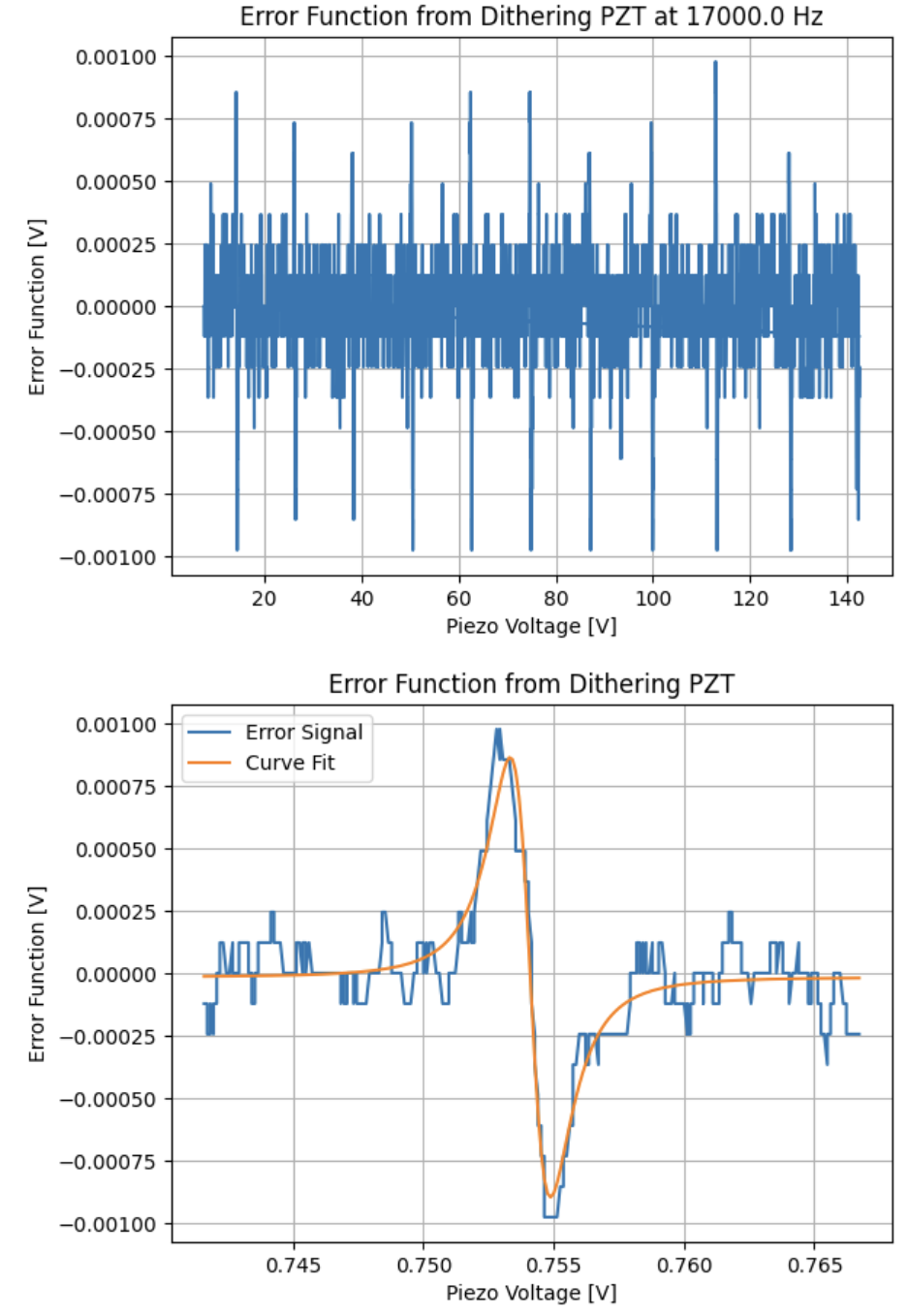
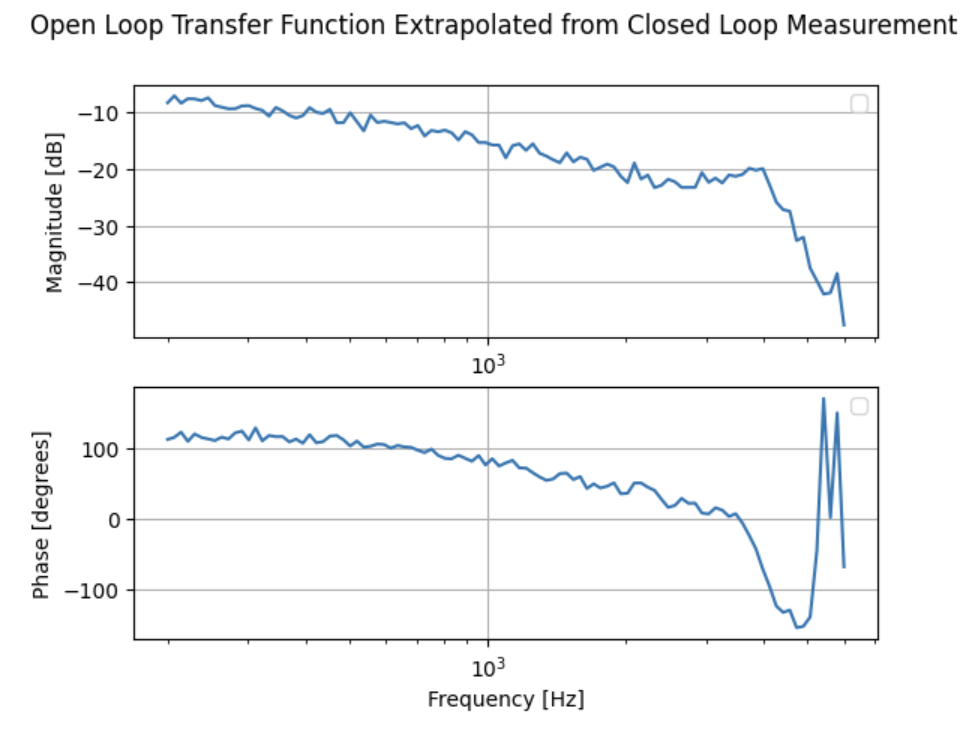
Results: The loop closes and is stable with the default parameters (quadrature factor = 1, dither amplitude = 0.01, dither frequency = 17 kHz, autogain = 1. It is a soft loop for now as can be seen from its TF here because increasing the gain seems to make the transmitted power oscillate, and we are quite close to the SNR limit on the "in2" of the RP (see error signal shape here) which sees the 17 kHz dither of the CLF REFL PD. If needs be we can always add an amplifier on this path to improve the SNR (SR560-style as the minicircuit ones don't go as low as 17 kHz).
Conclusion: the dither loop should be well-tuned enough to allow us to proceed towards sending the BOPO into the MZI and do alignments.
The dither lock only acquires lock when the CLF beam is well aligned into the cavity. This means that in alignment mode, we should keep the CLF at 15MHz detuning, but detune the LO by that same amount in order to see visibility fringes.