Inertial sensors based on an optical readout technology have been developed in Liège and Brussels, BE. The optical readout is a homodyne quadrature Michelson interferometer with an optical layout similar to a HoQI sensor.
The noise floor of the sensors has been measured in Liège through coherent subtraction of multiple sensors placed side by side. However, the nonlinear response of the readout, coupled with a test environment that has relatively high signal amplitude, limits the residual due to nonlinear noise.
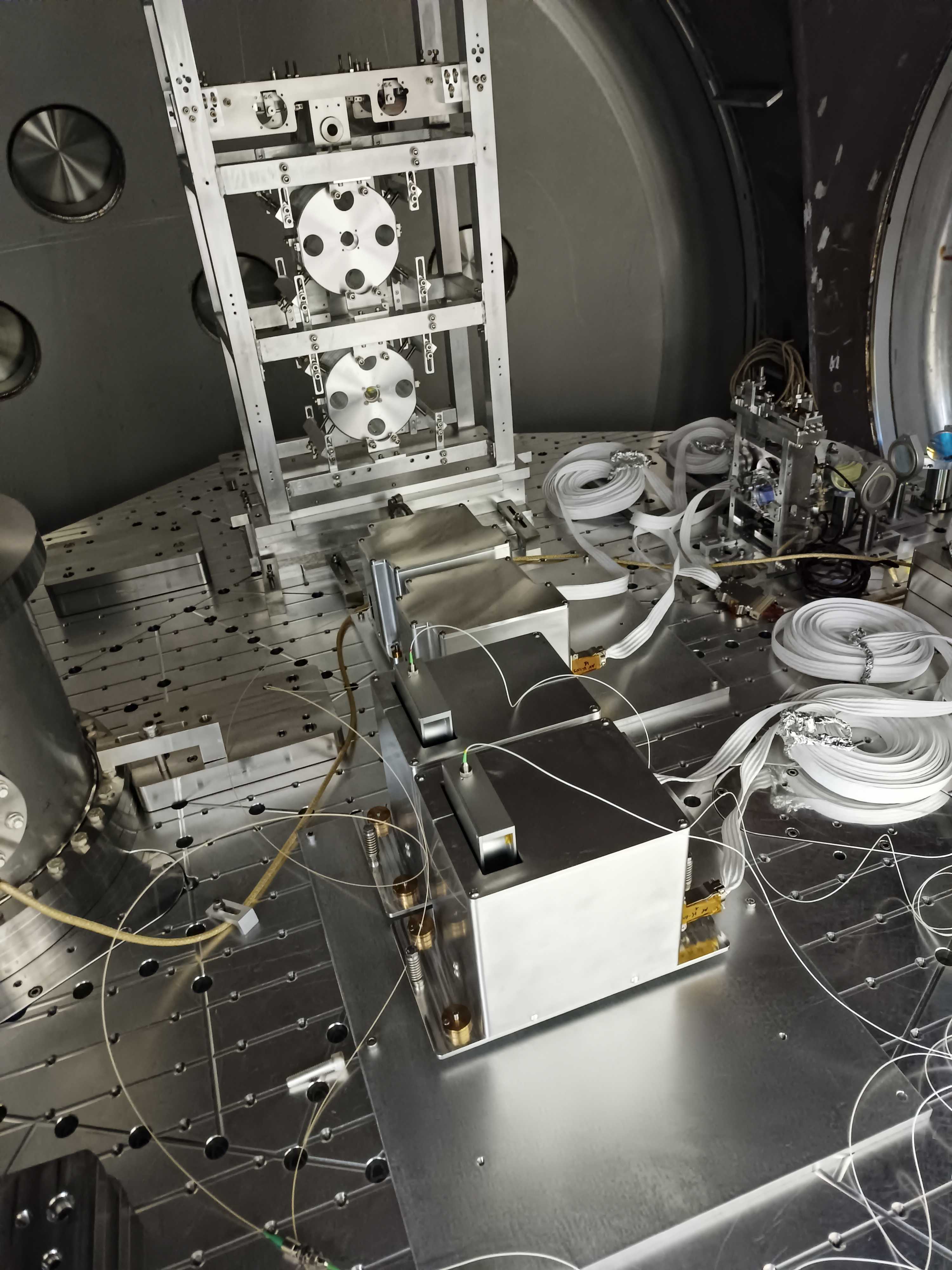
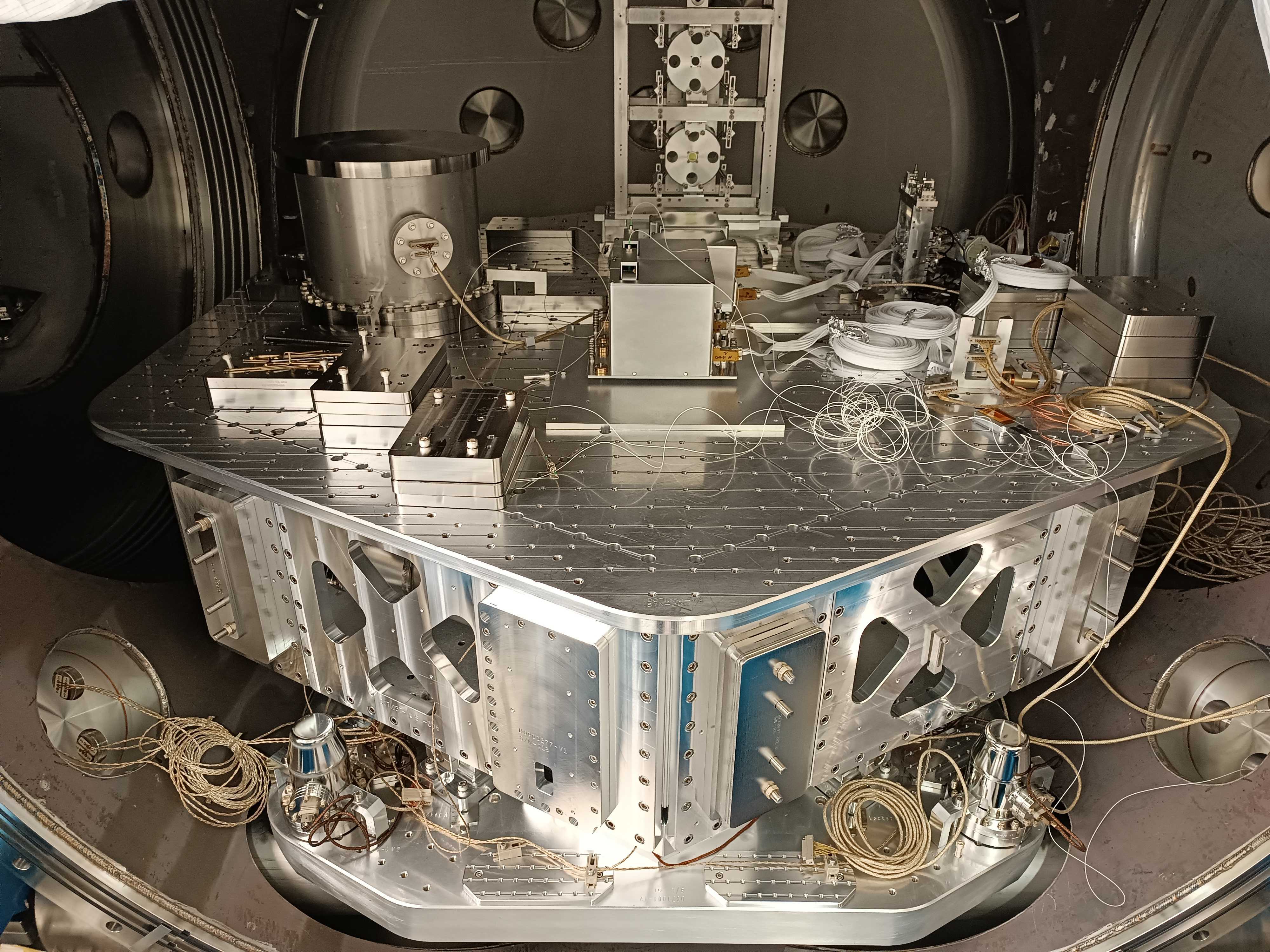
To improve the measurements and hopefully reach the predicted noise floor from our noise model, the sensors were tested in LASTI, in the HAMX chamber. The isolation performance of the HAMX-ISI table was reported in a previous entry on Thursday, 19 September 2024 (11761).
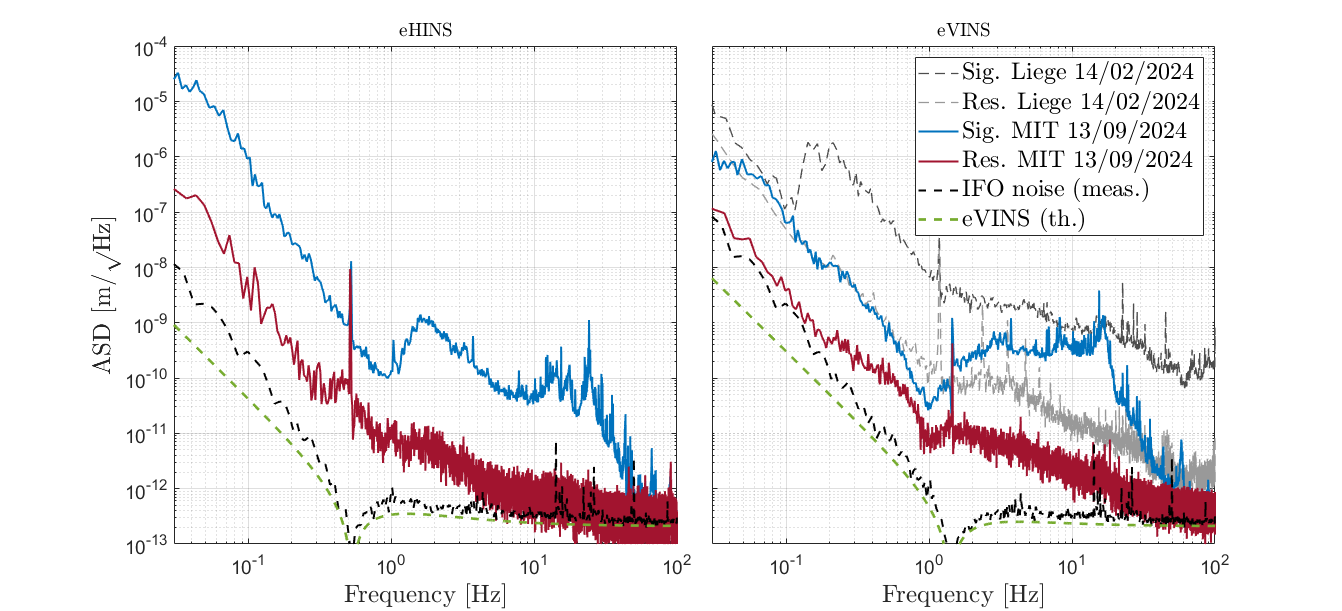
Attached are the results of the coherent subtraction of signals from the horizontal and vertical sensors. The residual obtained on the isolated ISI is an order of magnitude lower than what was obtained in Liège, demonstrating the nonlinear nature of the sensor. The measurements hit a practical prediction of the noise floor (dashed line trace), obtained by measuring the sensor's signal when mechanically blocking the inertial mass. The gap in the 100 mHz - 10 Hz bandwidth is probably due to residual nonlinear noise. The dashed green trace represents the inertial sensor noise model. The measurements, both the residual and the blocked-mass signal, are in good agreement with the noise model above 1-10 Hz and are acquisition-noise limited. Below 1 Hz, the measurements deviate from the noise model, and we strongly suspect laser noise to be the source of this low-frequency noise. We are investigating ways to actively stabilize our laser frequency noise (NKT-Koheras Adjustik X-15).
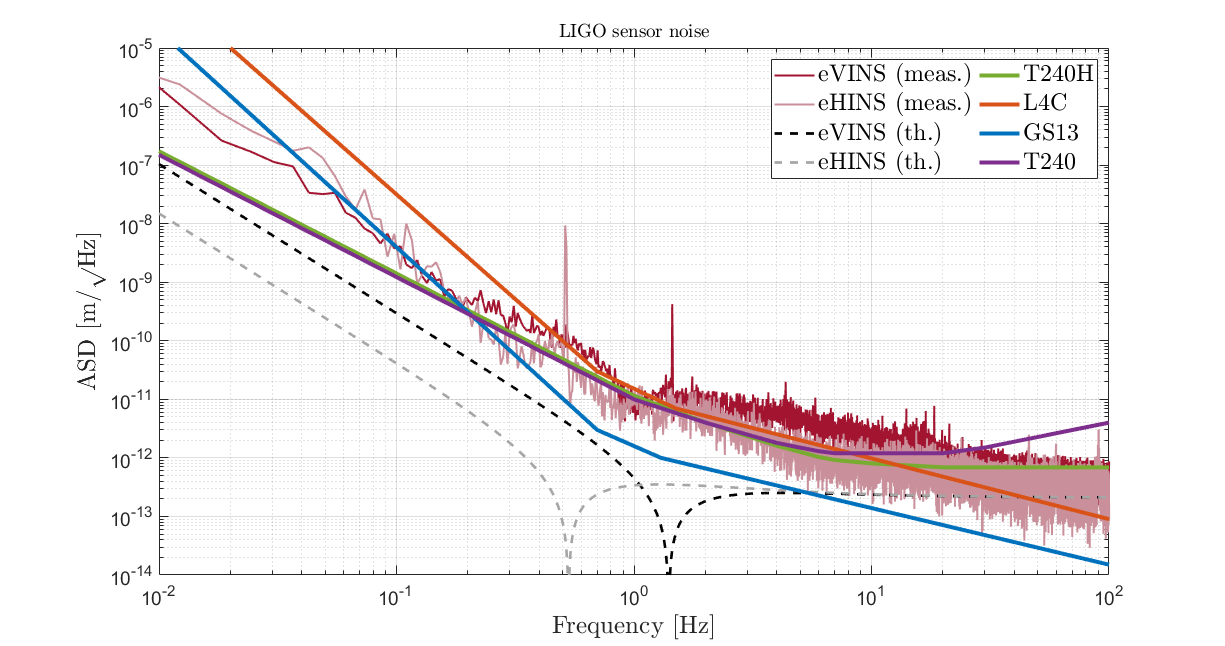
A second figure shows a comparison between these inertial sensors and LIGO sensors. Currently, the performance of the optical sensors is comparable to that of other sensors. The limitations in this noise figure exist, and we expect improvements in future iterations, particularly in the sub-1 Hz bandwidth.