hudsonl - posted 21:46, Tuesday 27 August 2024 (11744)
Spectrum Acquisition with Red Pitaya Validation
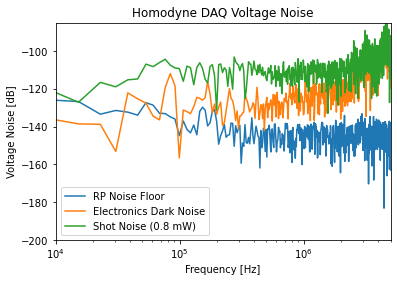
I tested the planned data acquisition setup for the homodyne spectra in the Heisenberg interferometer setup. I connected the output of the compact squeezer's homodyne's DC differential port to the input of a 9 MHz bandwidth -25x amplifier circuit and then the output of this circuit to the input of a red pitaya. The amplifier is needed since the homodyne's output voltage noise is about 23 nV/rt(Hz), whereas the red pitaya's input-referred ADC noise is a few hundred nV/rt(Hz).

With this electronics chain, I measured the dark noise (orange curve) and shot noise (green curve) of the homodyne. The blue curve shows the red pitaya's ADC noise with its input terminated by a 50 ohm SMA terminator. The mean values of these spectra between 100 and 700 kHz are
ADC noise: -139.8 dB
Dark noise: -126.7 dB
Shot noise (0.8 mW): -109.8
This gives a dark noise clearance of 16.9 dB. The compact squeezer's local oscillator can be adjusted up to 5 mW, which would give an extra 8 dB of dark noise clearance, such that the total clearance between shot noise and dark noise is about 25 dB in this frequency range. This should be sufficient for the measurements we want to make.

Note: The average values computed above were computed by averaging the PSDs in this frequency range in units of V^2/Hz and then converting these averaged values to dB units. This gives a different average value than converting to dB units first and then averaging. I believe the choice made here is the correct one: for averaging, variances should be summed, not ASDs or the logarithms of variances.
Images attached to this report