hudsonl - posted 15:54, Wednesday 10 July 2024 (11697)
External Clocked Red Pitayas Work with Pyrpl and are Phase-Stable
After verifying that I could connect to the external clock red pitayas once they're clocked with the click shields, I tested that I can interface with these devices from my laptop with pyrpl and that their outputs are in fact phase-stable and synchronized. To test their interface with pyrpl, I initially used pyrpl to connect to all three red pitayas and flash the LEDs on the red pitayas. This ensures that there's a functional connection between my laptop and the red pitaya FPGAs.

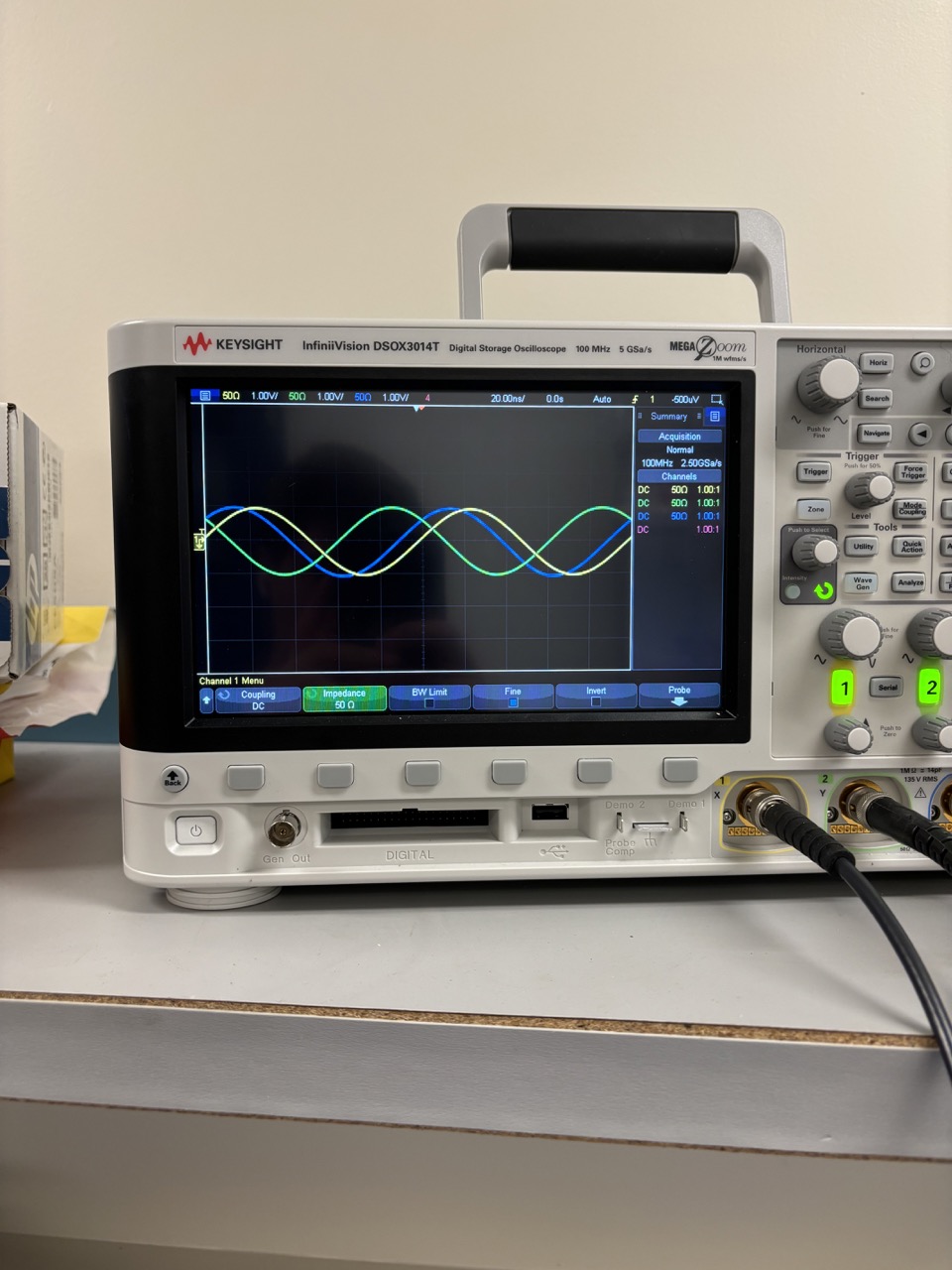
I then used pyrpl to have each red pitaya output a 10 MHz sine wave to ensure that (1) the red pitayas interface with other pyrpl modules and (2) that the outputs of the externally clocked red pitayas are in fact phase-stable relative to each other. Both appear to be true. I determined the phase stability by looking at the sine waves output by the different red pitayas on an oscilloscope. These sine waves are stationary relative to each other, indicating that the red pitayas are appropriately synchronized. The attached image shows the scope trace with the 10 MHz sine waves, one from each red pitaya I tested. All three were synchronized to the same external clock.

All of these tests were done by connecting all three red pitayas to an ethernet multiplexer and the ethernet multiplexer to a PC laptop. I had trouble connecting my laptop to any red pitaya (externally clocked or not) with a direct wired connection, although this should not be a problem once they're on the wifi.
Images attached to this report