
[Malo, Jacques]
The goal of yesterday's work was to improve the alignment+Mode matching from the cSQZ to the HD. It has been reported that the visibility was 80% and was likely one of the main limiting factors for having more SQZ (see my last post where I had 2.5dB of SQZ vs 14dB of aSQZ).
We started the shift by putting the cSQZ system into HD alignment mode (see Hudson's entry https://emvogil-3.mit.edu/lasti/index.php?callRep=11634). I moved the 90% pickoff from the input of the fiber bench to the polarization control paddles on the CLF path, and then moved the 5% picloff for the CLF from the input of the first AOM to the input of the fiber bench. I tuned the lightwave power so that the CLF input into the cSQZ has ~40mW, while the input into the SHG has ~3mW. I had to increase the gains of the OPO PDH PD and the PD/beam blocker on the path towards the HD; I had to flip a ND 2.0 filter and add another ND 0.6 filter in front of the CLF reflected PD. I had to add a ZFL amplifier to the RF output of the OPO PDH PD. With the setup adjusted this way, one should see up to 80uW CLF power out of the OPO going to the HD, when the SHG and OPO loops are closed.
At first both the SHG and OPO loops could close (provided that the temperature was tuned on coresonance). But the CLF and LO powers were unstable. Some tips for stabilizing the powers:
1/ Change the OPO temp to be out of phase matching but in coresonance, so that the noise from the GR does not affect the transmitted CLF.
2/ Optimize all polarization paddles and waveplates to maximize the powers, both on the CLF path and the LO path. To balance the powers, only use the optical attenuators without touching the polarizing elements.
With these tips implemented, the procedure for HD visibility maximization is the following:
1/ Balance the powers between the CLF and LO using the attenuators and checking on either PD channel of the HD.
2/ Check that the powers stay balanced over ~2minutes to ensure that the polarizations are optimized.
3/ move the lenses of the telescope on the cSQZ path and realign the two mirrors in order to optimize the visibility. Repeat.
Since the OPO lock is fragile, we had repeated unlocks of it and I struggled to close the loop each time, because the opo.lock() function needs a coresonance to engage. Therefore I will write a code which does not need IR resonance for it to close.
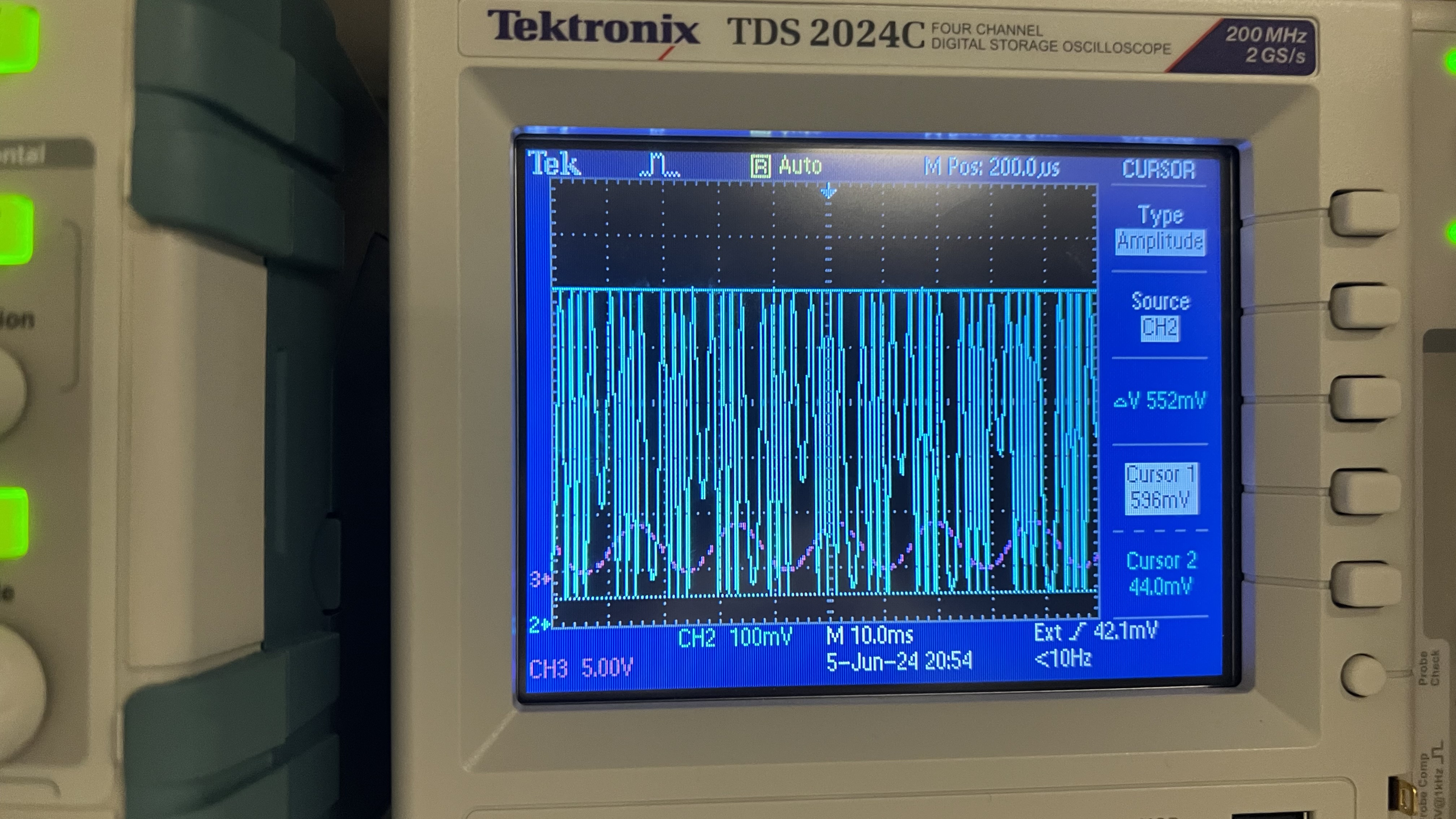
Results: at the end of the shift Malo managed to obtain 86.3% of HD visibility (vis = (596-44)/(596+44), upwards form the 80% measured by Hudson last time (https://emvogil-3.mit.edu/lasti/index.php?callRep=11632). See screenshot. We should still be able to further improve this.
The weather outside was hot (~30°C) but the lab temp and humidity was reasonably well controlled ( between 20.6 and 21.1°C and between 50% and 53%).