Yesterday, I took several measurements with the UMZI 23m with the Thorlabs laser and different laser currents. I summarize in the following table the important parameters for each configuration:
| Laser current [A] | V_DC output [mV] | Vpkpk output [mV] | VCO FM dev |
| 0.548 | 880 | 270 | 5kHz |
| 0.546 | 867 (875 after) | 396 (300 after) | 2kHz |
| 0.544 | 877 (870 after) | 180 (130 after) | 2kHz |
| 0.542 | 860 | 250 (388 after) | 2kHz |
| 0.540 | 850 (855 after) | 270 (208 after) | 2kHz |
| 0.552 | 879 (868 after) | 220 (200 after) | 2kHz |
| 0.550 (previous) | 570 | 170 (130 after) | 5kHz |
The values *after* mean after the measurement to show that the amplitude of the fringes oscillates over time. Going lower in laser current, i.e. 0.539A, gives smaller fringes amplitude (difficult to lock) and going higher was introducing evident frequency noise visible in the fringes.
I also characterized the same loop with the NKT laser - UMZI 23m:
- V_DC output = 426 mV
- Vpkpk output = 340 mV
- VCO FM dev = 2kHz
These values are constant after the measurement, the fringes DON'T FLUCTUATE with the NKT LASER (as it is supposed to be).
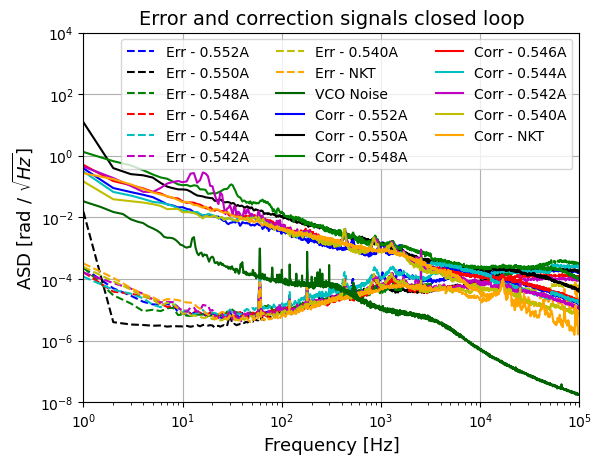
Fig. 1 shows the error and correction signals for differen laser currents for the Thorlabs laser. The orange curve is the NKT measurement. The dark green curve is the VCO noise calibrated in rad/rtHz for a frequency deviation = 2kHz. The curve with lower power noise seems the one corresponding to a laser current = 0.540A.
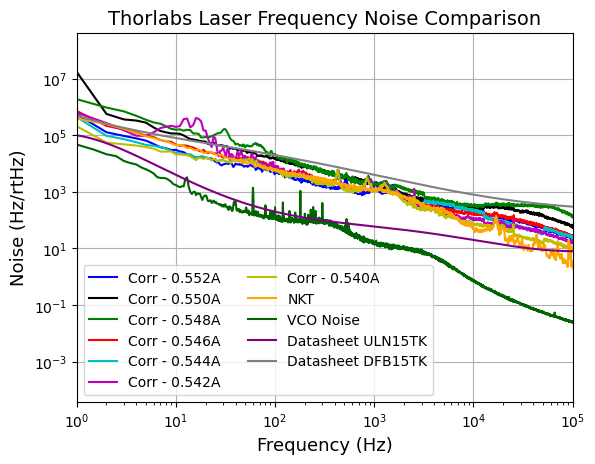
Fig. 2 shows the referred laser input power for the cases discussed above, the VCO noise and the Thorlabs lasers frequency noise specs.
It seems that the laser frequency noise is still higher than what it is supposed to be. There are some structrures at lower frequencies that could be a good sign.
I set the laser current = 0.540 A and I did some measurements shown in the following entries.