In the past days I have been trying to measure the frequency noise of the new ULN15TK thorlabs laser, using the UMZI. I tried with 1km unbalance and it was too much for fringe wrapping issues as I mentioned in a past entry. I spliced and tried the 100m and 200m spools but that was also too much: the fringes were mostly hidden by frequency noise on the oscilloscope and that made it impossible to lock the UMZI. Moreover, with such unbalance, the fringes were oscillating in amplitude as well. I looked around for shorter fibers and I found some thorlabs P3-1064Y-FC and P3-980A-FC fibers of 2m and 5m used for 1064nm experiments, that are also good at 1550nm.
The final configuration that allowed me to lock the UMZI was with a total unbalance between the two arms of 23 meters:
2 x 2m (AFW 1550nm patchcord - SM1-22-T) + 5m (P3-1064Y-FC) + 2m (P3-1064Y-FC) + 2 x 5m (P3-980A-FC) = 21m
Then the long path counts also the AOM and the polarization controller and a BS that gives ~6m. The short path has 2 BS that gives ~4m. This gives 2m extra unbalance between the arms.
tau = 1.45 * 23m / 3e8 m/s ~ 1e-7 s
UMZI 23m Thorlabs Characterization:
VCO frequency deviation = 10kHz (VCO TF = 6.5 kHz/rad)
Error signal calibration = 75 mV/rad
DC output power 1811 = 570 mV
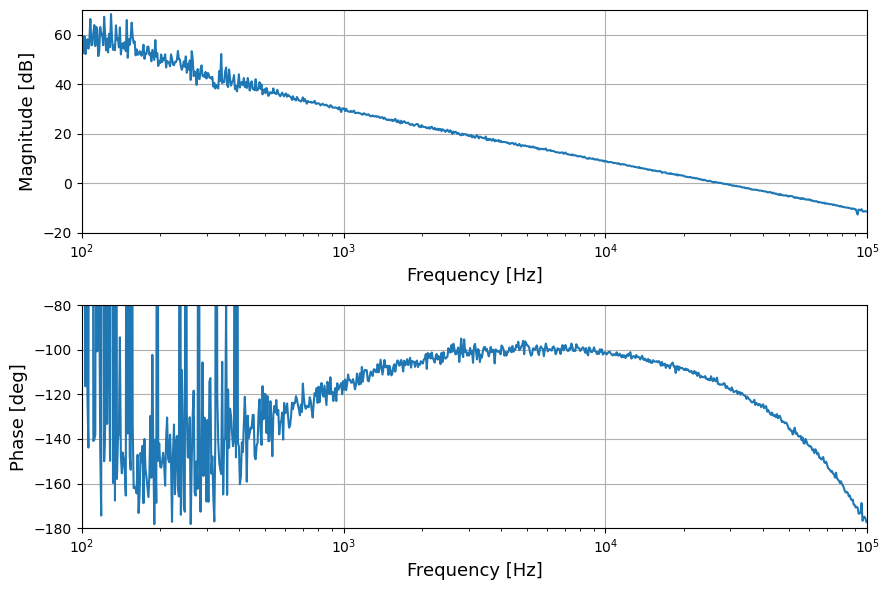
UGF ~ 22kHz (swept sine 200mV)
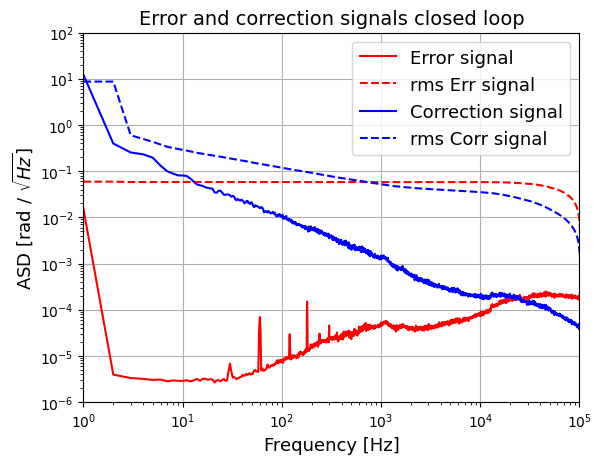
Fig. 1 shows the error and correction signals calibrated in rad/rtHz.
Fig 2 shows the OLTF of the loop.
The curves are not spoiled by acoustic peaks like the measurements taken with the NKT and this suggests that we could be limited by laser frequency noise.
UMZI 23m Thorlabs Noise Budget:
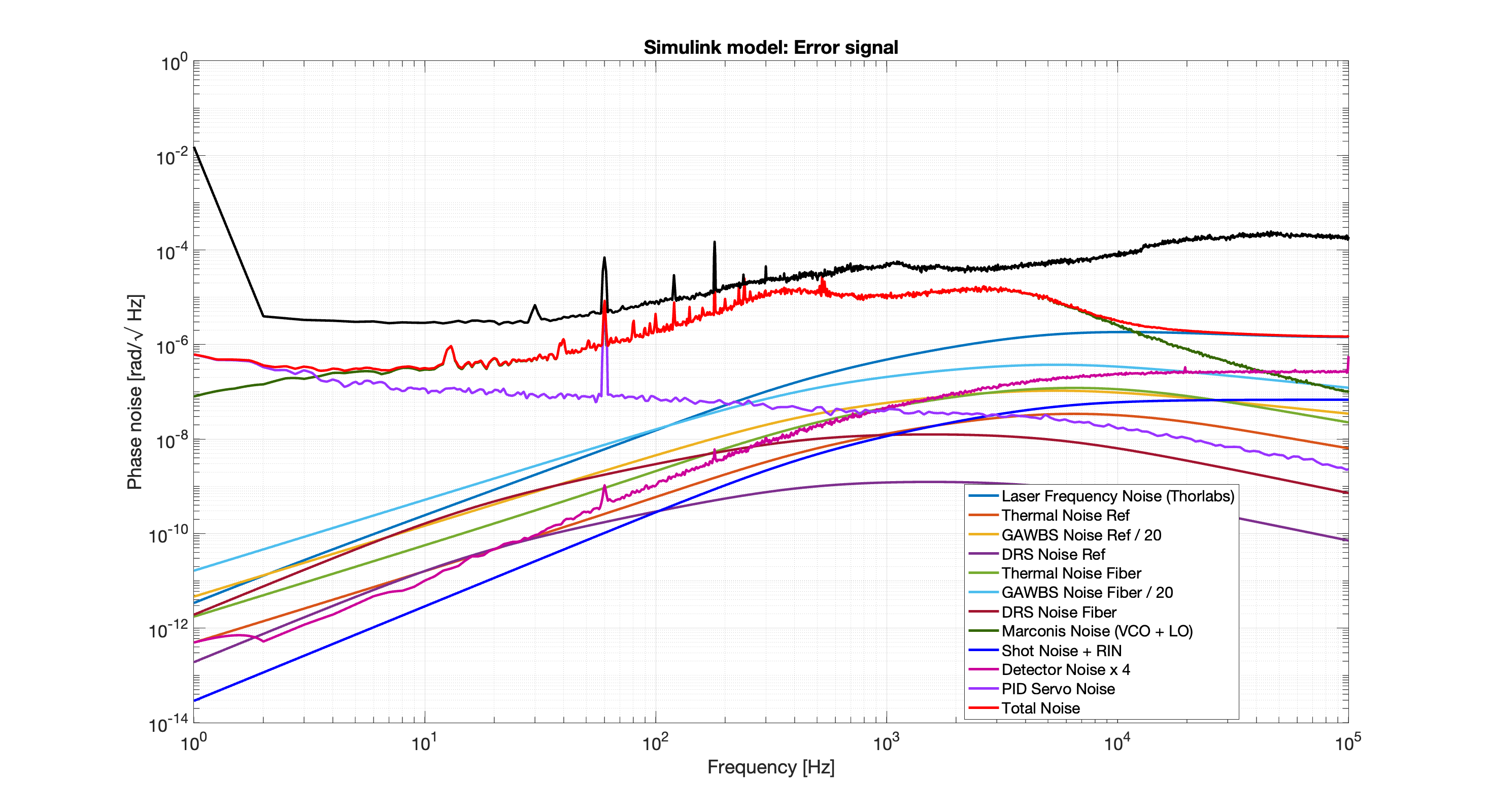
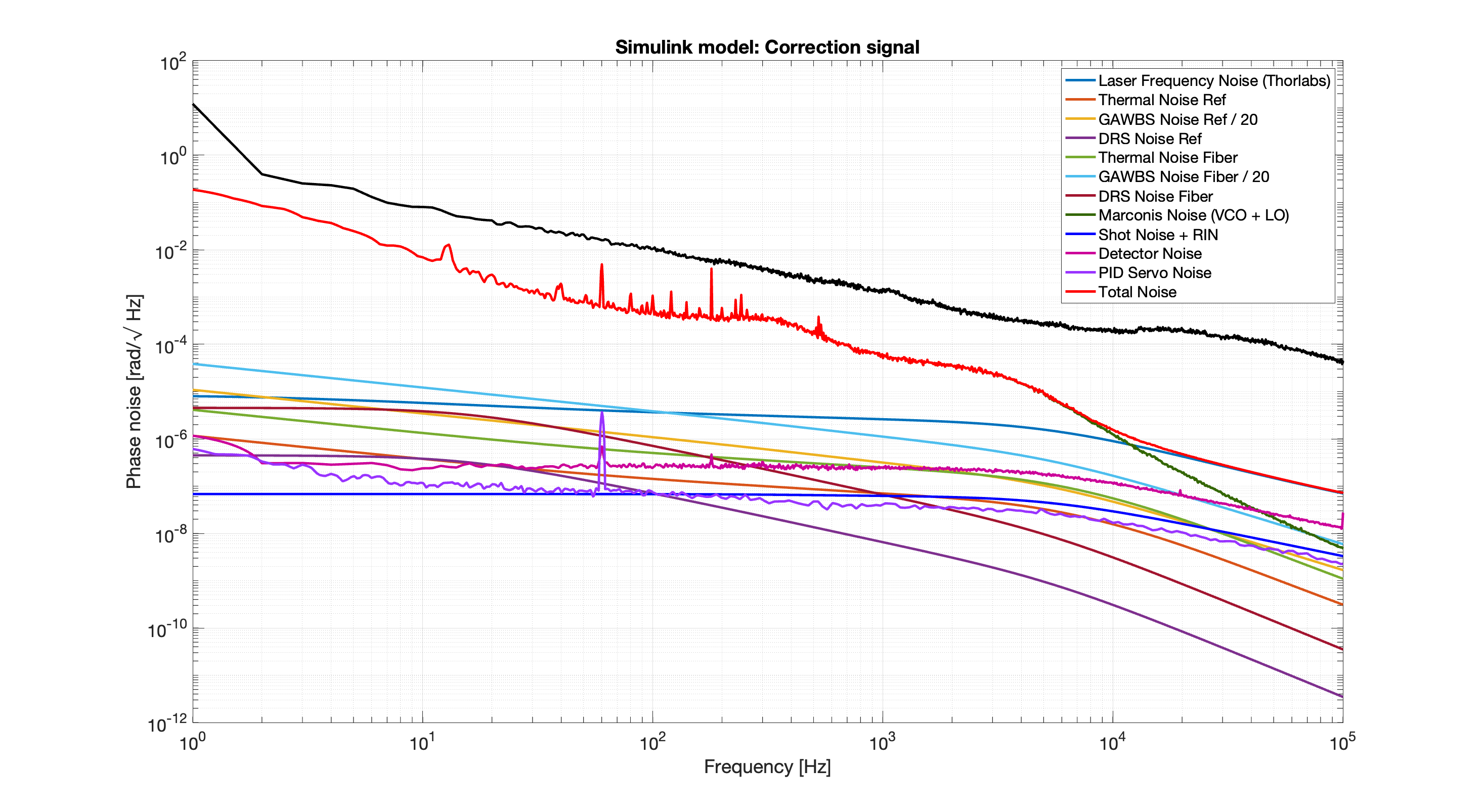
I also computed the noise budget. Fig. 3 shows the error signal and Fig. 4 the correction signal. I included the ULN15TK laser frequency noise fitted by the measurement provided with the laser. It seems like if the VCO noise limits the low frequency of the error signal but the correction signal is flat and seems like it could be limited by laser frequency noise.
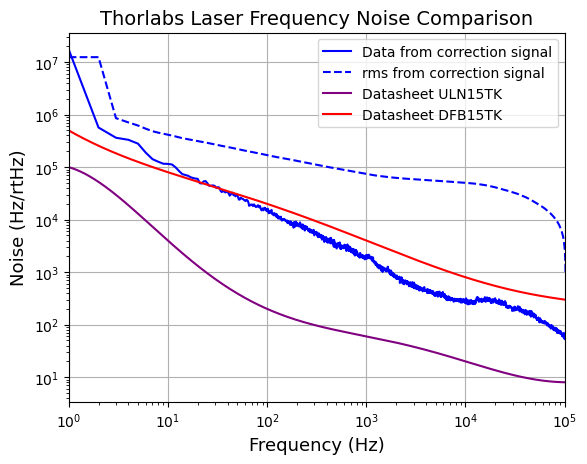
Thorlabs Laser Frequency Noise Comparison:
I decided to calibrate the correction signal into referred laser input noise and compare it with the ULN15TK provided date (fitted) and the DFB15TK datasheet (fitted).
To convert the correction into input noise, since the AOM in this case is on one arm and not at the entrance of the interferometer, I did:
asd_freq(omega) = 1/ (2 * pi * tau) * (1+G) * VCO / freq * 1 / G * asd_phi(omega)
where tau = n * L / c with n = 1.45, L = 23m, c = 3e8 m/s; G = OLTF and asd_phi(omega) is the correction signal calibrated in rad/rtHz shown in Fig. 1.
Fig. 5 shows the comparison of the ULN15TK and DFB15TK laser frequency noise and the correction propagated to the input of the system. I did not correct for the OLTF in this case since the UGF is around 22kHz.
The laser frequency noise computed from the data is 10-100 time higher than the specs and lower than the model DFB15TK above 50Hz.
I added the rms of the reconstructed input noise and I belive it to be around 1e6Hz - 2e6Hz. If I convert it into maximum differential arm length I get: DL = 16m - 32m, as I expected from the measurement I made.
Why do we see this excess in noise? Are we sure that it is laser frequency noise? The fact that we don't see the peaks as in UMZI NKT in the audio band suggest that there is a noise that covers it and it can be luckly to be frequency nosie. Are there other sources we are not considering? I am sending the plot to the Thorlabs Technical support.