The other day I locked the UMZI 1km with the NKT, I took the Corr, Err, OLTF and I made a noise budget. Since I was supposed to be limited by frequency noise, I thought it was a good idea to re-measure it with a loop that is more reliable than the unbalanced Michelson.
UMZI 1km NKT Loop Characterization:
VCO frequency deviation = 5kHz (VCO TF = 3.9 kHz/rad)
Error signal calibration = 104 mV/rad
DC output power 1811 = 200 mV
P0 (before BS1) = 139 uW
Pout = 9uW
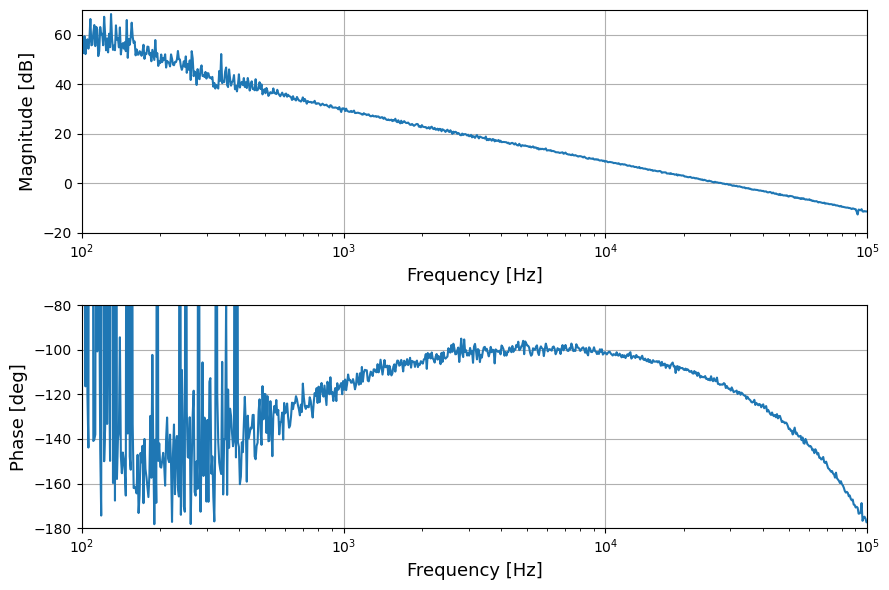
UGF ~ 30kHz
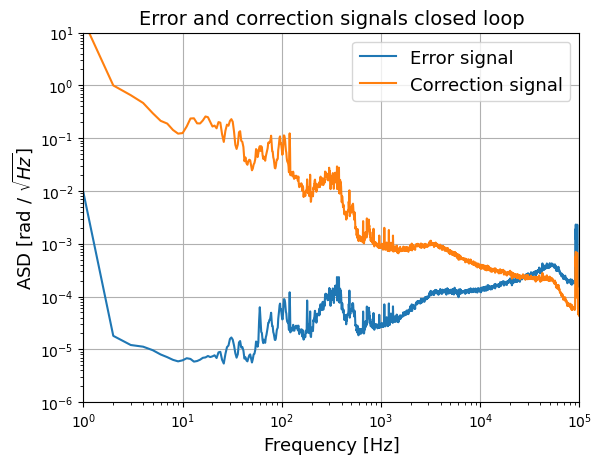
Fig. 1 shows the error and correction signals calibrated in rad/rtHz.
Fig 2 shows the OLTF of the loop.
UMZI 1km NKT Noise Budget:
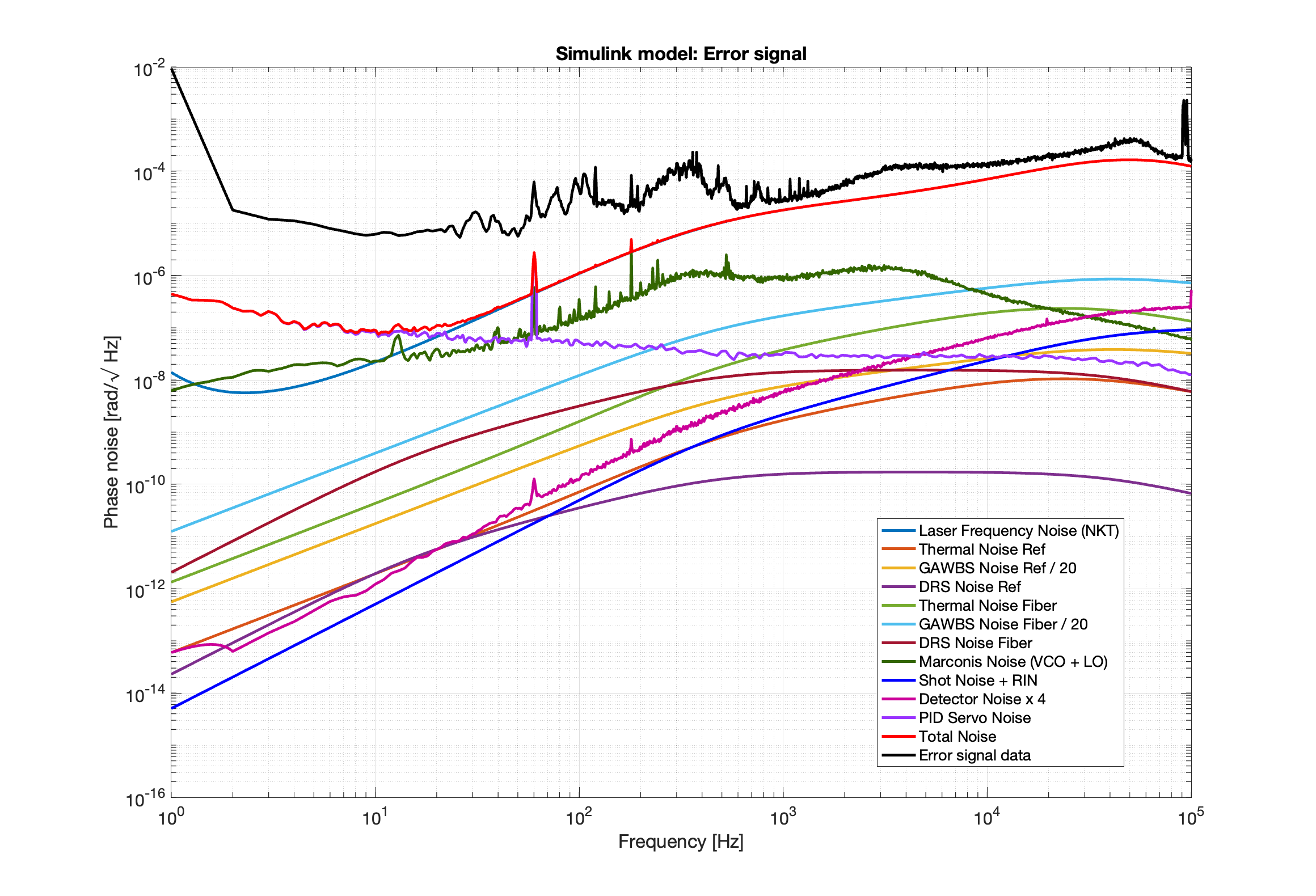
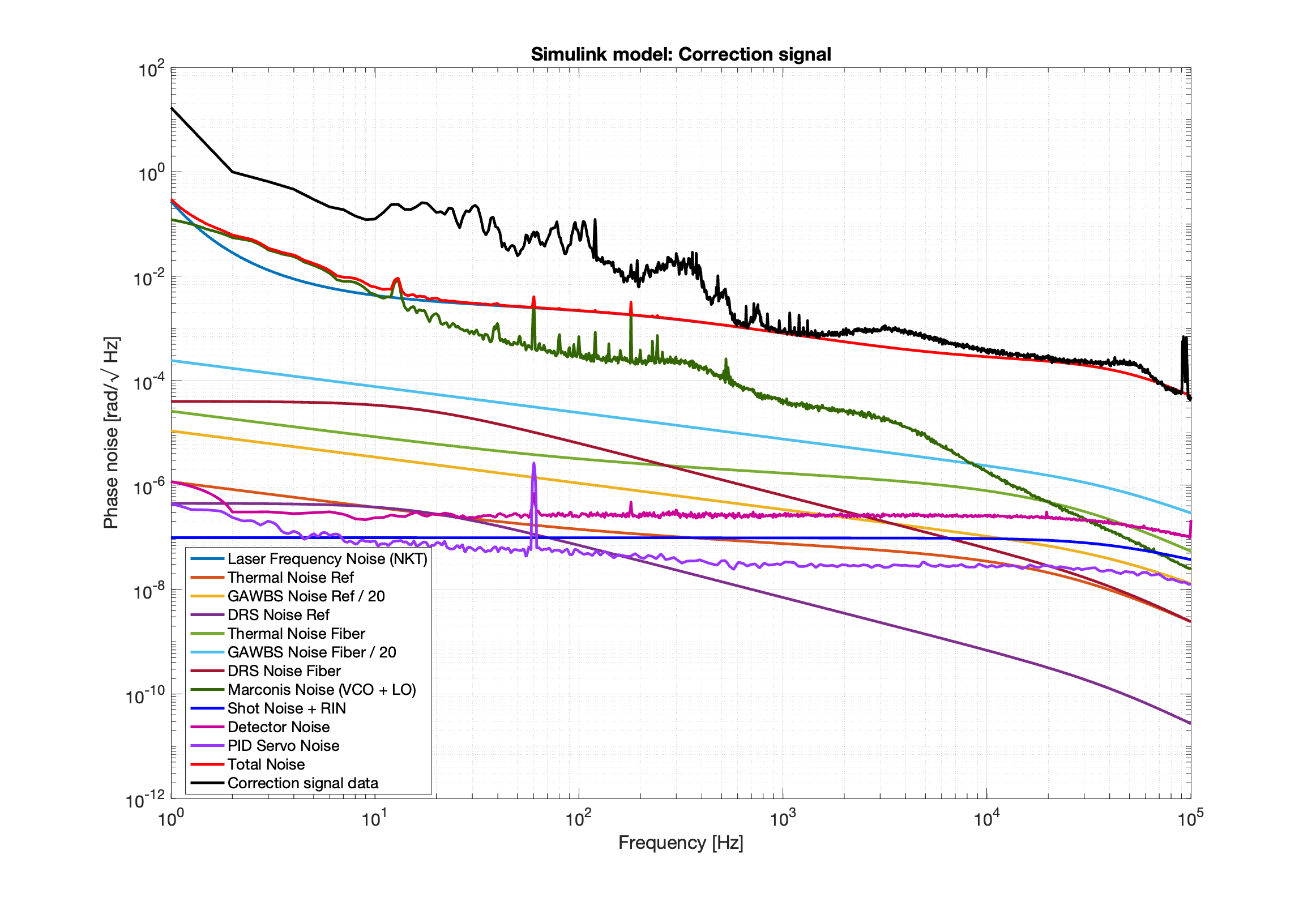
I also computed the noise budget. Fig. 3 shows the error signal and Fig. 4 the correction signal. I included the E15 NKT laser frequency noise fitted by the AEI data. The noise budget suggests that the laser frequency noise limits the high frequency.
NKT Laser Frequency Noise Comparison:
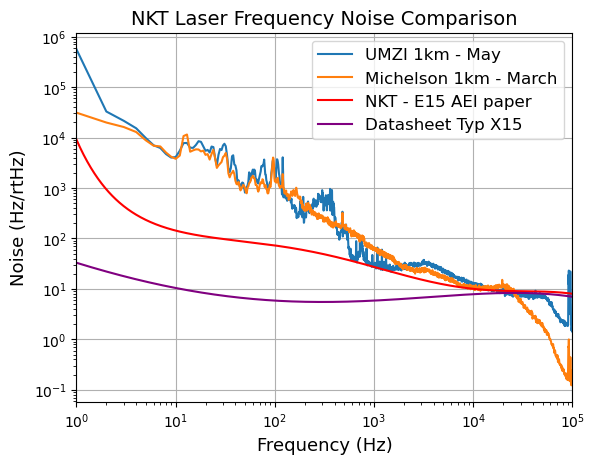
I decided to calibrate the correction signal into referred laser input noise and compare it with the X15 datasheet and E15 data.
To convert the correction into input noise, since the AOM in this case is on one arm and not at the entrance of the interferometer, I did:
asd_freq(omega) = 1/ (2 * pi * tau) * (1+G) * VCO / freq * 1 / G * asd_phi(omega)
where tau = n * L / c with n = 1.45, L = 1km, c = 3e8 m/s; G = OLTF and asd_phi(omega) is the correction signal calibrated in rad/rtHz shown in Fig. 1.
Fig. 5 shows the comparison of the NKT X15 and E15 laser frequency noise and the correction propagated to the input of the system. I did not correct for the OLTF in this case since the UGF is around 30kHz.
The noise at high frequency is in agreement with both the X15 and E15 specs, while below 1kHz the system couples with other sources of noise difficult to measure. The bump between 1kHz and 10kHz could be due both to a cross-coupling of the excess amplitude noise already shown in the past or also to a bump that is present in the data that can be found on the NKT note (https://www.nktphotonics.com/wp-content/uploads/2022/01/frequency-stability-application-note-version-1-1-.pdf) at around 5kHz. In order to reduce the excess noise below 1kHz, we need to use the vibration insensitive spool that has been sent to re-wind with a 1km new sm28-ultra fiber and a decent acoustic isolation.
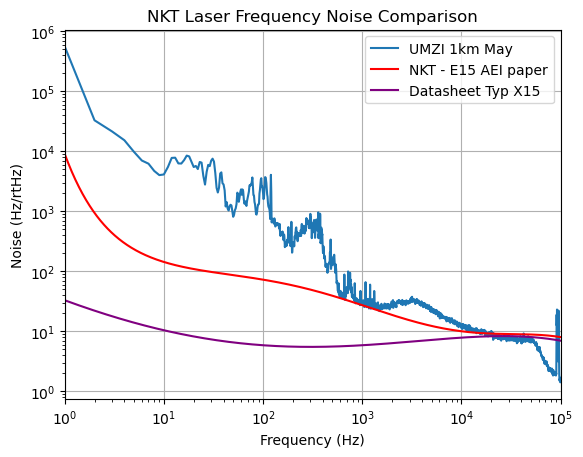
I also compared it with data acquired in March with the Michelson 1km unbalances interferometer used as pre-stabilization. Attached the comparison with the most recent data (none corrected by the OLTF). They are in agreement.