eoelker - posted 19:12, Wednesday 15 May 2024 (11636)
GRAVITES low power homodyne
I put together a fiber coupled homodyne for stabilizing the GRAVITES interferometer for low power operation.  Due to issues with Raman scattering, we will likely have to operate with ~100 nW of light at the output and good noise performance in the 10-100 mHz band.  With a transimpedance >= 1 MOhm, this should be no problem.  I modified one of Tomoki's aLIGO diagnostic homodyne boards (D1300671-v6) to work with low power/high transimpedance.

Changes: I unstuffed the resonant paths, the DC lowpass was unstuffed and inductors replaced with 0 ohm resistors, U9 -> OPA828, R29 -> 1 MOhm (feedback cap also removed), D11/D14 -> C30617BFCH ingaas diode, FC fiber recepticle.  This diode has the same pin configuration as the ETX-500 , so it actually fits in one of the existing PD footprints on the board.  However it's base is larger than the ETX-500 and I had to cover the thru-holes for the high QE diodes on D11/D14 with tape to avoid a short to the diode case.  I have not yet attempted to increase the transimpedance gain of the PD1 and PD2 outputs.  They are currently useless for 100 nW input power.

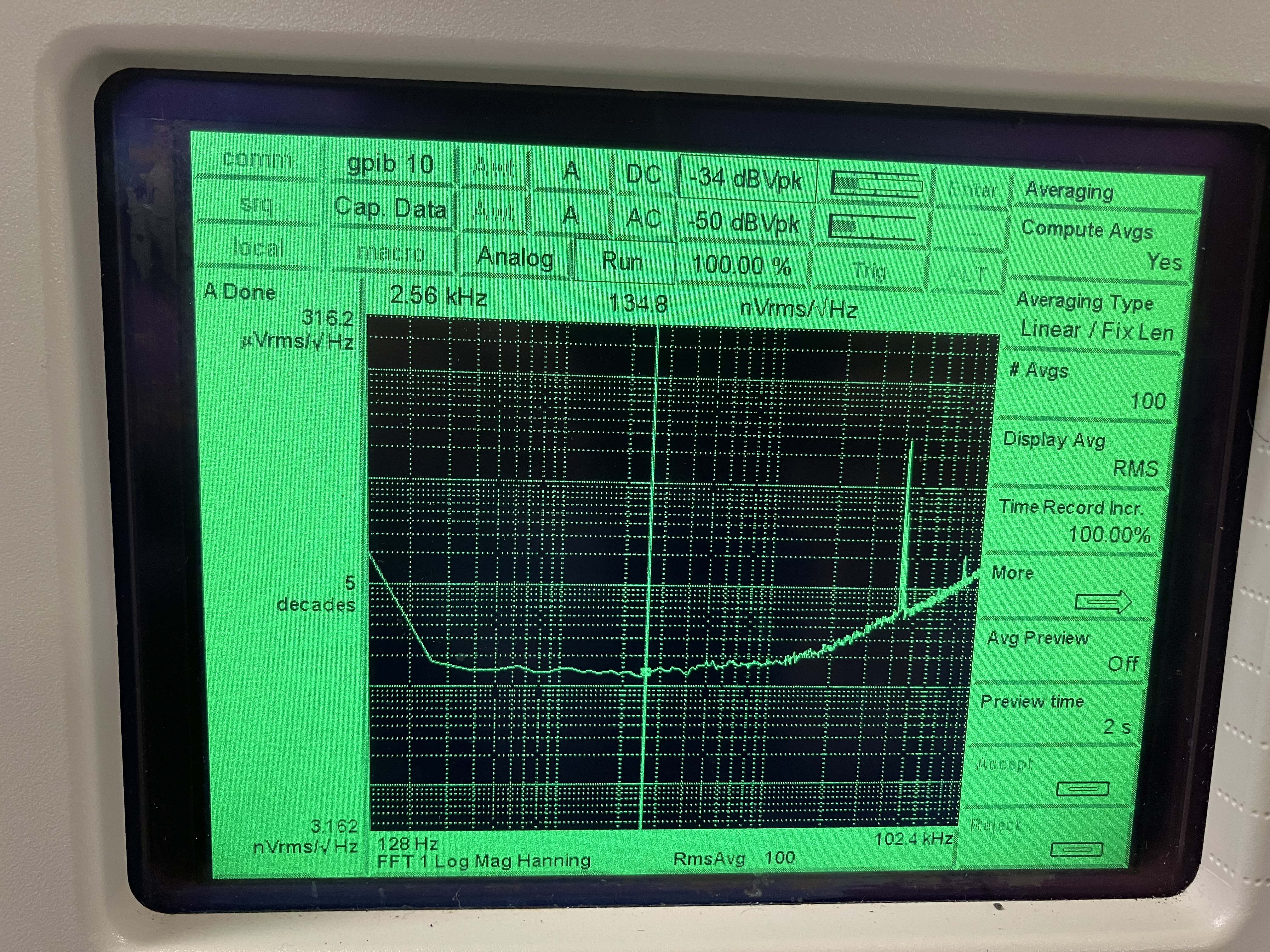
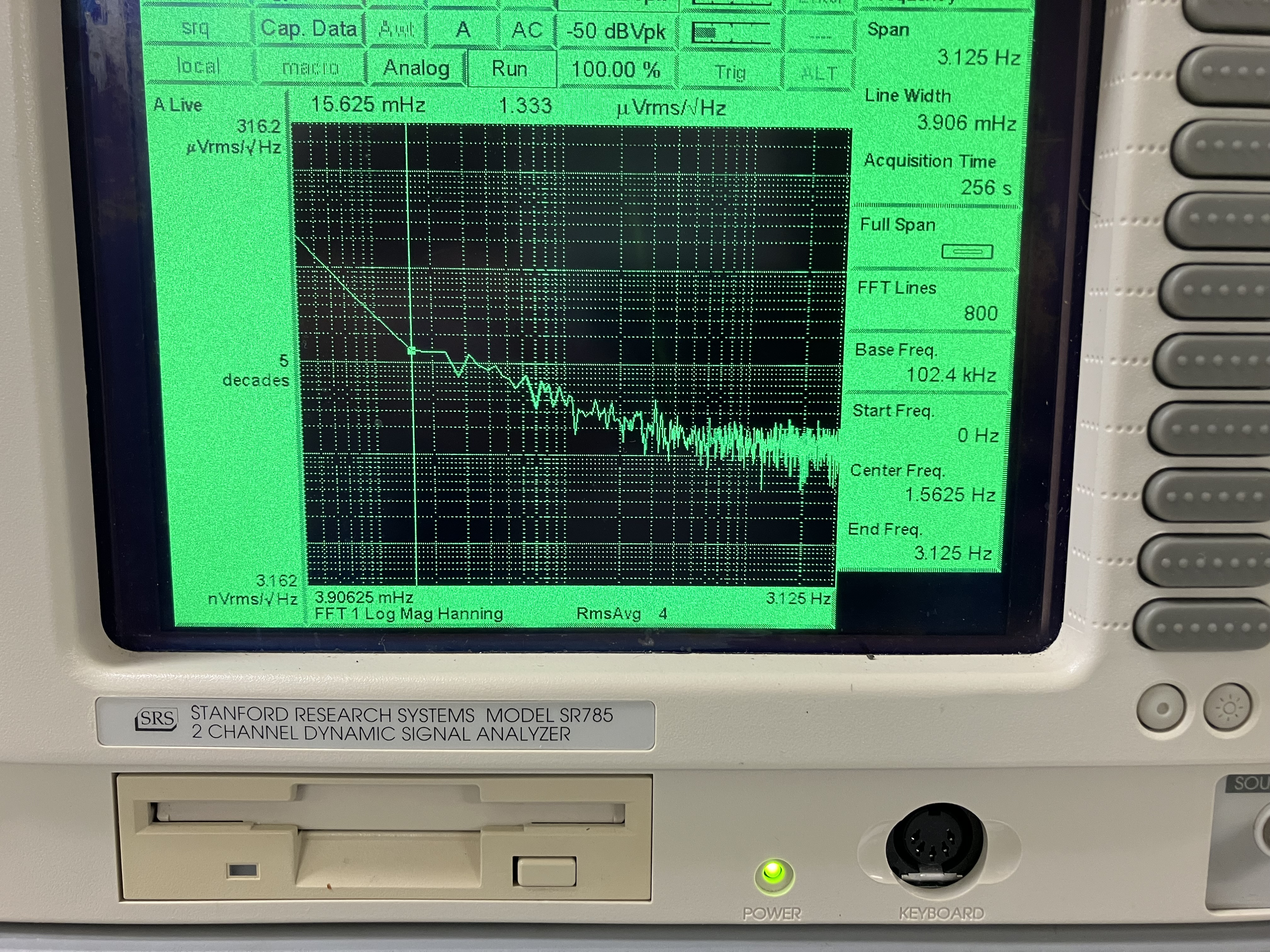
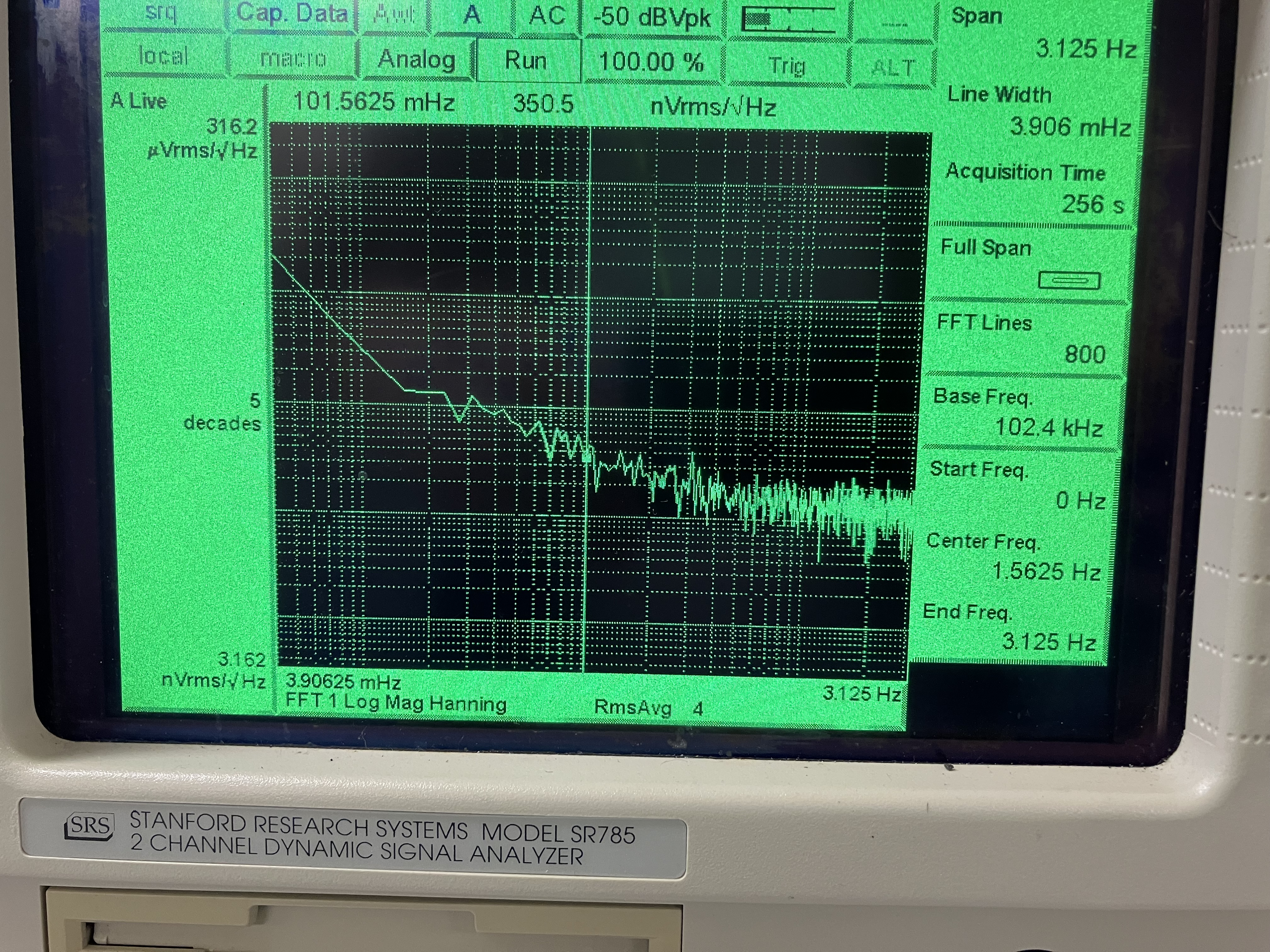
The noise performance looks sufficient. From about 0.5 Hz-10 kHz it is Johnson noise limited. Should be just shot noise limited for 100 nW at these frequencies.  At high frequencies, we see a roll-up in noise.  This does not seem to be due to the photodiode capacitance.  Their total capacitance is way too low (The fiber coupled diodes only have ~0.5 pF each).  Tomoki's board likely has several pF of stray capacitance, but this is also insufficient to explain what we're seeing based on my circuit noise budget.  Interestingly, we see the same noise when I remove the last 0 ohm resistor on the input path before U9.  This should get rid of almost all input capacitance, so the frequency dependence of the noise seems to be from the op amp itself.  I'm not certain, but this could be a roll-up in current noise at high frequencies, a common issue in low current noise JFET op-amps.  There is no plot of current noise vs frequency in the OPA828 datasheet, just a value at 1 kHz (my circuit noise budget currently assumes that the current noise is frequency independent).  We don't really care about the high frequency noise performance for GRAVITES, so this isn't an issue.  At low frequencies, the performance looks good: ~400 nV/rtHz at 100 mHz and ~2 uV/rtHz at 10 mHz.

There's a bit of room to increase the transimpedance more if we'd like.  Haven't plugged this pd spectra into our interferometer noise budget, but I suspect it won't be our limiting factor at our desired measurement frequency (likely 10-100 mHz).
Images attached to this report