[Eleonora, Medha]
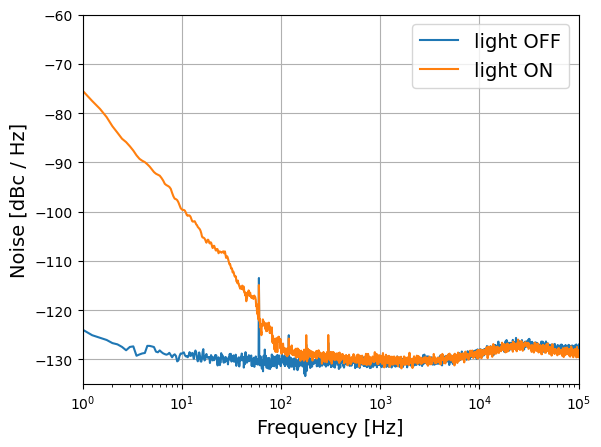
In the past we measured the RIN of the new thorlabs laser at 1550nm. We found out that the measurement is limited by the detector noise (using both the PDA20CS and the 1811) above 100Hz. We are confident that the noise comes from the detector since it is not changing by turning off the laser. Therefore, the detector noise measured is higher than what expected from the datasheet.
The noise floor on the SR785 was of 2-3uV/rtHz above 100Hz that normalized by the power and converted in dBc/Hz gives ~ - 130dBc/Hz for each setting on the PD.
The computed values from the specs are obtained with the formula
Detector Noise = NEP * R(lambda) * Gain(depends on the gain setting).
0dB setting:
det_noise_V = 5.12e-11*1.5e3 = 7.68e-08 V/rtHz
det_noise_dBc = 20*np.log10(det_noise_V/0.72) = -139 dBc/rtHz
20dB setting:
det_noise_V = 6.54e-12*1.5e4 = 9.81e-08 V/rtHz
det_noise_dBc = 20*np.log10(det_noise_V/7.2) = -157 dBc/rtHz
50dB setting:
det_noise_V = 2.91e-12*4.75e5 = 1.38e-06 V/rtHz
det_noise_dBc = 20*np.log10(det_noise_0db/9.92) = -160 dBc/rtHz
For the setting 0db and 20db we had 0.45mW arriving on the detector that corresponded to 0.72V and 7.2V respectively on the oscilloscope.
For the setting 50db we had 21.1uW arriving on the detector and 9.92V on the oscilloscope. We installed a BS to decrease the power and being able to raise the gain in order to see if the detector noise was decreasing and we could get a better RIN measurement.
Fig.1 shows the intensity noise spectrum in dBc/Hz with the laser ON and OFF. The measurement for frequency < 100Hz is in agreement with the measurement provided by thorlabs where we have -100dBc at 10Hz and -130dBc at 100Hz. At 1Hz they measured -60dBc, which is higher than the -75dBc we measured but it might be due to our measurement accuracy.
I checked the shot noise level of the measurement just in case:
Shot Noise = sqrt(2*I*e) = sqrt(2 * (0.72 V / 1.5e3V/A) * 1.6e-19A/Hz) = 1.23e-11/rtHz -> -218 dBc/Hz
for a power of 0.45mW (for lower powers it is smaller). This confirms that it is lower than the detector noise.
We are confident that the noise limiting us is detector noise since it stays also when the light is turned off. There might be a discrepancy between the data on the PD datasheet and the real parameters.
Our conclusion is that the intensity noise is up to specs so we won't investigate this further.