We have been investigating the laser frequency noise that presented the weird low frequency bump noise.
The frequency noise has been measured as correction signal after locking the Michelson with the AOM. The calibration factor is 6.5kHz / V given by the Marconi.
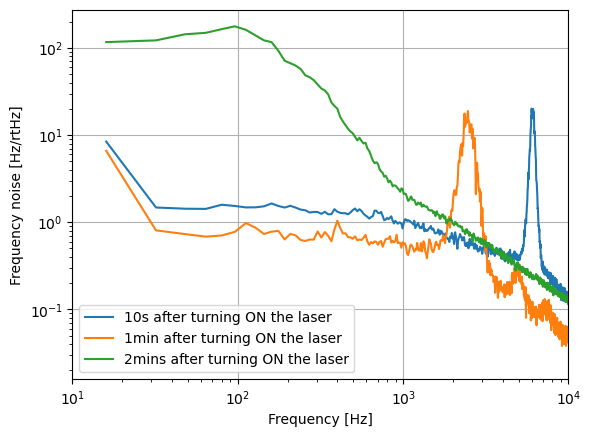
In Fig. 1 how the frequency noise changes as the time after turning on the laser passes: the bump apprears after 1-2 mins after I turn on the laser.
NB. I need to press the button outside the lab, i.e. disabling the interlock, to remove the bump once I turn the laser on again. Just stopping the emission is not enough.
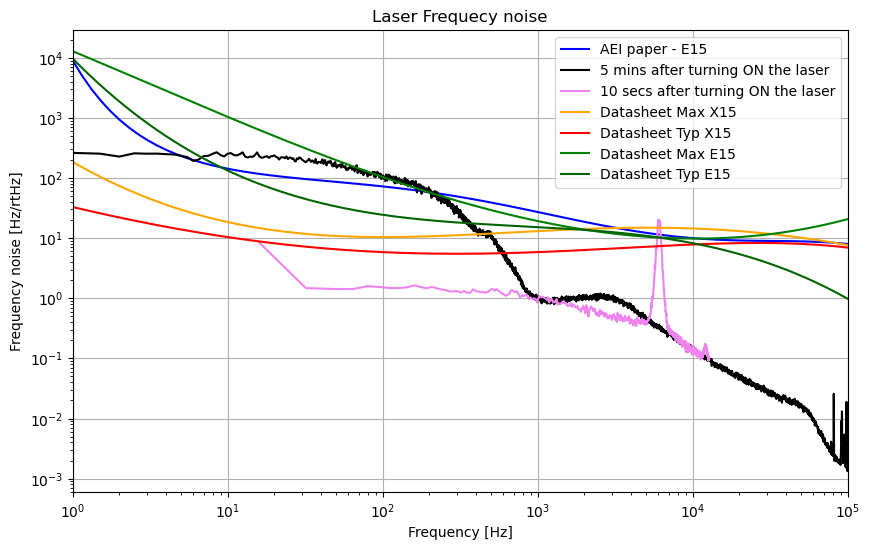
In Fig. 2 the measured frequency noises, after 10 seconds in violet and several minutes in black, the phase noise converted in frequency noise given by the datadsheet both for the X15 and E15, in blue the frequency nosie measured at AEI (https://www.mdpi.com/2410-390X/6/1/15). The phase noise is expressed in dB(rad/rtHz)/m on the datasheet that is a bit surprising. Eric suggested to convert it using the formula used on the optica paper of chris et at (https://opg.optica.org/optica/fulltext.cfm?uri=optica-9-11-1238&id=518455):
S_dnu(omega) = S_phi(omega) / [(2 * pi * tau)^2 * sinc^2(omega*tau/2)]
where tau = L*n / c with L = 1m, c speed of light and n = 1.45.
We sent the plots to NKT to understand the calibration they use in the datasheet and where this extra noise at low frequency comes from.
I also noticed that the amplitude of the fringes of the error signal used to calibrate the error signal from V/rtHz to rad/rtHz changes over time after turnin ON the laser: it passes from 100mV to 500mV in a couple of minutes.