Today I changed the optical setup of the long arm of the UMZI to introduce some pick-offs for the monitor of the polarization before and after the polarization controller.
After the 1km spool there is a SM AOM and then I added a 95/5 BS and I connected the 5% port to a SM PBS and the 95% port to the polarization controller. After the controller I added a 95/5 PM BS and I connected to the 5% port to a PM PBS and the 95% port to the other PM BSs before the 50/50 BS and the PD.
I connected two PDA20CS thorlabs PDs to the outputs of the PBSs. The gain on the PDs is 10dB. I measured the powers with the oscilloscope and I got:
- BEFORE the polarization controller:
- port 1 : 208 mV
- port 2 : 108 mV
- AFTER the polarization controller:
- port 1 : 156 mV
- port 2 : 12 mV
The signals did not change after the polarization controller by disabling it (the change in polarization might be slower then what I observed it for).
The result of this measurement is that the controller seems to work.
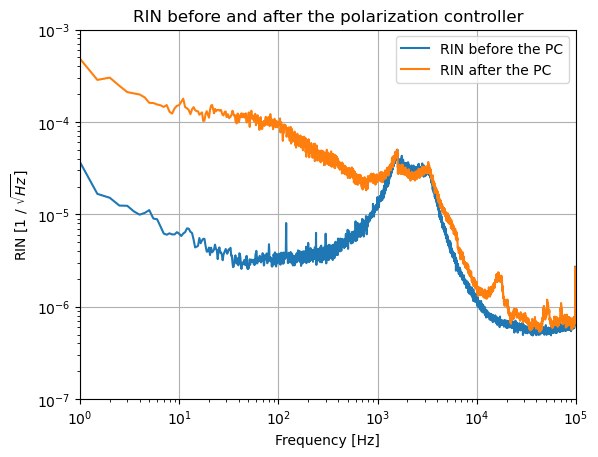
I also acquired the RIN before and after the polarization controller. I measured the power spectrum with the SR785 at the 5% port of the new BSs I installed, meaning before entering the PBSs.
The power level on the SM side (BEFORE) is 336 mV and on the PM side (AFTER) is 176 mV. I used these DC powers to normalize the spectrum shown in Fig. 1. The low frequency of the spectrum is higher after the polarization controller.
Today I measured the RIN also before the spool and with the polarization controller OFF, to understand what is introducing the excess of noise at different frequencies.
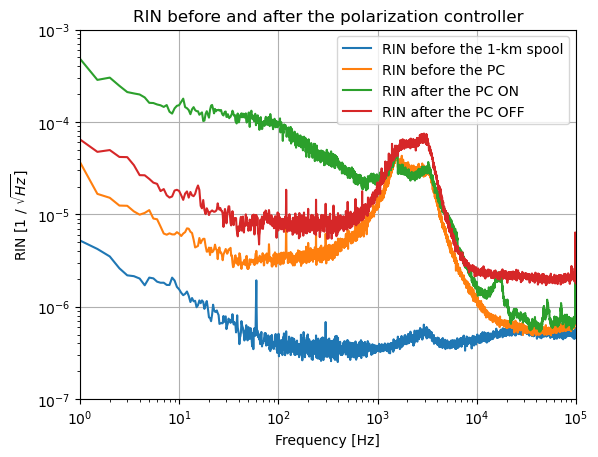
Fig. 1 shows:
- RIN before the 1-km spool in blue
- RIN after the spool but before the polarization controller (PC) in yellow
- RIN after the PC when PC is enabled in green
- RIN after the PC when PC is disabled in red
The structrure between 2kHz and 4kHz is amplified by the spool, since it is way smaller before and it is present independently from the PC. The noise at low frequency (< 1kHz) is excited by the PC. To address this problem we can consider to feedback a signal to control the intensity noise after the PC.
To understand if it is possible to easily reduce the 2-4kHz noise, I covered the spool with the box we built for the Michelson setup.
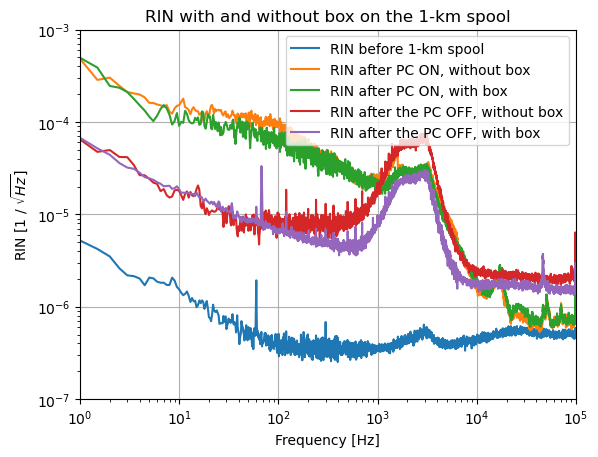
Fig. 2 shows:
- RIN before the 1-km spool in blue
- RIN after the PC when PC is enabled without box in yellow
- RIN after the PC when PC is enabled with box in green
- RIN after the PC when PC is disabled without box in red
- RIN after the PC when PC is disabled with box in purple
The noise is not reduced by covering the spool with the box, so we might need to think of something better to isolate the spool.