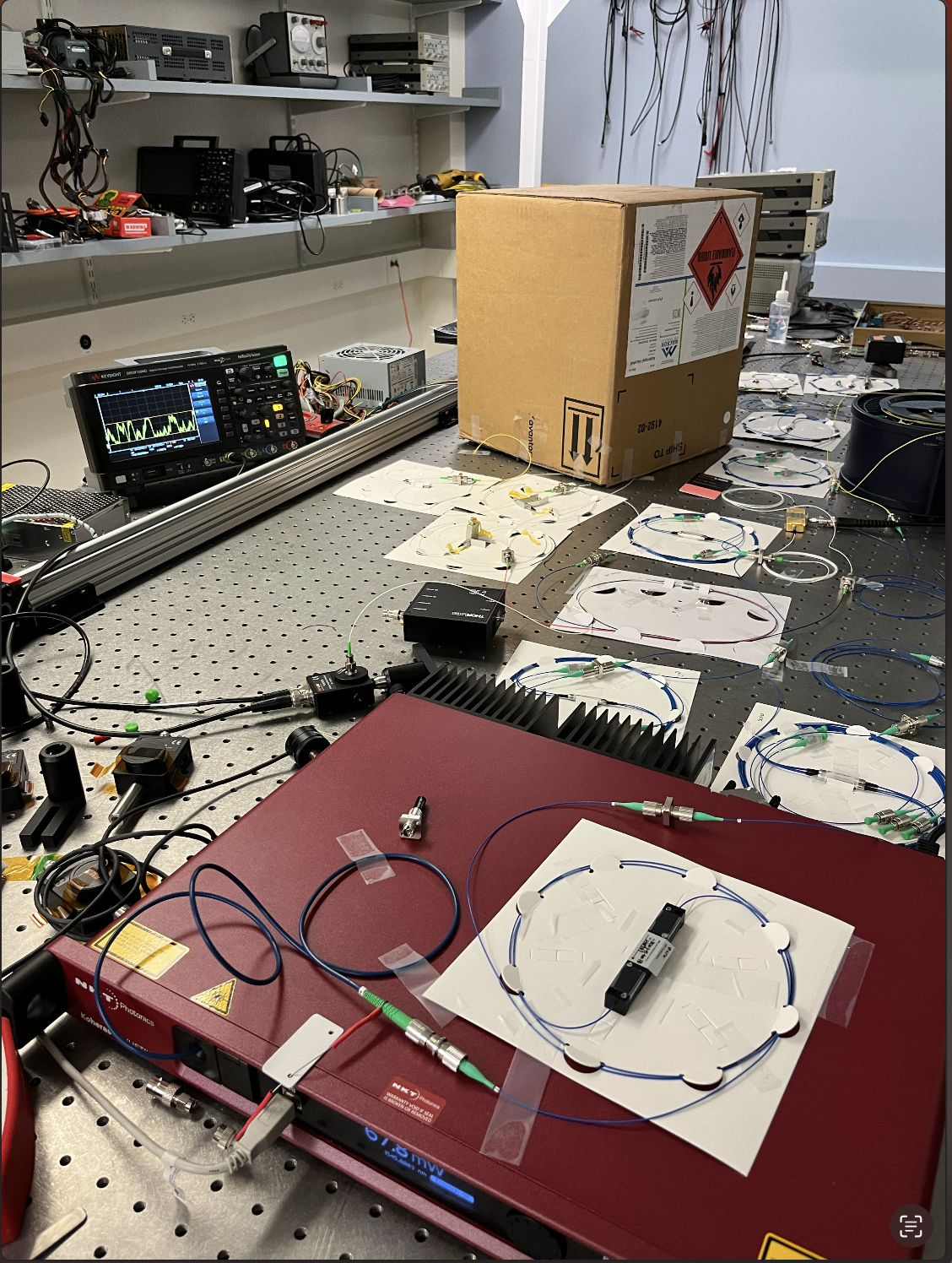
[Eleonora, Eric, Medha]
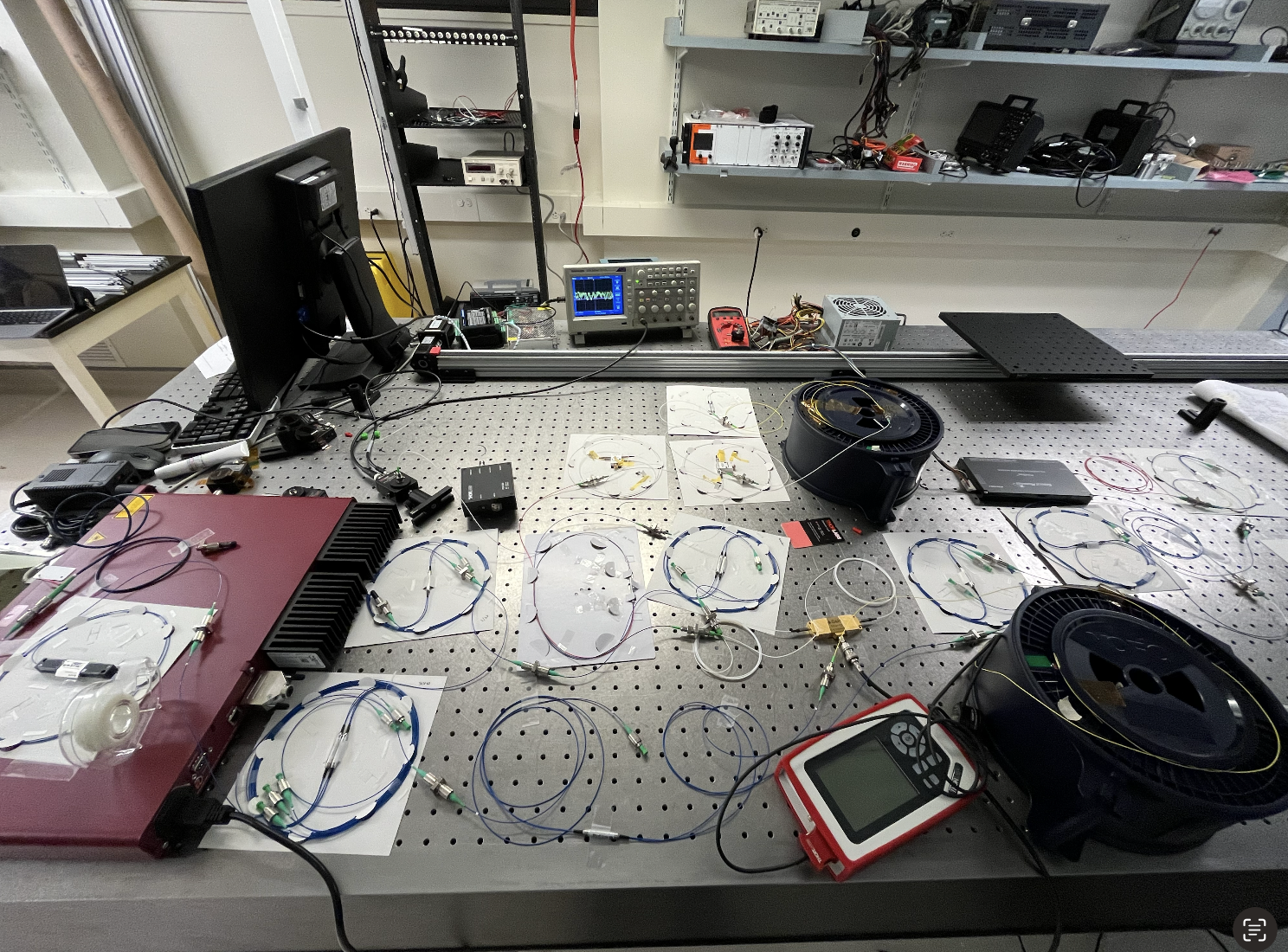
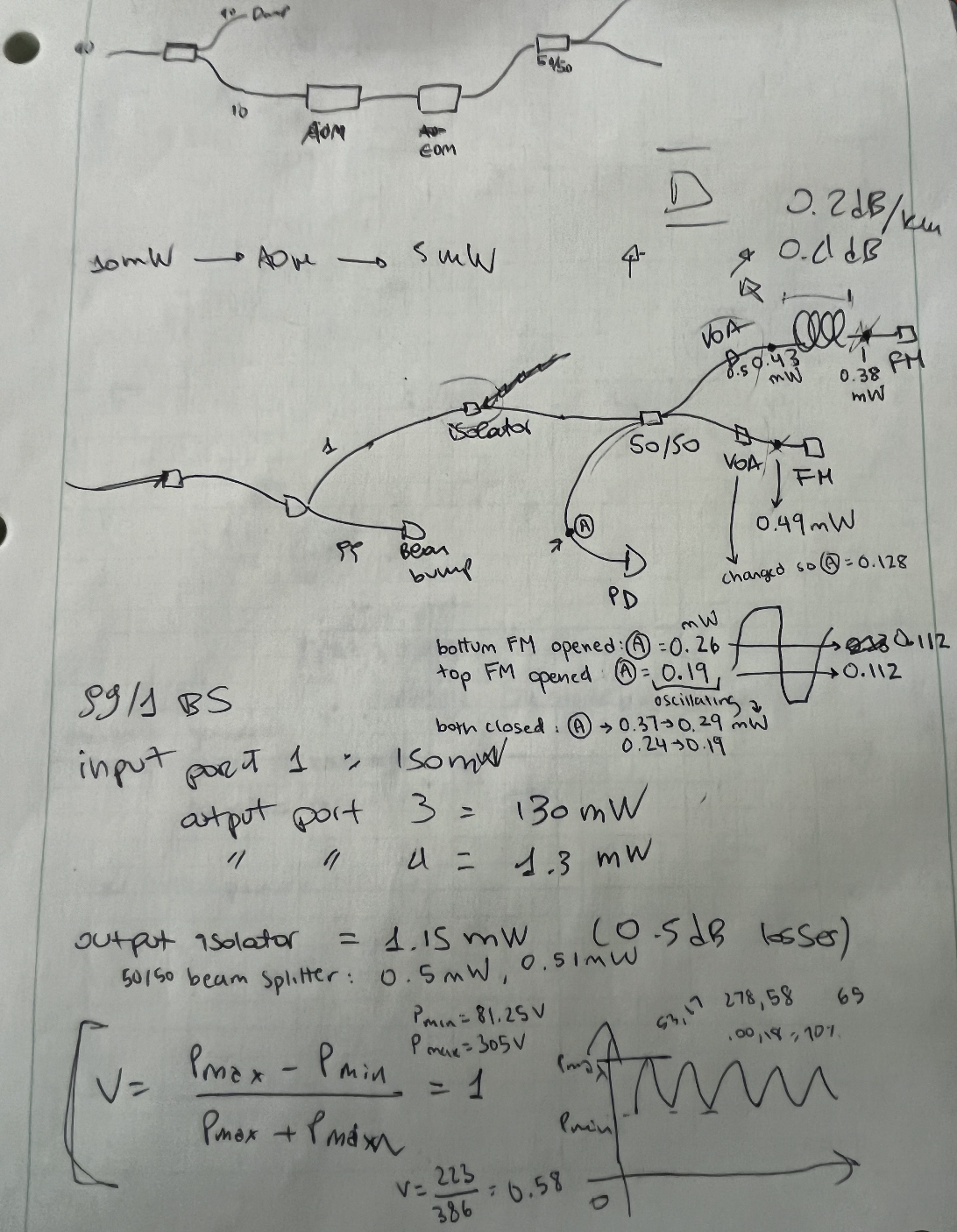
We built a Michelson interferometer as shown in Figure 1. Its schematic diagram is shown in Figure 2. Before the interferometer, we added a 99/1 beam splitter and isolator to limit the power of light entering.
Measurements:
At the input of the 99/1 beam splitter, there was 150 mW of power initially and the outputs had 130 mW and 1.3 mW. After the isolator, the 1.3 mW of power reduced to 1.15 mW. This was split between the 2 output ports of the next 50 50 beam splitter. The lower arm (shorter) had 0.49 mW and the upper (longer) arm had 0.43 mW. After the 1 km long spool on the upper arm, the 0.43 mW dissipated to 0.38 mW. The other "input" end of the 50/50 beam splitter was connected to the PD which was connected to an oscilloscope. A power meter was connected right before the PD. When the bottom arm was opened, the power meter showed 0.26 mW and when the top arm was opened, it showed 0.19 mW. Then we adjusted the VOAs on both arms until both measurements were the same (at 0.112 mW).
Once the oscillascope was connected, the visibility could be calculated through the formula: (P_max-P_min)/(P_max+P_min).
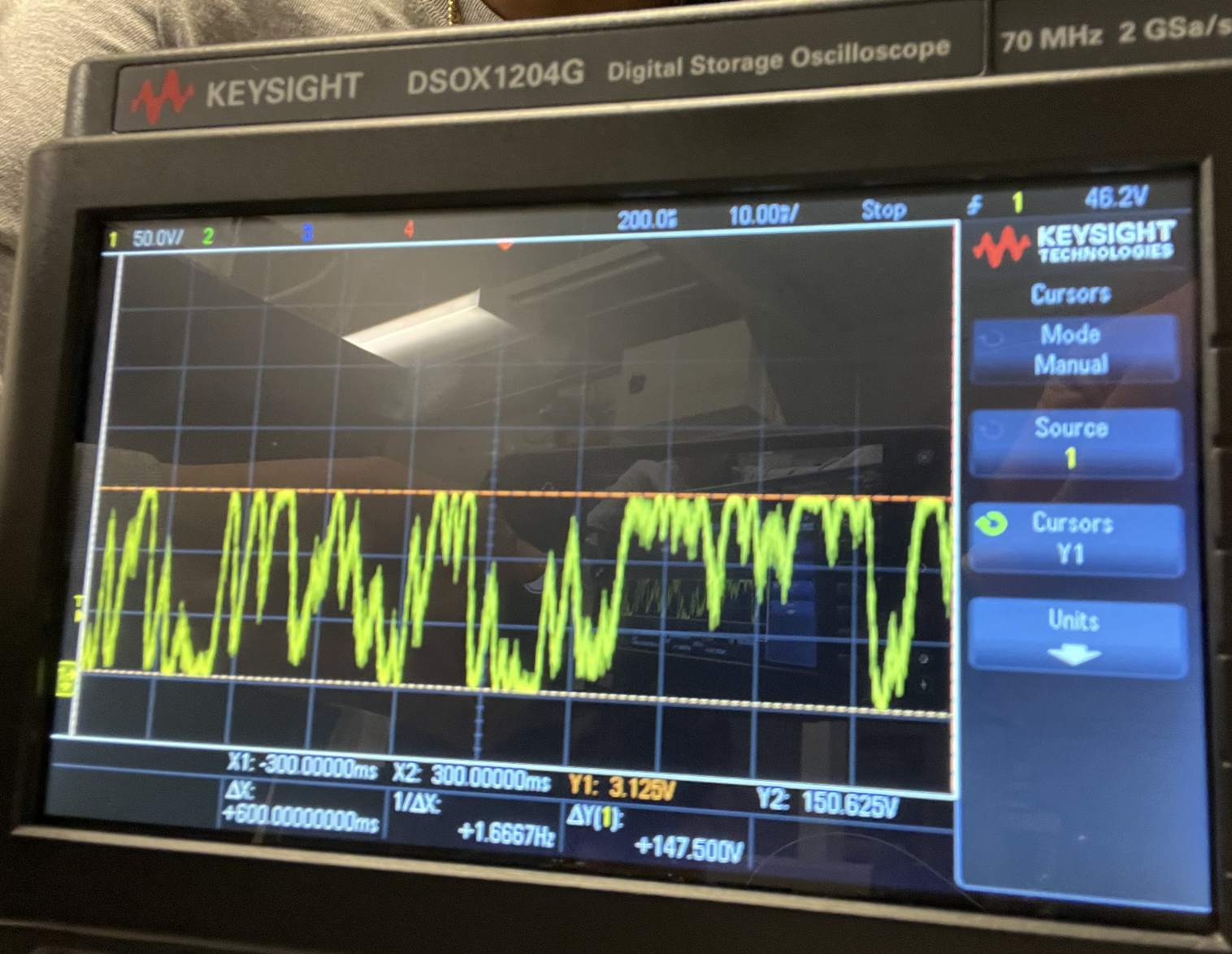
A higher visibility is better. Initially the visibility was around 50% but after changing the VOAs, adding the AOM, and removing noise, the visibility jumped up to 96%.
AOM installation:
In order to be able to see the fringes better, we added an AOM before the 50/50 beam splitter (PM AOM FibreQ 1550). We drove the AOM with a Marconi at 40 MHz and 24 dBm amplitude. The modulus of range was 10 mHz. Yesterday the visibility was around 65% but today we reached 96% after tuning the VOAs. Still, the fringes are not completely sinusoidal because of acoustic noise as shown in Figure 3. The power after the AOM was 0.5 mW.
Reducing noise:
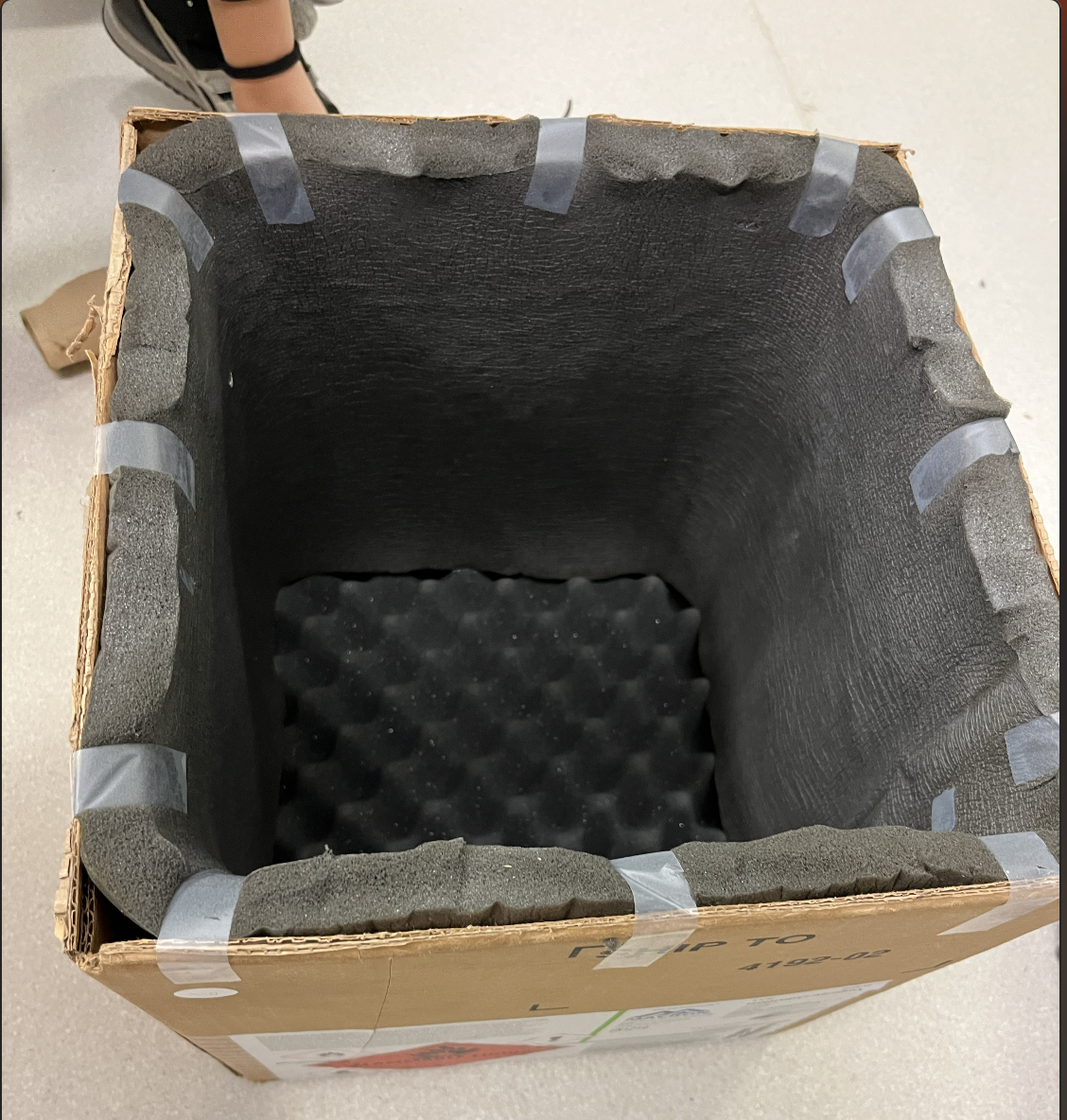
In order to reduce the acoustic noise, we built an insulation box for the 1 km spool. We used this "sponge-isolating-material" in a cardboard box (figure 4 and figure 5) and covered the sides and top and covered the spool. We also covered the bottom with rubber but did not glue yet it to avoid damage. After the addition of this box, the fringes were definitely less susceptible to acoustic noise. However, they still do not look completely sinuisoidal.