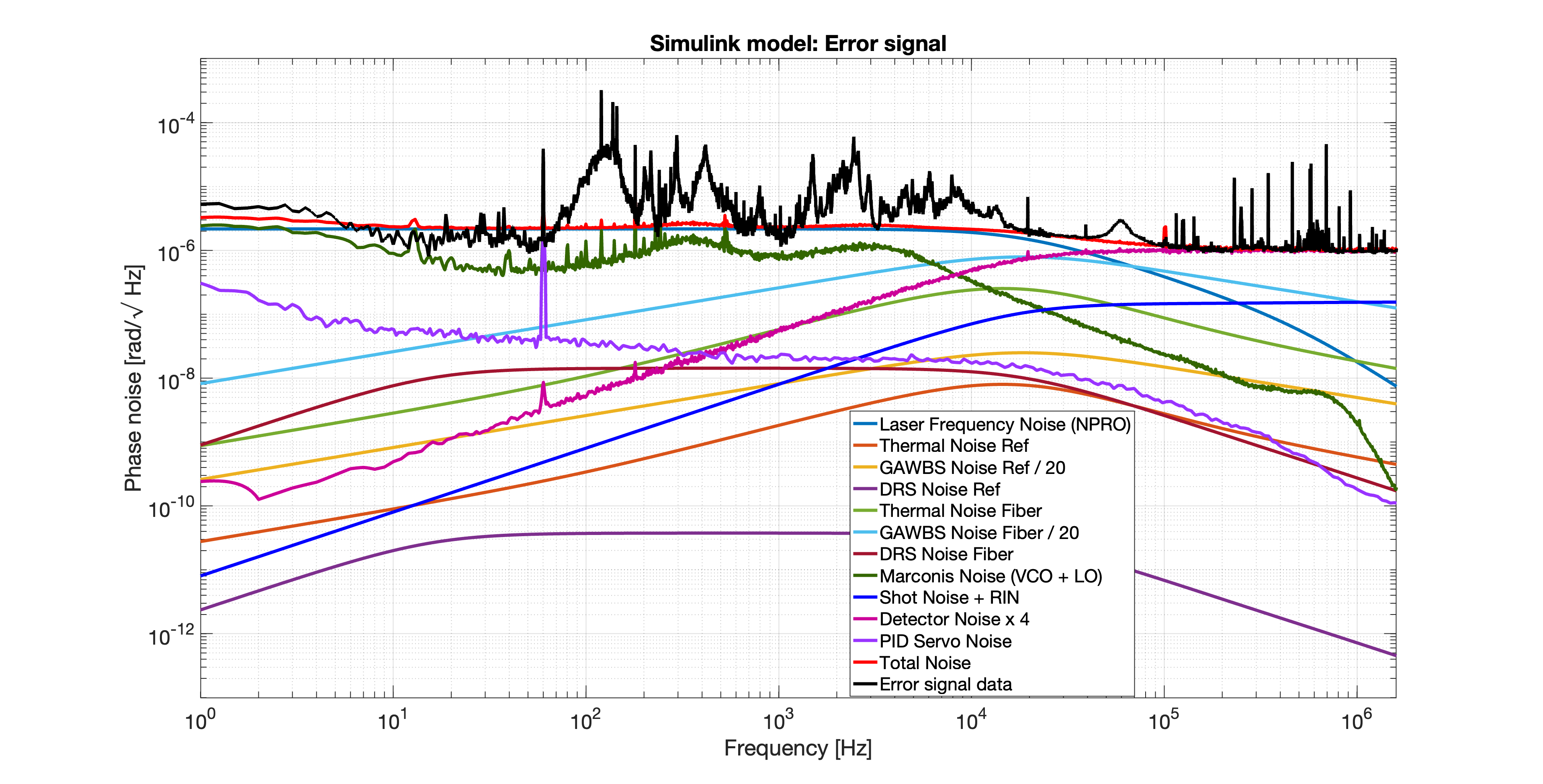
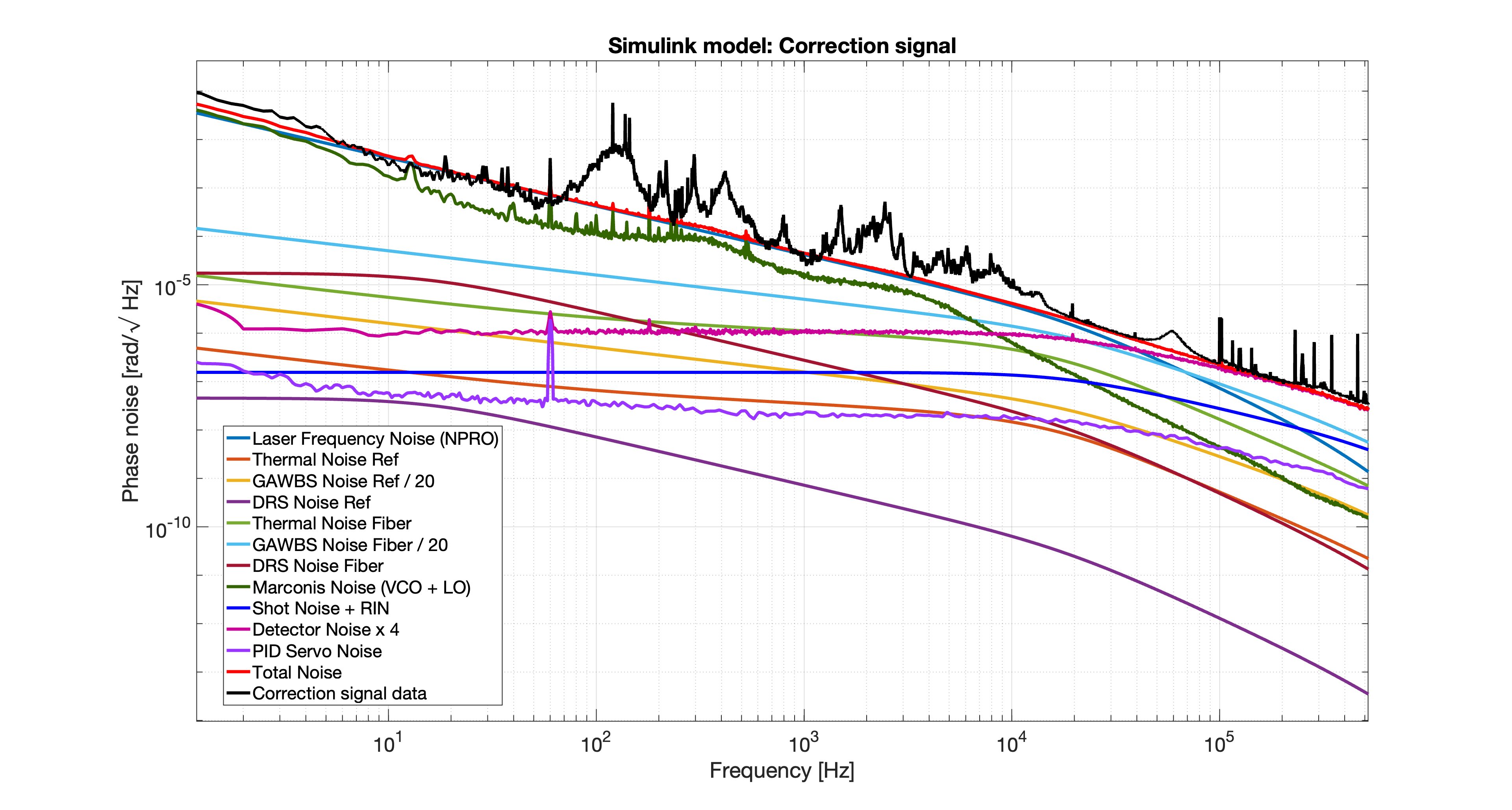
I put togehter all the new elements and I run the simulink model to check if we are limited by GAWBS also at higher frequencies.
The updates wrt to the previous study are:
1. SR560 in DC with gain = 100 (before it was LP @ 3kHz and gain = 100) to reduce the noise at high frequency and avoid to be limited by its noise
2. measurements up to 1.6MHz : measurements up to 100kHz have been acquired with the SR785 and from 100kHz and 1.6MHz with the AG4395A (GPIB)
3. the noise of the marconi has been corrected as explained in the entry 11430
Simulink parameters:
PDH gain = 270000000
PID : zeros [], poles 2*pi*[0.5e6] (due to the SR560 behavior, see entry 11423), Gain [1]
VCO : zeros [], poles -2*pi*[0], Gain 2*pi*1.5e3
In Fig.1 the error signal closed loop simulink model is shown.
In Fig. 2 the correction signal simulink model is shown.
Conclusions:
1. the GAWBS is not the limiting factor since at high frequency we have a white noise limiting the measurement.
2. the model of the GAWBS is wrong: in order not to interfere with the correct measurement I need to divide it by at least a factor 10. Just to set it below the limiting noises, I divided it by 20 in this simulation.
3. we considered RIN and shot togheter as RIN + shot = sqrt(3) * shot (electric blue curve). 3 comes from the intensity noise due to the RIN + 2 shot noise contributions coming from the two sidebands at w0+/-80MHz.
4. The detector noise is the dark noise of the 1811 PD and it has the same shape as RIN and shot noise. I multiplied this by 4 in order to match the model.
Open question: why do we have this excess of white noise? Are we not considering the RIN + shot + dark noise correctly? Eric suggested that there might be an other source of white noise not considered yet.