[Eleonora, Slawek, Eric]
On Friday afternoon, we adjusted the settings of the two Marconis and synchronized them to be able to measure their noise phase-locking them.
First of all we synchronized them to the internal clock (10MHz) of the SG384 RF generator since it was the best signal: the first Marconi (2030) intenal clock was saturating at a lower frequency, maybe due to an aliasing problem; the second Marconi (2026) needs an external clock. We divided the SG384 with a power splitter and sent the clock signal to both instruments.
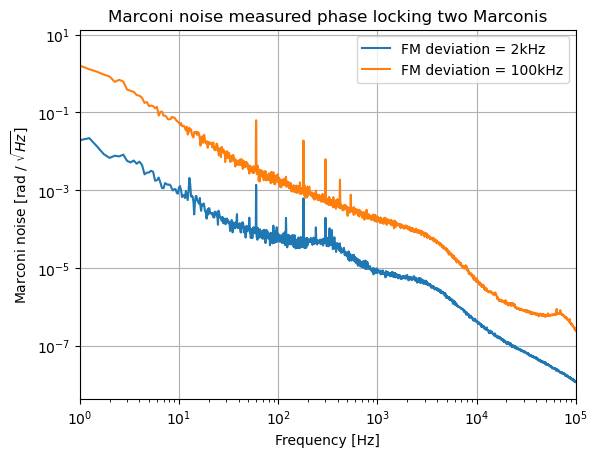
Then we set the Marconis to be symmetric in order to be able to extract the noise of each of them just by diving the spectrum by sqrt(2). We used a phase detector instead of a mixer since it requires the same input powers: we found a minicircuits ZRPD-1+ phase detector that wants 7dBm inputs. We set the Marconis to take the external modulation and the same FM deviation. We performed the noise measurement for both 2kHz and 100kHz FM deviations to check how the noise behave by increasing the actuation range.
1. FM deviation = 2kHz
SR560 settings: LP 100kHz, LP 6dB/oct, Gain = 10
The calibration factor, measured in the previous entry, is 1.48kHz / V.
2. FM deviation = 100kHz
SR560 settings: LP 100kHz, LP 6dB/oct, Gain = 1
The calibration factor in this case is 75kHz / V.
The comparison between the two configurations is shown in Fig. 1. The noise spectrum is the phase-lock loop correction signal. We can conclude that the noise increases with the range, in this case by a factor 50-100 between 2kHz and 100kHz. The noise is in agreement with what we expected from the datasheet. NB 100kHz is the max range for the Marconi.