[Eleonora, Slawek]
Today I changed the setup of the setup in NW22 since we were limited by the servo controller noise and the VCO noise. We replaced the VCO with a Marconi and the LB1005 with an SR560.
We synchronized the Marconi and the SG384 Standford generator (LO) with the internal clock of the Stanford since it was less noisy: the Marconi internal clock had a low frequency oscillation that was saturating at 10V. Then zooming in we saw the 10MHz oscillation. We decided to use the Stanford internal reference since it was just a 10MHz signal.
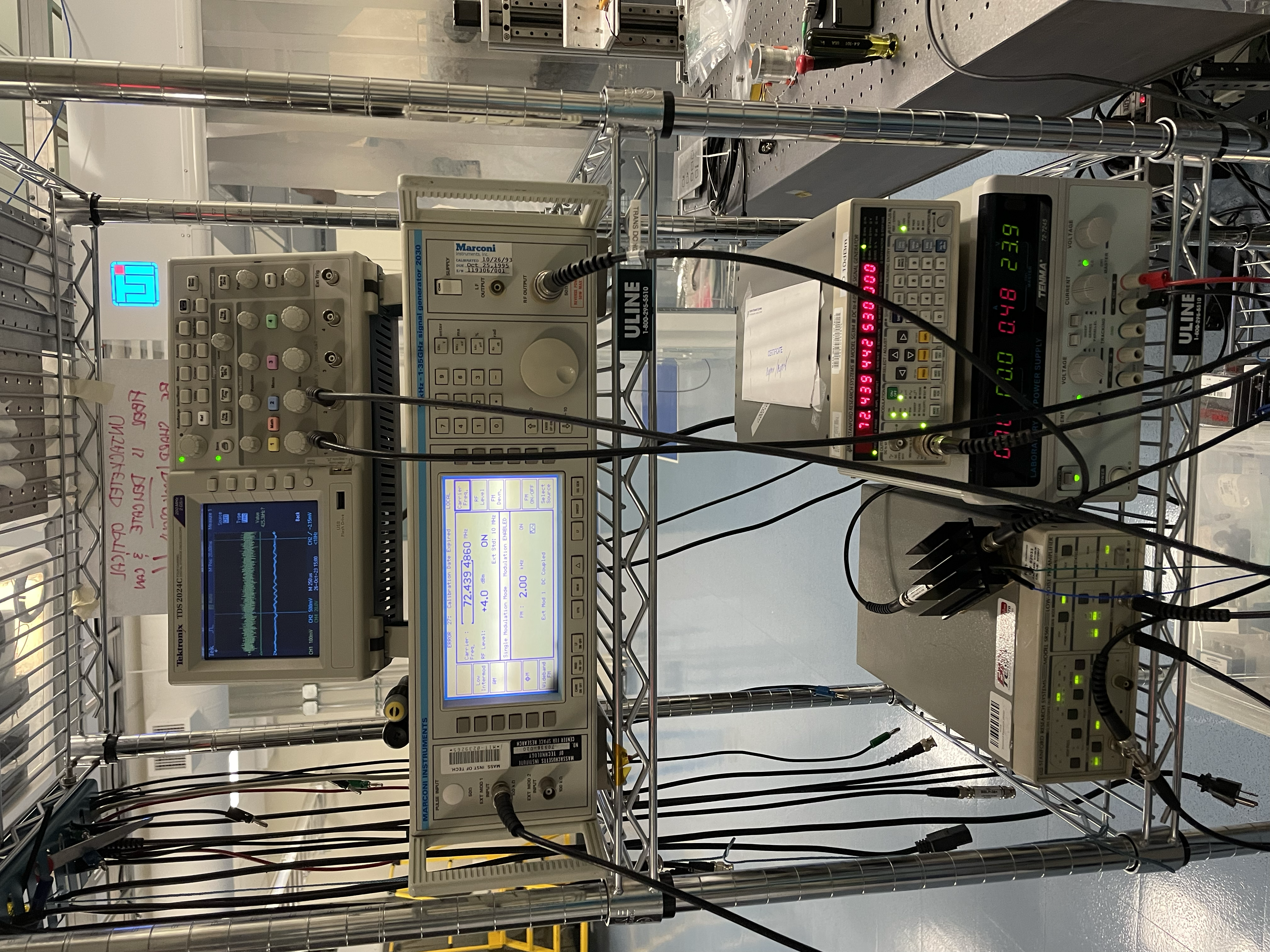
To lock the loop we set the SR560 to: Gain = 100, Low pass at 3kHz, DC coupled. The error signal is now way less noisy than before and it seems also more responsive on the oscilloscope. The actual electronics setup is shown in Fig. 1. We set the resolution of the Marconi to 2kHz/V.
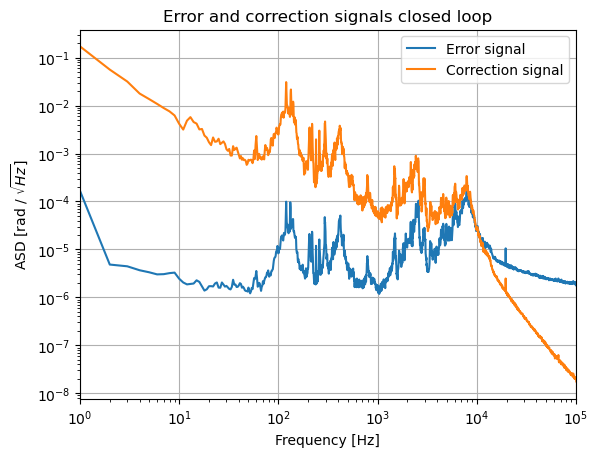
The correction and error signal in loop are shown in Fig. 2 for this configuration. We see that we have more than a factor 1000 noise suppression now.
Next steps:
- Measure the Marconi noise with a phase lock with an other Marconi
- Measure the SR560 noise as we did for the LB1005
- Include these noises and corr/error signals in the Simulink simulation
- Replace the SG384 Stanford LO RF generator with another Marconi
- Repeat these measurements
Today I measured the OLTF of the system under these conditions.
I added an SR560 with gain = 1 and with a DC configuration, in order to be able to measure the OLTF, before the servo controller in loop. I was taking the output before the new SR560 and the input afterwards. In this way ones bypasses the SR560, measuring the response only of the elements in loop.
I sent a swept sine of 10mV amplitude, 100-100kHz frequency, to the channel -B of the new SR560. I connected the error signal of the loop (output of the mixer) to the channel A of the SR560 and I sent the same channel to SR785 channel B. The SR560 output signal was sent to the SR7585 channel A.
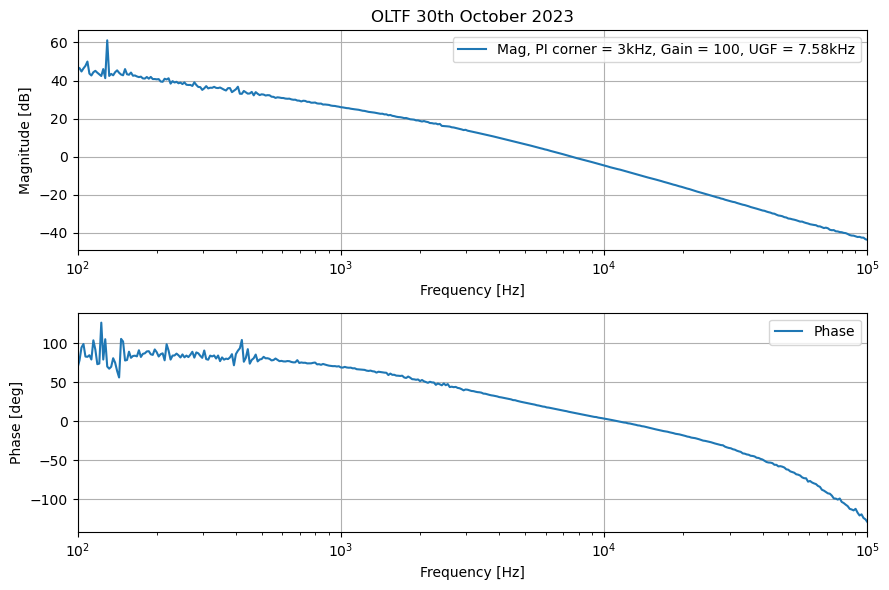
The OLTF is shown in Fig.1 and it gives us an UGF of 7.58kHz.
The Marconi 2030 amplitude power is set to 5dBm, since the amplifier has a 24dB gain and the AOM wants max 29.5dBm RF power.