epolini - posted 20:13, Thursday 05 October 2023 (11357)
OLTF of the unbalanced MZI
[Eleonora, Wen]
Yesterday, we acquired the OLTF of the unbalanced MZI with the SR785 to characterize the loop.
We inject a sweep sine from 100 Hz to 10 kHz and we measured the TF in different configurations:
Before lunch
- 1 kHz PI corner of the LB1005, LF gain limit = 90 dB (the gain doesn't have a knob so we cannot see its value a priori), amplitude of the injected noise = 220 mV -> measured UGF ~ 8 kHz
After lunch
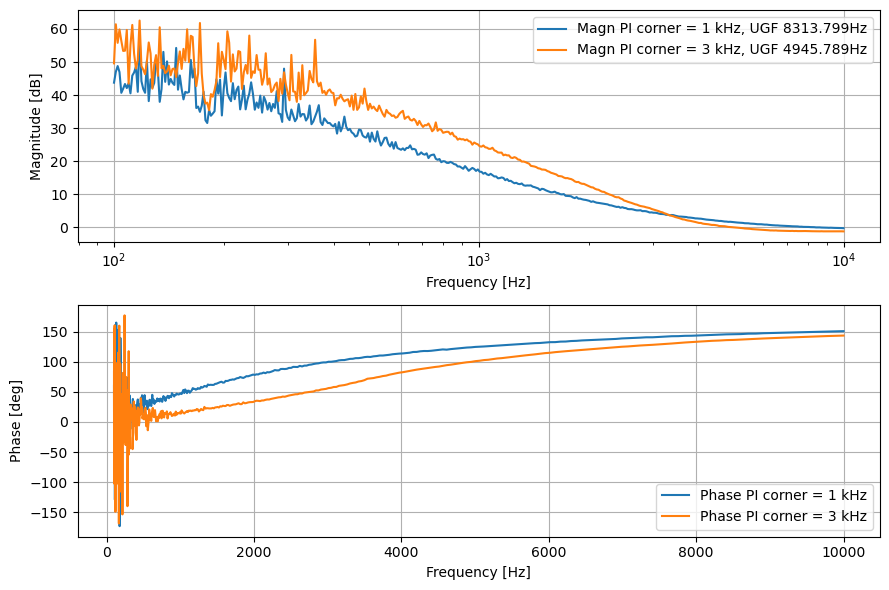
- 1 kHz PI corner of the LB1005, LF gain limit = 90 dB (the gain doesn't have a knob so we cannot see its value a priori), amplitude of the injected noise = 100 mV -> measured UGF ~ 8 kHz (Fig.1 in blue)
- 3 kHz PI corner of the LB1005, LF gain limit = 90 dB (the gain doesn't have a knob so we cannot see its value a priori), amplitude of the injected noise = 150 mV -> measured UGF ~ 4.7 kHz (Fig.1 in orange)
- for 10 kHz PI corner frequency, the loop is unstable
Something that can be noticed is that the noise amplitude, needed to perform this measurement, incresed between before and after lunch. It can be due to a change of the demodulation phase, since it is not controlled. This is not the case unlocking and re-locking the loop. The TF shape did not change.
Images attached to this report