
hudsonl - posted 18:15, Tuesday 12 September 2023 - last comment - 20:01, Tuesday 12 September 2023(11318)
OPO Piezos
(Hudson and Masaya)

The OPO lock's stability seems to be changing quite a bit even over fairly short timescales. The transmitted power level with the OPO locked also seems to be consistently less than the peak power level when we scan the OPO, which is odd.

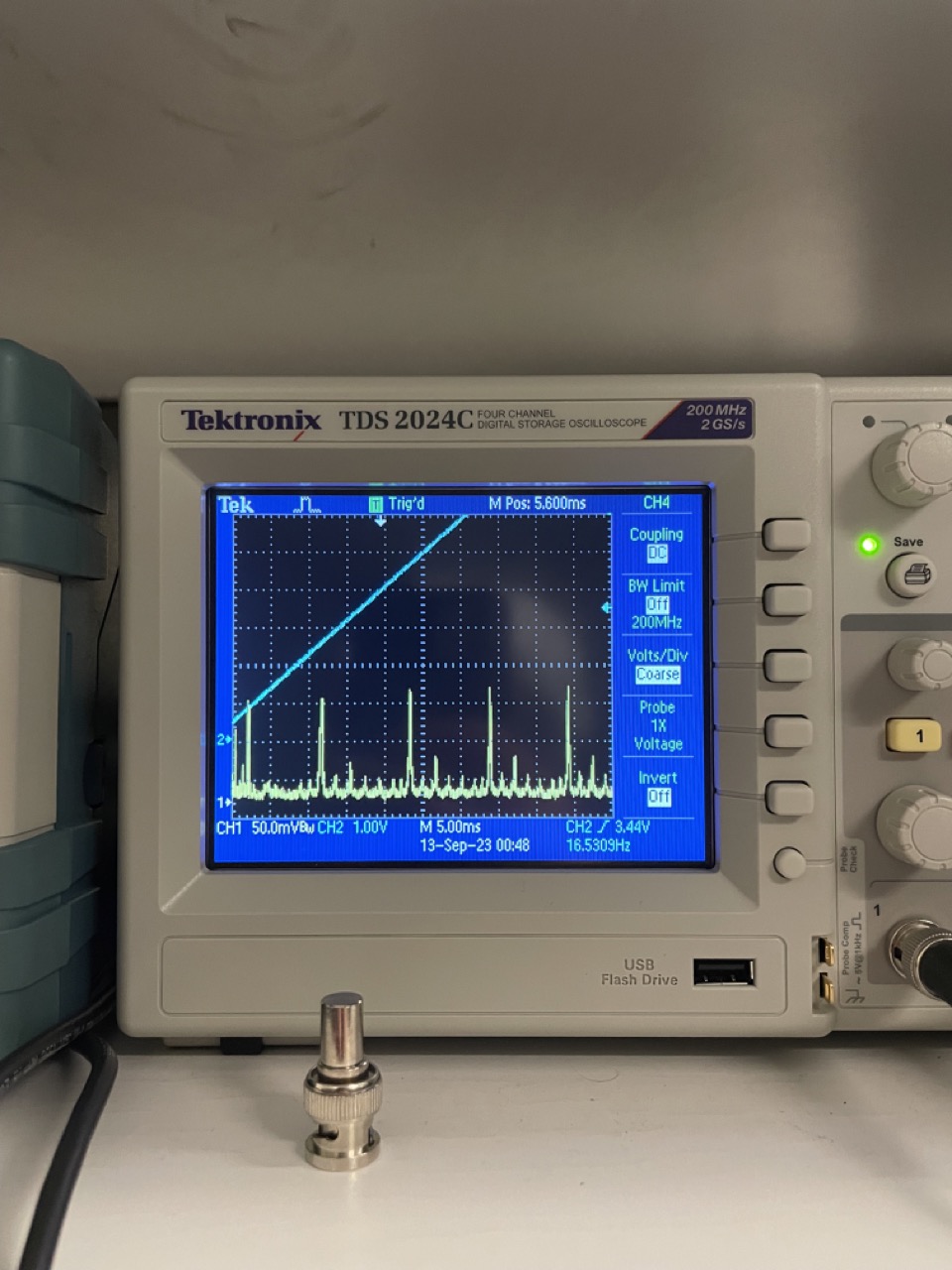
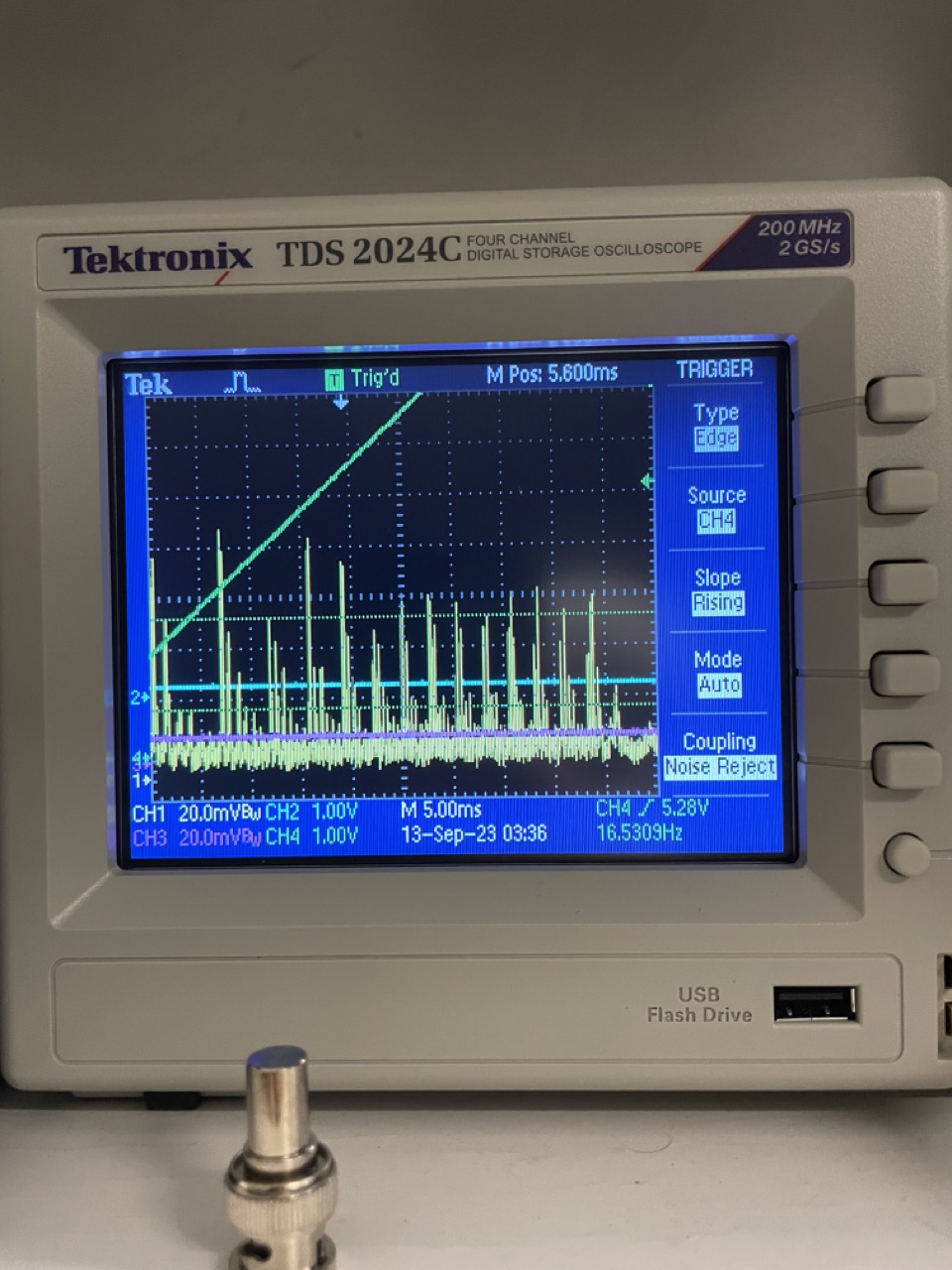
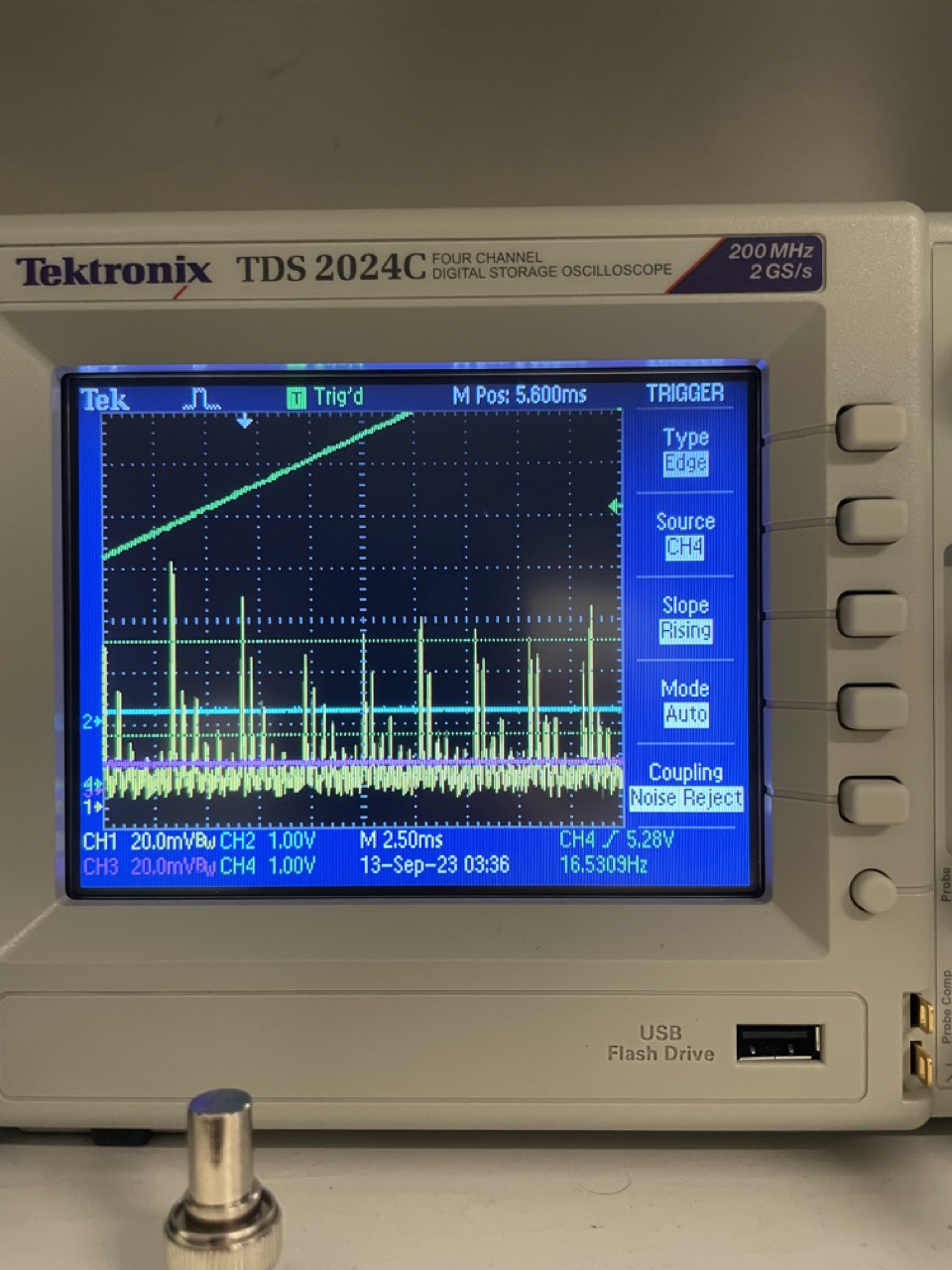
After some experimentation, we believe this is because one of the piezos is actuated nearly perpendicular to the cavity axis, whereas the other piezo seems to be actuated at an angle to the cavity axis. The attached images show cavity scans with the piezo attached to M3 (channel 2 is scanning) and with the piezo attached to M4 (channel 4 is scanning). On both cavity scans, channel 1 shows the 532nm power on a transmission PD (a PD 100a on the 60dB  gain setting). As can be seen in these cavity scans, scanning M3 results in much less higher-order mode content and the TEM00 spikes have similar power levels. Scanning M4, we see much larger higher-order mode content and highly inconsistent power levels in the TEM00 mode.

We attribute the fact that the transmitted power level is below the peak power level when scanning the cavity to the fact that we were taking a cavity scan with M3, but using M4 to control the cavity length when the OPO was locked. Similarly, we attribute the fact that the OPO lock's stability was changing often to the OPO locking on different resonances which have significantly different power levels when actuating on M4.

To fix these problems, we plan to use only M3 to both dither and control the OPO cavity length going forwards. The dither signal is 0.16V peak-to-peak, so there should be plenty of room to dither and actuate the same piezo.
Images attached to this report
Comments related to this report
I updated the OPO locking procedure to dither and actuate only on M3. This seemed to increase the lock's stability significantly and made it so that when the cavity is locked, it's output power is the maximum power observed from scanning hte cavity.

The lock has a bandwidth of 400 Hz and a phase margin of 7 degrees, so it's very close to being unstable. I'm going to play around with the loop shape and see if I can use a lower-value of resistor in series with the PZT on M3 to increase the pahse margin.