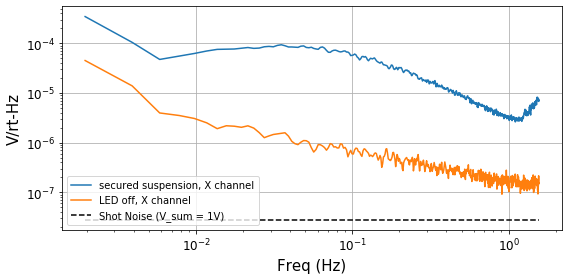
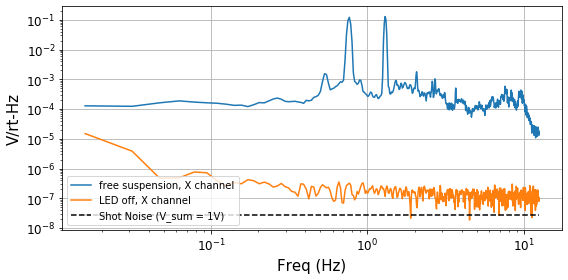
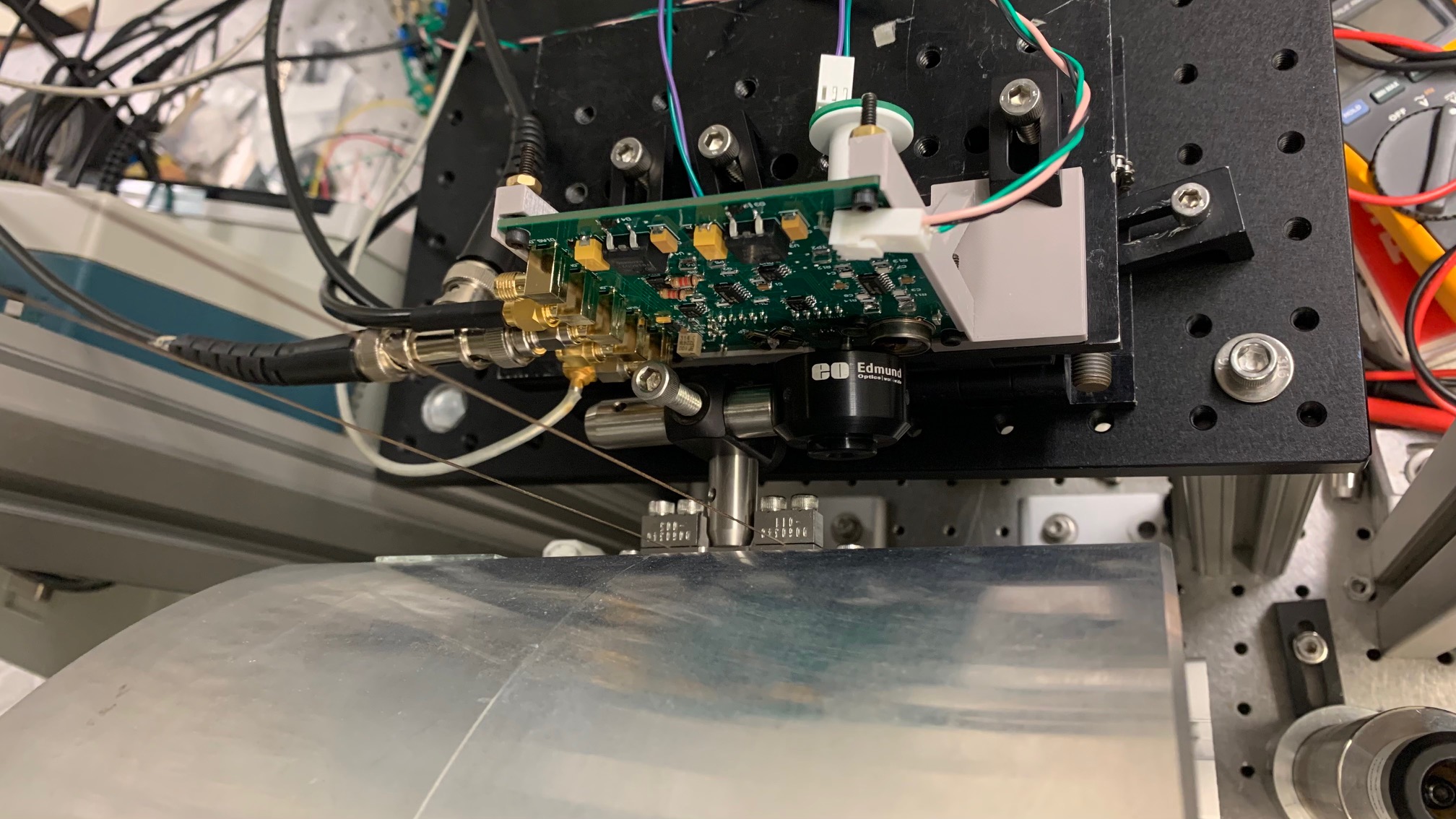
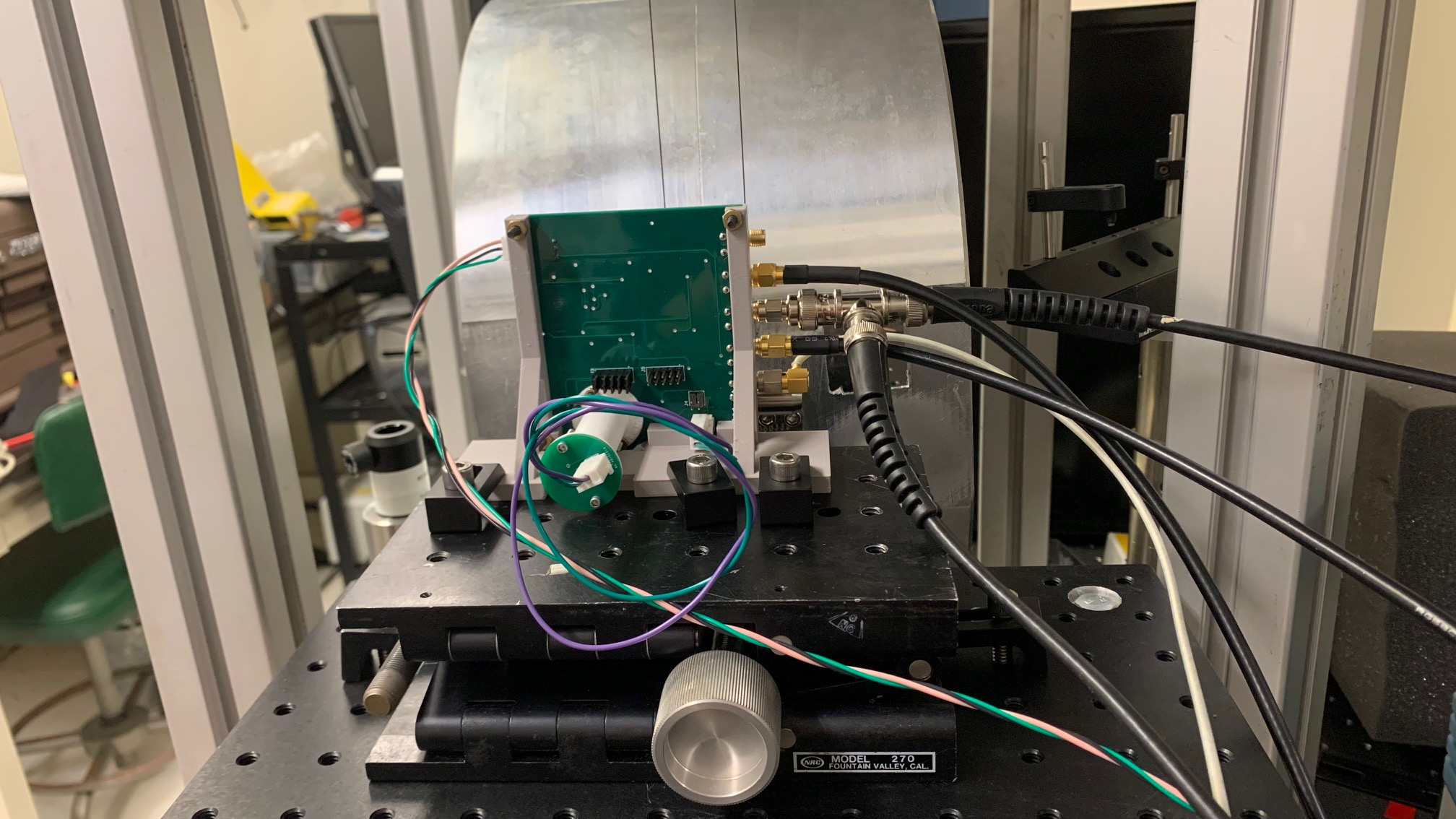
Mounted a retroreflector on the existing suspension in the red lab and the QPD board on a raised plate to test sensor on a free hanging suspension. Still using a passive high pass filter before the demodulation stage and no amplification in the summing/differencing stage. Saw regular motion of the suspension around 1Hz which did not settle even after leaving for ~1hr (~20 Hz range plot). Also measured noise below 1 Hz with suspension "locked" (resting on the jack) and with the LED off (~1Hz range plot). note: except for LED off measurements, could not get a quiet enough signal to leave spectrum analyzer input range at -50dBV, usually settled at -34dBV instead.
Away for two weeks but when I come back we'll look at noise below 1Hz when the retroreflector is more securely fixed with respect to the QPD. Also getting updated qpd board and looking into replacing the corner-cube retroreflector with a cats eye retroreflector which could decrease the footprint of the sensor and increase sensitivity.
The idea of the cat's eye is essentially (pardon the ASCII)
----------|               / \--------------||

QPD & LED |   <-- D -->  | f |  <-- d -->  ||mirror

----------|               \ /--------------||
where the lens and mirror are rigidly mounted to the suspension mass, while the QPD & LED are mounted to the suspension cage. By choosing d = f, the ray transfer matrix of the cat's eye is
[[ -1, 2 * (f - D),]

    0,          -1,]]
This is a retroreflector in the usual sense of the word, in that any ray arriving from a large distance D >> f will be directed back from where it came from (i.e., the ingoing ray can be described by the vector [r, -r/D] for any lateral offset r satisfying the paraxial approximation, yielding an outgoing ray [r, +r/D]).
However, for our purposes we really do want to image the LED onto the QPD, meaning any vector [r, ϕ] eminating from the LED is imaged onto the vector [-r, -ϕ] at the QPD. In order to do this, we need to null the off-diagonal element of the cat's eye ray matrix, which means enforcing D = f. In practice that might be difficult, since D probably needs to be controlled to within ~1 mm, but is probably okay to try as a first attempt. One could also rigidly mount a second lens in front of the QPD/LED (with focal length f′ equal to mounting distance d′) so that the rays going toward the cat's eye are collimated:
----------|-------------- / \               / \--------------||

QPD & LED |  <-- d' -->  | f'|  <-- D -->  | f |  <-- d -->  ||mirror

----------|-------------- \ /               \ /--------------||
In this case, the exact distance D becomes irrelevant, though it should probably be kept small (few millimeters?) to avoid too much light lost.