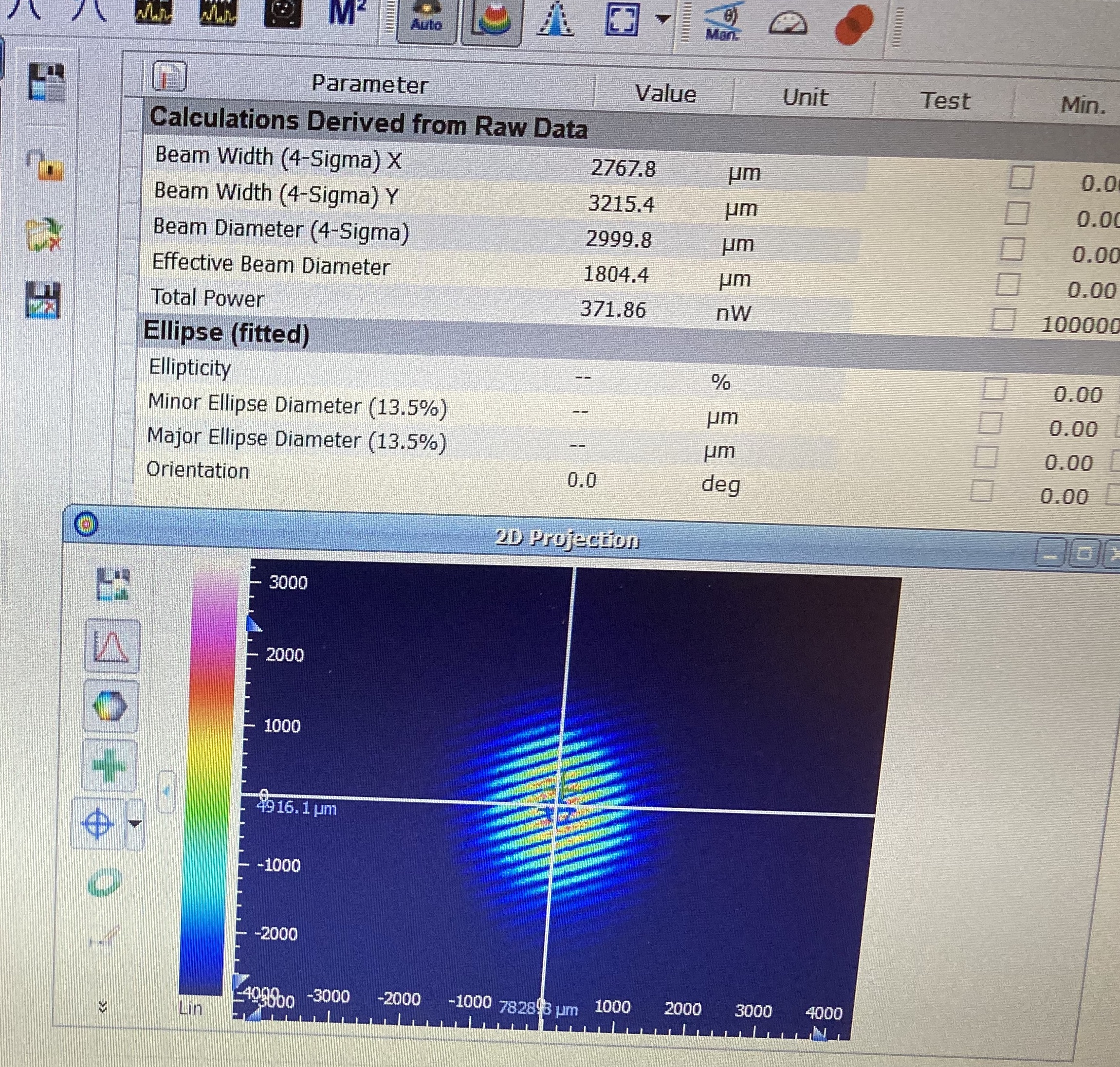
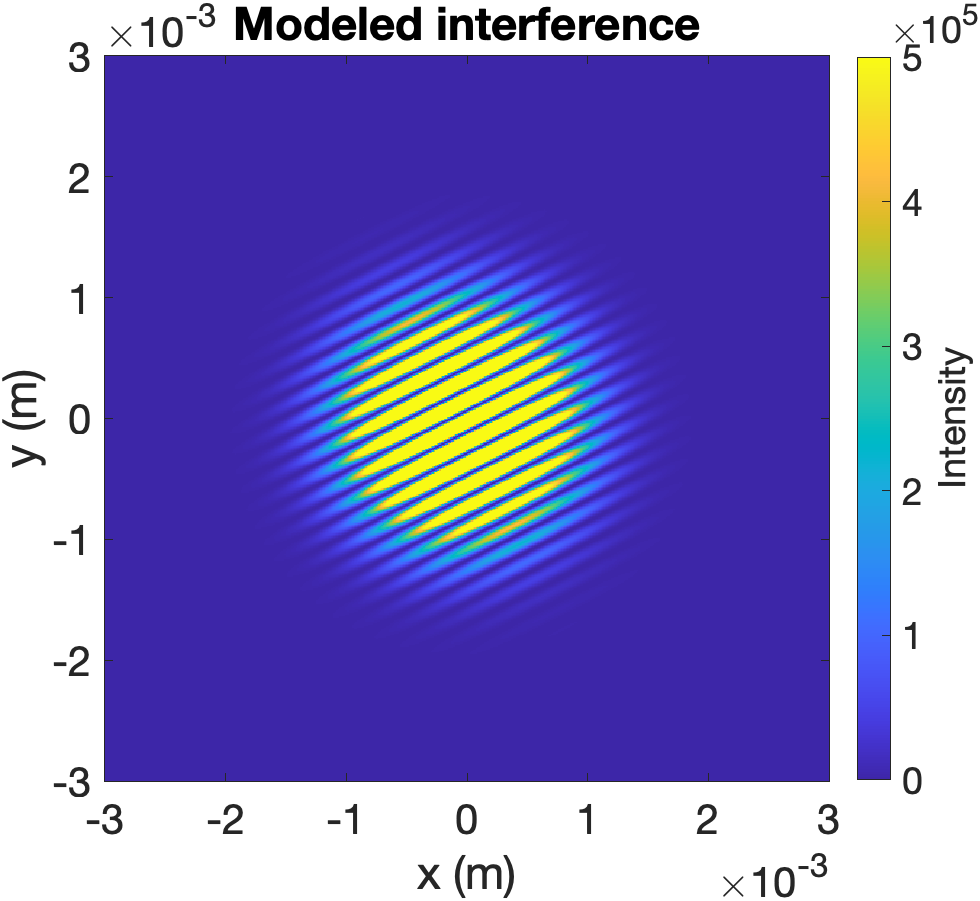
I set up the Mach-Zehnder arms, looked at the fringes, and compared them with simulated ones. I used the beam profiler to coarse align each beam to the output beam splitter. Since the beam alignment is coarse, the overlap is imperfect, leading to parallel fringes. As for the model, I approximated the collimated beams as Gaussian beams (2mm dia) with a large Rayleigh range. Interference intensity, I = |E1+E2|^2 where
E1(x, y, z) = A * exp(-((x - Delta_x)^2 + (y - Delta_y)^2) / w^2)
* exp(-i * (k*z + k*(x - Delta_x)^2 + (y - Delta_y)^2)/(2R) - psi
+ k*x*sin(alpha1) + k*y*sin(beta1))
Ais the peak electric field amplitude at the beam waist.wis the beam radius.(1mm)kis the wavenumber, equal to2*pi / lambda, wherelambdais the wavelength of the light.Ris the radius of curvature of the beam's wavefronts.(200m)psiis the Gouy phase shift.Delta_xandDelta_yrepresent the displacement of the beam in the x and y directions, respectively. (0.1mm,0.1mm)alpha1andbeta1represent the angular misalignment of the beam in the x (pitch) and y (yaw) directions, respectively. (-0.17deg,0.34deg)zis the propagation distance. (~2m)
The first exponential term represents the Gaussian profile of the beam in the transverse (x, y) plane, taking into account the displacement of the beam. The second exponential term accounts for the phase variations due to propagation, wavefront curvature, the Gouy phase shift, and the angular misalignment of the beam.
The next steps include setting up the pico-motors, configuring the gigE camera, and pre-training an RL agent with the simulated model.